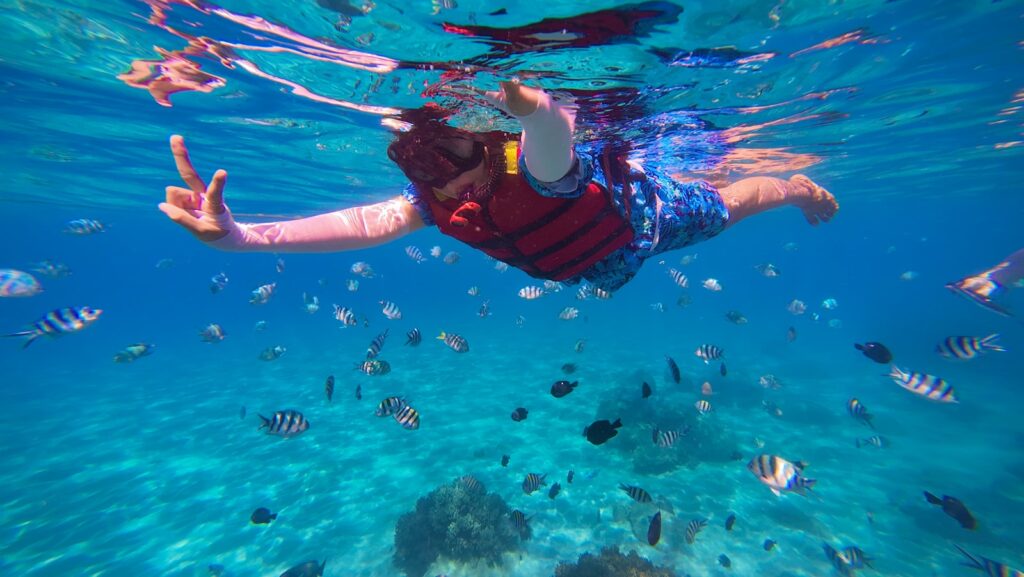
Komodo snorkeling with kids is genuinely doable — but whether your seven-year-old gets a magical turtle encounter or a white-knuckle drift through strong current comes down entirely to which spot you enter, when, and on what kind of boat. There is no park-wide minimum snorkeling age. What exists instead are operator norms: most boats ask that young children stay aboard at current-prone sites and allow supervised snorkeling at calm, shallow spots from around age six with a parent in the water. Confirm the exact policy with your operator before booking — the matrix below reflects common industry practice as observed by guides in Labuan Bajo as of June 2026, not a codified regulation.
Why the Spot Matters More Than the Age
Komodo National Park is not one homogenous body of calm sea. It is a fast-moving tidal system squeezed between islands, and a site that is perfectly flat at slack tide can become an impassable drift channel ninety minutes later. What makes a spot family-friendly is not just coral cover — it is the predictability of the current and the depth of the entry zone.
A ten-year-old strong swimmer is fine at Siaba Besar on any normal day. The same child at Karang Makassar (Manta Point) on a running tide is a rescue waiting to happen. No blanket age rule substitutes for a competent guide reading the water that morning. Good operators skip entries when conditions are wrong. Treat that as a quality signal, not a disappointment.
The Age-by-Spot Suitability Matrix
The table below uses four practical tiers that reflect what you will hear from most Labuan Bajo operators. These are norms, not enforceable park rules. Always confirm with your specific operator before arrival.
| Site | Toddler & Under-6 (boat/beach only) | 6–9 yrs (parent in water, calm only) | 10–13 yrs (moderate current, guide present) | Teen 14+ / Confident Swimmer (operator discretion) | Current Grade |
|---|---|---|---|---|---|
| Siaba Besar (Turtle City) | Watch from boat; shallow enough that even being in the water near the ladder is low-risk at slack tide | ✓ Top pick — 2–6 m protected hard coral, mild current, multiple green turtles routine | ✓ Comfortable — stays well within depth range, turtle encounters at 2–4 m | ✓ Excellent — longer free-range snorkel, can explore outer reef edge with guide | Mild–Protected |
| Kanawa Island | Beach entry in very shallow water at the shore edge; parents can supervise from sand | ✓ Good — beach-entry house reef from ~1–2 m rising to 5–8 m, protected bay, one of the safest entry points in the area | ✓ Comfortable — healthy coral garden, can explore to 5 m with snorkel tube | ✓ Full reef access, visibility frequently excellent | Mild–Protected |
| Taka Makassar (sandbar) | Sandbar is exposed at low tide — toddlers can wade and play in the shallows (0.5–1 m) right on the bar itself | ✓ At slack tide on the bar edge only — reef starts within arm’s reach of the sandbar in very shallow water | ✓ At slack tide — snorkel around the sandbar perimeter, watch for guide’s signal before moving toward deeper edges | ✓ With attention to tide — sandbar edges drift toward the manta channel on a running tide; confident teen can manage with guide | Tide-Dependent: calm on bar at slack, hazardous at edges on running tide |
| Pink Beach (Pantai Merah) | Beach access; young children can paddle in surf zone — no snorkeling recommended under 6 here | Conditional — semi-sheltered bay, but micro-currents around the headlands have caught experienced adults off-guard; parent-in-water, stay in the inner bay only | Conditional — inner bay fine, outer sections have stronger flow; never without a guide in water | ✓ Outer reef accessible with supervision; reef condition variable by micro-location | Variable: inner bay moderate, outer sections can run strong |
| Kelor Island | Better known for the hill hike; boat stop only for the very young | Conditional — shallow fringing reef 1–3 m near beach, but a channel off the headland produces stronger flow; entry only on the calm lee side at mild tide | Conditional — lee-side entry fine at slack; guide must assess on the day | ✓ With assessment — interesting fringing reef when current cooperates | Variable: lee-side calm, headland side stronger |
| Karang Makassar (Manta Point) | Boat only — no exceptions; drift current is the norm here | Boat only — even the calmest days involve open-water drift; a six-year-old in a life vest in running current is not a safe proposition | Not recommended — drift site, currents routinely described as strong; a confident 12-year-old with significant prior snorkel experience may be allowed at operator discretion in unusually calm slack conditions only | Operator discretion — guide reads the current before entry; teens enter only when the drift is manageable; operators skip this stop entirely when current is too strong, which is the right call | Strong / Drift — tide-dependent, can be approached at slack on calm days |
| Mawan | Boat only | Boat only | Not recommended — current rated strong, manta encounters often on rising tide; mantas and occasional reef sharks; experienced guided snorkelers only | Experienced teen, operator’s call — not a beginner site at any age | Strong |
All grades reflect typical conditions and operator norms as of June 2026. Conditions vary by tide, season, and weather. Confirm suitability with your operator on the morning of departure.
Gear Reality for Kids: What the Boat Provides vs What to Bring
Here is the honest version that most booking pages skip.
Nearly every day tour includes mask and snorkel for adults. Children are a different story. Budget shared boats carry a small number of child-sized masks — often scratched, with tired silicone seals that do not form a reliable fit on a small face. Fins for children are less common still. A child who keeps flooding their mask gives up inside five minutes. Bring your own child-size mask and snorkel from home; the incremental luggage weight is worth every minute of calm water confidence.
Personal Flotation Devices (PFDs) for Kids
Indonesian maritime law requires life jackets for all passengers on board. Compliant operators provide them. The problem is fit. Budget boats carry adult foam vests and perhaps one or two child sizes that may or may not match your child. A vest that rides up around a small child’s chin is not safe snorkeling gear — it restricts movement and face-down position in the water. Bring your own child PFD if your child is under ten or a weak swimmer. A well-fitted vest also reduces anxiety dramatically for first-timers and allows them to float comfortably without treading water, which extends the enjoyment window considerably.
Rashguards and Sun Protection
Water temperature in Komodo runs 25–29°C depending on the month (south-park upwelling sites can drop to around 22–25°C). For children spending 30–60 minutes in the water, a long-sleeve rashguard plus leggings provides sun protection and mild warmth. No Indonesian national law bans oxybenzone/octinoxate sunscreens in Komodo as of June 2026, but mineral sunscreen is strongly recommended practice on any reef. Apply before boarding — kids forget on the water and the midday equatorial sun is not forgiving.
Seasickness Management for Families
This is the factor families underestimate. The transit from Labuan Bajo harbor to Karang Makassar or Padar runs through open water that can be choppy on standard day-tour routes. Slow wooden boats pitch more than speedboats; the upside is lower noise and a steadier platform once anchored.
Practical steps: give children an appropriate seasickness medication the night before (consult your doctor — dimenhydrinate or meclizine have good pediatric track records; ginger alternatives work for mild cases). Keep kids focused on the horizon during transit, not on screens. Have a sick bag accessible and normalise the possibility without dramatising it. Most children feel dramatically better once they are in the water — movement and engagement override nausea for most kids. The misery is usually in the transit, not the snorkel.
If your child is prone to motion sickness, a speedboat charter shortens total transit time and lets you move between stops faster. That alone can be the difference between a memorable trip and a wretched one.
Why a Private Charter Pays Off for Families
A shared open-trip boat on the standard Padar–Pink Beach–Komodo–Taka Makassar–Manta Point–Kanawa/Kelor circuit carries up to 20–22 passengers. The itinerary is fixed. Entry at each stop is timed to the group, not your child. If your six-year-old needs fifteen minutes to get comfortable at the entry point while the guide manages four other nervous first-timers, the pressure is real and the schedule does not flex.
A private charter changes the entire dynamic. You set the sites — skip Manta Point entirely if the current looks wrong for your group, spend an extra thirty minutes at Siaba Besar because the turtles are cooperating, let your teenager do a second drift while the younger ones rest on deck. Private speedboat charters for small families of 2–6 people run approximately Rp 6–10 million per day; larger or premium vessels Rp 10–18.5 million per day (last verified June 2026 — prices are volatile; confirm current rates before booking). Park and ranger fees are still paid separately in cash — budget Rp 400,000–550,000 per adult foreigner for a full itinerary including Padar and a dragon-viewing landing.
For a family of four foreigners, the shared boat saves perhaps Rp 3–4 million upfront. Against the value of a relaxed, child-paced day with flexible site selection and a guide whose full attention is on your group, the math tilts toward private faster than most families expect.
Ready to plan the right itinerary for your family’s ages and swimming levels? Plan your trip with our concierge — we can match you to an operator whose boat setup and guide-in-water practice fits your group, and sort the charter vs open-trip question before you arrive. WhatsApp planning works well for families with specific questions about child gear and custom stops.
The Family Picks: Siaba Besar, Kanawa, and Taka Makassar
If you have children under twelve and you are building an itinerary from scratch, anchor it around these three sites. Each one can occupy a confident young snorkeler for 30–60 minutes without requiring drift experience or strong swimming ability.
Siaba Besar
Called Turtle City for a reason. The shallow protected hard-coral reef runs 2–6 m in the main snorkel band. Current is mild to negligible in most conditions. Multiple green turtles per session is common — not guaranteed, but the density is high enough that disappointed families are the exception, not the rule. This is the single best family snorkel site in Komodo National Park. If you only have time for one site with under-tens, make it this one. For full site detail, see our Siaba Besar snorkeling guide.
Kanawa Island
Beach-entry house reef, protected bay, 1–2 m depth rising gradually to 5–8 m. No boat ladder anxiety for reluctant first-timers — kids walk straight in from the sand. Visibility is frequently good, coral health is solid, and the gentle slope means a child can control their own depth with minimal effort. Good choice for a second site on a family itinerary, or as a main event when you want relaxed time in the water rather than a rushed multi-stop loop. Full details at our Kanawa Island snorkeling page.
Taka Makassar
The sandbar itself is a delight for younger children who are not ready to snorkel at all — they wade, look at reef fish in ankle-deep water, and take photographs on a stripe of white sand surrounded by blue. For older children and teens, the shallow reef edge around the bar offers genuine snorkeling at the right tide. The catch: Taka Makassar sits right at the edge of the manta channel, and the bar edges become hazardous on a running tide. A competent guide times entry here precisely. See the full Taka Makassar snorkeling guide for tide and timing detail.
A Note for Senior Snorkelers and Multigenerational Groups
The same logic applies to grandparents or senior family members joining a Komodo trip. The family-friendly sites above — Siaba Besar, Kanawa, Taka Makassar at slack — are also the right picks for anyone who wants calm, shallow snorkeling without fighting a current. The life-vest comfort question matters here too: a well-fitted vest makes a 70-year-old’s time in the water safer and more relaxed. The private charter advantage is amplified in multigenerational groups where snorkel ability spans three decades of fitness levels. Plan the itinerary around the least-confident snorkeler, not the most confident one — the strong swimmers can always fin further from the entry point.
Questions to Ask Your Operator Before You Book
No planning page replaces a direct conversation with the boat operator. Before committing, ask these:
- What child-size gear is on board?
- If the answer is vague or unavailable, bring your own child mask and PFD.
- Is a guide in the water at each snorkel stop?
- This is common practice on reputable boats but not a park-wide enforced standard — operator-dependent. Confirm, especially for sites with any current.
- Which stops do you skip when conditions are not right?
- An honest operator names specific sites (Manta Point and Mawan most often). An operator who claims every stop is always available regardless of conditions is not being straight with you.
- Can we adjust the itinerary on the day for our children’s pace?
- On a shared open trip the answer is usually no. On a private charter it should be yes.
- How do you handle park fee booking for children?
- Most operators manage the SiORA booking system on your behalf — confirm this is included. Park entry for foreign adults runs approximately Rp 250,000 per person per day (last verified June 2026; confirm with your operator as fee structures have changed and the conservation fee of around Rp 100,000 remains contested between sources). No separate snorkeling activity fee appears in current 2026 fee tables for snorkelers.
Booking Disclosure
This guide is an independent planning resource. The content reflects our own research and on-water experience — no operator can pay to change what we publish. If you find the information useful and choose to book through one of our recommended partner operators, including Komodo Luxury (a sister brand within Juara Holding Group), they may pay us a referral fee at no extra cost to you. We flag that relationship directly so you can factor it in. We recommend Komodo Luxury because their private family charters align with the gear-standard and guide-in-water practices described above — not the other way around.
To get itinerary suggestions matched to your children’s ages, swimming levels, and dates, use our planning form or reach us on WhatsApp. We respond quickly during Labuan Bajo business hours and can help you figure out whether a private charter genuinely makes sense for your group size and budget before you commit.
Frequently Asked Questions
Is there a minimum age for snorkeling in Komodo National Park?
There is no park-wide regulatory minimum age for snorkeling. Operator norms vary: most boats allow children from around age 6 to snorkel at calm sites (Siaba Besar, Kanawa) with a parent in the water and a mandatory life vest. Drift sites like Karang Makassar (Manta Point) are typically restricted to strong teen and adult swimmers at operator discretion. Confirm the policy directly with your operator before booking, as norms differ boat by boat.
Do Komodo tour boats provide life jackets for children?
Indonesian maritime law requires life jackets for all passengers, and compliant operators provide them. The practical issue is fit: budget boats carry a limited range of child sizes and the fit may not be reliable for a small child snorkeling face-down in the water. For children under 10 or weak swimmers, bringing your own well-fitted child PFD is strongly recommended. A properly fitting vest allows a child to float calmly without treading water, which makes the experience far more enjoyable and safer.
What is the best Komodo snorkeling site for families with young children?
Siaba Besar, also called Turtle City, is the standout family pick. The shallow protected hard-coral reef sits in the 2–6 m range, current is mild, and green turtle sightings are common — not guaranteed, but the site density is high enough that most families see several. Kanawa Island is the second-best option, with easy beach entry and a gentle slope from very shallow water. Both sites are suitable for children aged 6 and up with a parent in the water.
Should I book a private charter or a shared tour for a family snorkeling trip in Komodo?
For families with children under 12, a private charter almost always delivers a better experience. A shared open trip follows a fixed itinerary with up to 22 passengers; stops are timed to the group and the schedule does not flex for a child who needs extra time at the entry point. A private charter lets you build the itinerary around your children’s ages and ability, skip unsuitable sites, and have the guide’s full attention on your group. Private speedboat charters run approximately Rp 6–10 million per day for 2–6 passengers (last verified June 2026 — confirm current rates). For a family of four, the per-person cost premium over a shared trip is often smaller than it first appears.
Can toddlers join a Komodo snorkeling boat tour?
Yes — toddlers and very young children can join as boat passengers on most operators’ trips, though they will not snorkel at current-prone sites. At Taka Makassar they can wade in ankle-deep water on the sandbar at low tide. At Siaba Besar and Kanawa the boat anchors in calm conditions and a toddler can be held in the water near the ladder by an adult. Bring your own well-fitted toddler PFD and sun protection. On a long day-trip running 6–8 hours in equatorial heat, also prepare for the reality that a two-year-old may need the shade of the boat cabin well before the itinerary finishes.