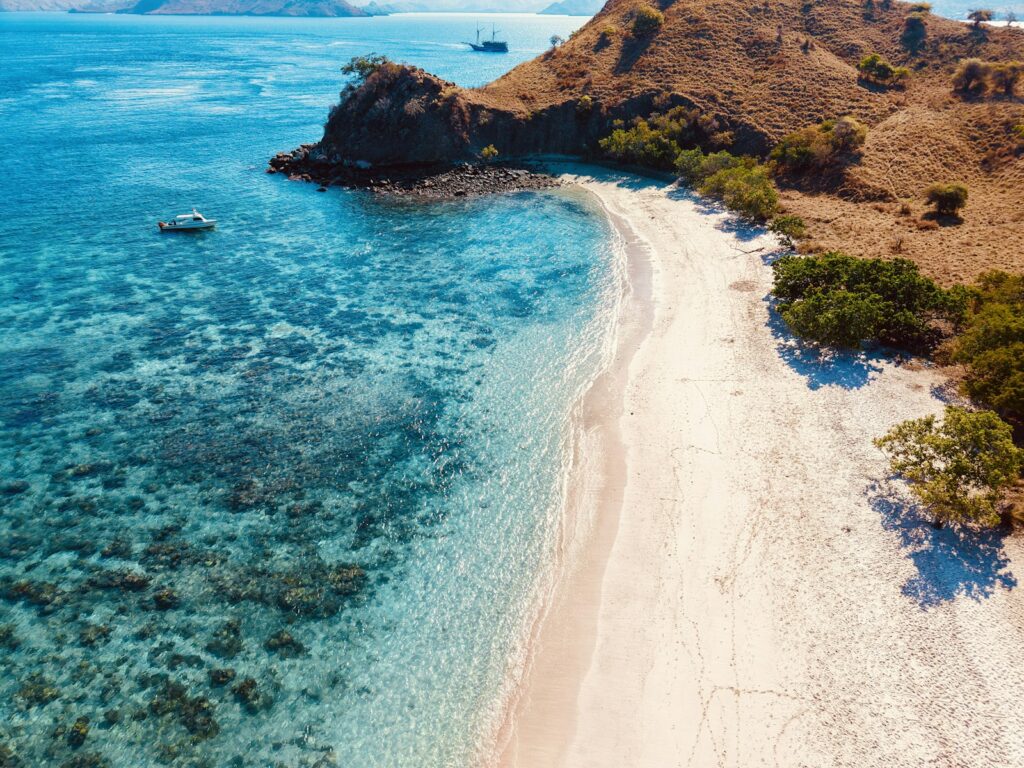
Pink Beach Komodo snorkeling means entering the water from a striking pinkish-sand beach inside a semi-sheltered bay, about 40 minutes by speedboat north of Labuan Bajo, and snorkeling over a fringing reef that grades from shallow rubble to modest coral gardens — depending on exactly where you drop in. The reef is real, the fish are real, and the pink really is pink. But two things the tour brochures skip: the current off the headland at the bay's eastern point has swept snorkelers, and the reef condition varies sharply by micro-location, with visible anchoring damage in certain spots and no independent coral-cover survey to quote.
What Makes the Sand Pink
Every tour operator says the same thing: "the sand is pink from crushed red coral." That line gets copied so reliably that it has become the accepted version. It is not exactly wrong — fragments of dead red coral do contribute — but the more precise explanation is that the dominant pink-to-red particles are skeletal remains of Homotrema rubrum, a small foraminifera that lives attached to reef rubble, and fragments of red coralline algae. Both are carbonate organisms; both leave red-pink grains when they die and break down. The foraminifera explanation has been cited in marine science contexts for Indonesian pink-sand beaches; "crushed red coral" is the simplified tour-literature shorthand.
This matters slightly more than trivia. Hard coral is protected under Indonesian law, and the framing of "crushed coral" — combined with the visible reef damage from anchoring — sometimes leaves visitors with a confused picture of how the beach got this way. The pink sand is a natural accumulation process, not the result of reef destruction. The reef damage from boat anchoring is a separate, ongoing problem in specific spots.
The color is most vivid in the early morning when the angle of light is low and the sand is damp near the water line. By midday it reads more peachy. Pack expectations accordingly.
The Bay Layout and Why Zone Matters
Pantai Merah (the Indonesian name) is a small, curving beach on the southeast coast of Komodo Island. The bay opens to the south. Most tour boats anchor mid-bay and swimmers enter from the boat or wade from the beach; the fringing reef runs parallel to the shoreline and extends along both flanks of the bay.
Think of the bay in three zones:
- Zone A — The Beach Shallows (0–2 m)
- Sandy bottom with scattered rubble and small coral heads. Current: essentially nil in normal conditions. Visibility: can be stirred by boat traffic and foot traffic close to shore. Best for: young children in life jackets, total beginners, anyone who wants a slow look at reef fish without committing to depth. Coral cover here is patchy; do not expect a garden.
- Zone B — The Fringing Reef Band (2–8 m)
- This is the main snorkel zone. The reef slopes from about 2 m down to sandy patches at 6–8 m. Coral condition varies noticeably — the left (western) side of the bay generally shows better hard coral structure than the right, partly due to anchor damage from boats habitually dropping on the eastern side. Visibility in this zone typically runs 10–25 m in dry season (April–November); the 10–15 m figure is more realistic in January–February when seas are murkier. Current: mild to negligible inside the bay at most tide states. Grade: beginner-friendly.
- Zone C — Off the Eastern Point
- Here the sheltered bay ends and the exposed southeastern headland begins. Current accelerates sharply around this point, especially on a running tide. This is where documented sweep incidents have occurred — snorkelers who drift east of the bay's mouth can be pulled toward the point faster than they can swim back. Stay inside the bay. The point is not a marked exclusion zone on any map, which is exactly why it catches people out. A good guide will brief you on this before entry; if yours does not, ask.
Reef Condition: An Honest Assessment
No independent hard-coral-cover survey for Pink Beach is publicly available as of June 2026. What does exist is consistent anecdotal observation from snorkelers, dive guides, and liveaboard operators over several years: the reef here is moderate at best. It has not recovered to the density visible at sites like Siaba Besar or Kanawa, and repeated anchoring in the same spots has caused obvious physical damage — broken table corals, rubble fields where structure used to be.
That said, the site is not barren. On a good visibility day in the May–October window, you will see healthy Porites colonies, some branching Acropora in protected corners, and reasonable fish diversity — wrasses, parrotfish, surgeonfish, the occasional hawksbill turtle moving through. It is a pleasant snorkel. It is not the best snorkel in the park.
The honest reason Pink Beach appears on nearly every itinerary is not the reef — it is the beach itself. The pink sand, the red-rock backdrop of Komodo Island, and the photogenic quality of the scene make it a near-mandatory stop on any visual itinerary. Tour boats include it as a combination land-and-water stop. Snorkeling is part of the experience, not the reason to be there.
If you are on a day trip and your primary goal is underwater experience, Pink Beach earns its place as a visual and beach stop. If you have a choice of where to spend your actual in-water time, Siaba Besar (shallow, protected, turtles) or Kanawa (better coral, calm current) will serve you better. On a well-designed itinerary you get both: Pink Beach for the view, a dedicated reef stop for the snorkel.
Current Warning: What Actually Happens Off the Point
The bay at Pantai Merah is semi-sheltered, and within the bay the current is manageable for most swimmers most of the time. This has contributed to a perception that Pink Beach is uniformly calm — an impression reinforced by the fact that it is routinely described as a family stop.
The eastern headland changes that completely. Currents in Komodo National Park are driven by tidal exchange between the Flores Sea and the Indian Ocean, and the channels and points around Komodo Island see strong tidal flow. The point at the eastern edge of the bay funnels this flow. Snorkelers who drift or swim toward it — sometimes because they are following fish, sometimes because they misjudge where the bay ends — can find themselves in a significantly stronger current than they expected. There is no posted sign. There is no buoy line.
The practical rules:
- Enter from the beach or the boat and snorkel parallel to the shoreline, not toward the point.
- Keep the beach in your sightline at all times. If the beach starts getting smaller rather than staying the same size, you are drifting out.
- Children and weak swimmers should stay in Zone A or the inner part of Zone B with a guide in the water.
- If your boat anchors far from shore and you need to swim to the reef, check the direction of drift before you enter.
- A guide who enters the water with the group is a meaningful safety factor here — ask before you book whether guides swim with guests.
This is not meant to frighten anyone away from Pink Beach. Thousands of people snorkel it every year without incident. The current risk is real and specific; knowing where it lives lets you avoid it.
Site Grade by Zone
| Zone | Depth | Current | Coral | Who It Suits |
|---|---|---|---|---|
| A — Beach shallows | 0–2 m | Negligible | Scattered rubble | All levels, young children, non-swimmers with vest |
| B — Fringing reef (western side preferred) | 2–8 m | Mild inside bay | Moderate; anchoring damage in spots | Beginners and above; life jacket fine for weak swimmers |
| C — Eastern point | Variable | Strong on running tide | Not the goal here | Do not enter; documented sweep hazard |
Visibility and Seasonality
Pink Beach sits in central Komodo, so its visibility tracks the park-wide pattern. Typical reported ranges (last verified June 2026 — traced to resort climatology data, single primary source; treat as indicative):
- April–October (dry season): 15–25 m typical, May peaking around 20–30 m — the clearest, calmest window.
- June–August: 15–25 m; water temperature drops to 25–27°C — a shorty wetsuit or rashguard with leggings is comfortable for long sessions.
- January–February (west monsoon): 10–15 m, rougher seas. The crossing from Labuan Bajo can be bumpy; some days the harbor master closes the port entirely. If you are traveling December–February, build buffer days into your itinerary.
Water temperature at Pink Beach sits in the 25–29°C range for most of the year; southern park sites can drop to 22–25°C due to Indian Ocean upwelling, but Pink Beach is a northern/central site and does not get those cold patches to the same degree. A 2–3 mm shorty is plenty if you run cold; most snorkelers are fine in a rashguard.
Getting There: How Pink Beach Fits a Day Itinerary
Pink Beach is almost always a stop on the standard shared day-trip circuit out of Labuan Bajo — typically the full-day route that includes Padar Island, Komodo Island (dragons), Pink Beach, Taka Makassar sandbar, and Manta Point. On a shared speedboat this day costs roughly Rp 1.4–1.6 million per person (around USD 85–100) last verified June 2026 — park fees are almost always excluded, so bring Rp 400,000–550,000 in cash for the entrance and harbor fees on a full itinerary.
Park entry for foreign nationals runs Rp 250,000 per person per day (2026 figure, multi-source; no separate snorkeling surcharge is itemized under the current fee structure — as of June 2026 snorkelers pay the same base entry as trekkers). Domestic visitors pay Rp 50,000 weekday / Rp 75,000 Sunday-holiday. A conservation fee of Rp 100,000 per foreigner is reported by some 2026 sources but not confirmed in others; ask your operator to confirm the total before departure. The harbor fee is Rp 25,000 per person. All figures last verified June 2026 — confirm with your operator, as the fee structure under PP 36/2024 is newer and some details remain unsettled.
On the standard 6-stop shared circuit, Pink Beach usually gets 30–45 minutes total — enough for a beach walk, a few photos, and a swim. If the underwater experience is your priority, a private charter that builds its itinerary around your snorkel interests — spending 60–90 minutes in the water at two or three dedicated reef sites — is a meaningfully different product. Private speedboat charters run roughly Rp 6–10 million per day for a small group, last verified June 2026.
Ready to work out which itinerary suits your group? Plan your trip with our concierge — or reach out via WhatsApp for a fast answer on timing, tides, and which stops to prioritize.
Gear Notes Specific to Pink Beach
The shallow fringing reef means you do not need open-water swimming confidence to see something worthwhile here. What you do need is a mask that seals. Rental masks on shared day boats vary from perfectly serviceable to foggy and leaking — quality is operator-dependent, and there is no standard. If you have your own mask, bring it. A properly sealing mask makes the difference between a frustrating squint and an actual snorkeling session.
Fins are useful in Zone B but not essential in Zone A. If the boat supplies fins, check sizing before you enter — mismatched fins on a current-prone site are a fatigue problem. Reef-safe mineral sunscreen is strongly recommended (not a legal requirement in Indonesia as of June 2026, but the right call for the reef regardless). Apply it 20 minutes before getting in so it has bonded to your skin.
For families: the beach entry and Zone A shallows work well for children from around 6 years with a life jacket and a parent in the water. Budget boats often carry adult-sized foam vests, not children's PFDs — if you are bringing young children, carry your own child-size personal flotation device. Guides in the water for non-swimming children are common practice on reputable operators but are not a park-wide requirement; confirm this before booking.
Pink Beach vs Other Central Park Sites
To calibrate expectations, here is how Pink Beach compares to the other common snorkel stops on the same day-trip circuit:
| Site | Best for | Current | Beginner-friendly? |
|---|---|---|---|
| Pink Beach | Beach/scenery + mild reef swim | Mild in bay; hazardous off point | Yes (stay in zone A/B) |
| Siaba Besar ("Turtle City") | Green turtles, protected reef | Mild–protected | Top beginner site in the park |
| Kanawa | Coral gardens, visibility | Mild–protected | Yes, very good |
| Taka Makassar | Sandbar photo stop | Mild at bar; hazardous at edges | Yes at low tide on the bar only |
| Karang Makassar (Manta Point) | Manta rays | Strong, drift site | Intermediate+; life jacket if weak swimmer |
A Note on Conservation
The anchoring damage at Pink Beach is visible and documented in operator community discussions, though no official remediation timeline is published. Mooring buoys are the standard solution — they eliminate the need for anchors and allow reef recovery — and some parks and dive operations in Indonesia have installed them at key sites. Whether Pink Beach gets a systematic mooring program in the near term is unknown.
As a visitor, the choices that help: do not walk or stand on the coral (even dead-looking rubble is substrate for recruitment); do not kick up sediment with fins close to the reef; reef-safe sunscreen; and support operators who have invested in guides who can brief passengers on these basics. Tour operators who explain why these rules exist, rather than just listing them, are usually the ones who enforce them.
Manta rays pass through or near Pink Beach occasionally, but this is not a manta site — Karang Makassar is where you go for manta encounters. Pink Beach is a beach, a moderate reef, and a visual stop worth experiencing. Knowing that going in sets you up to enjoy it on its own terms rather than feeling shortchanged by what it is not.
Planning a snorkeling-first day in Komodo and want help sequencing the stops around tides and your group's ability level? Use our planning form or send a WhatsApp message — we will help you build an itinerary that puts your in-water time where it counts.
Frequently Asked Questions
Is Pink Beach safe for beginner snorkelers?
Yes, within the bay. The beach-entry shallows (Zone A, 0–2 m) and the inner fringing reef (Zone B, 2–8 m) are calm in typical dry-season conditions and suitable for beginners and weak swimmers with a life jacket. The hazard is specific: the current off the eastern headland is strong on a running tide and has swept snorkelers. Stay inside the bay, keep the beach in your sightline, and you are in a manageable environment. Confirm before booking that your operator supplies guides who enter the water with guests.
What is the best time of year to snorkel at Pink Beach?
April through October (dry season) gives the most consistent conditions — visibility typically 15–25 m, seas calmer, fewer cancellations. May is often the peak visibility month, reported around 20–30 m. June through August is the busiest period but still excellent snorkeling. January and February bring rougher seas and lower visibility (10–15 m); trips still run but weather windows can be unpredictable and the harbor master sometimes closes the port. All visibility figures last verified June 2026 from resort climatology data — treat as typical ranges.
Why is the sand at Pink Beach pink?
The pink color comes primarily from the skeletal fragments of Homotrema rubrum, a small red foraminifera that lives on reef rubble, and from fragments of red coralline algae — both carbonate organisms that leave red-to-pink grains as they break down. Tour literature often says "crushed red coral," which is a simplified version; the foraminifera explanation is the better-supported science. The color is most vivid in early morning light when the sand is damp.
Are there park fees for snorkelers at Pink Beach?
Yes. Foreign visitors pay Rp 250,000 per person per day park entry (2026, multi-source figure). There is no separate snorkeling surcharge itemized under the current fee structure — snorkelers pay the same base entry as trekkers. Add a Rp 25,000 harbor fee. A conservation fee of Rp 100,000 per foreigner is reported by some operators but not confirmed by others. On a full day itinerary with Padar, Komodo dragons, Pink Beach, and Manta Point, operators typically advise bringing Rp 400,000–550,000 cash to cover all shared fees including ranger contributions. All figures last verified June 2026 — confirm the current total with your operator before departure.
How does Pink Beach compare to Siaba Besar for snorkeling?
Siaba Besar ("Turtle City") is the better pure snorkel site. It has a protected, shallow hard-coral reef at 2–6 m with reliably mild current, and multiple green turtles on almost every visit. Pink Beach has a more variable reef with anchoring damage in spots and a scenery-first character — the beach and the landscape are the draw, with snorkeling as a bonus. Both are on standard itineraries. If you only have time for one dedicated reef stop, Siaba Besar delivers more consistently underwater. Pink Beach is worth visiting for what it is: a visually remarkable beach where you can also get in the water.
Related reading
- Kanawa Island Snorkeling: The Easiest Great Reef Near Labuan Bajo
- Komodo Snorkelling Tours: Premium vs. Standard Compared for Your Luxury Bali Trip
- Which Komodo Day Tour Gives the Most Snorkeling Time? (Minutes-in-Water Breakdown)
- Tiket Masuk Taman Nasional Komodo untuk WNI 2026: Rincian Biaya Snorkeling