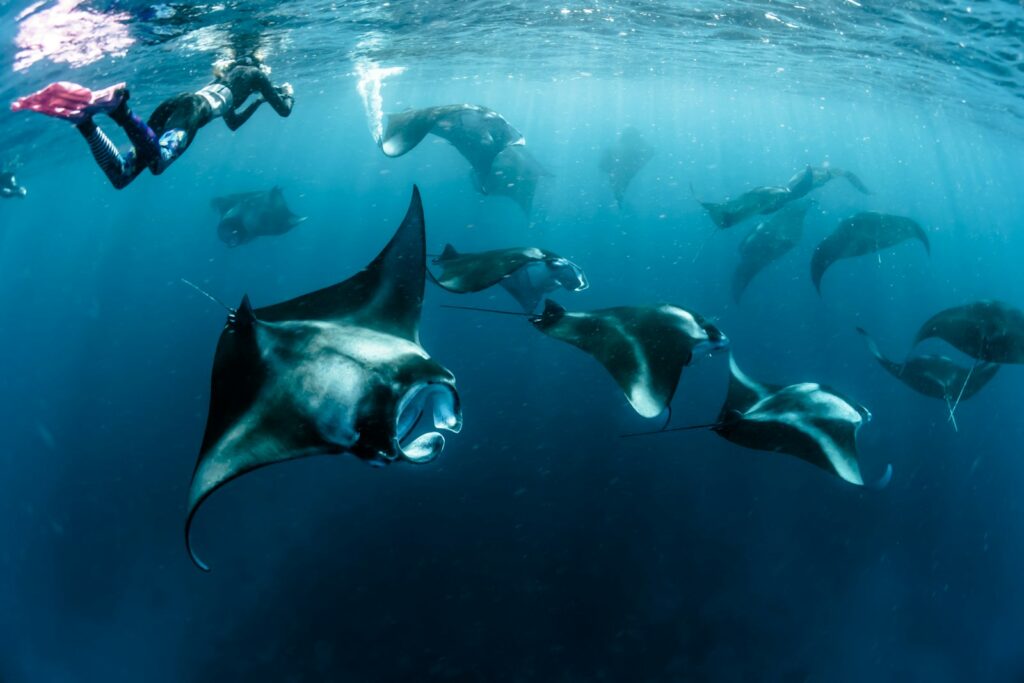
Snorkeling with manta rays in Komodo is genuinely possible without a dive licence — and the reason lies in how the animals feed. At Karang Makassar, widely known as Manta Point, oceanic manta rays (Mobula birostris) cruise the top zero-to-five metres of the water column, mouths open, filtering the plankton-rich soup that accumulates here on incoming tides. You float. They come to you. No certification required, no tank on your back.
That said, Karang Makassar is not a paddling pool. The plateau sits in a tidal channel; the current runs hard; and on the wrong tide, your operator will — correctly — keep you on the boat. This page covers what the site is actually like, who can manage it safely, when the mantas are most reliably present, and how to behave around them without causing harm.
What Is Karang Makassar?
Karang Makassar (the name means Makassar Reef) is a long rubble-and-sand plateau in central Komodo National Park, running roughly five to fifteen metres deep. It is not a lush coral garden — scattered bommies and a handful of cleaning stations mark the flat bottom, but the spectacle here is in the open water above, not the benthos below. Mantas glide up through the column, tip a wingtip at the surface, and bank back down. On calm mornings with a slack or early rising tide, they occasionally break the surface entirely.
The cleaning stations — coral heads at eight to fifteen metres where reef fish pick parasites from the mantas’ skin — are what divers aim for. Lying still on the bottom at depth, a diver can watch a manta hang overhead for minutes. Snorkelers do not get that particular angle. What snorkelers get instead is the wide-open silhouette from above: a three-metre-plus wingspan, white belly, slow spiral, sometimes a second animal following. Different. Worth having.
Can Snorkelers Actually See Mantas Here?
Yes — with an honest caveat about probability. Manta rays are present at Karang Makassar year-round, but encounter rates are not published anywhere in verified form, and any operator promising a sighting is making a claim the data does not support. What is well-established: this is the highest-probability manta spot in central Komodo for surface observers, and the feeding behaviour that brings mantas to the top of the water column specifically favours snorkelers over divers on the right conditions.
The cleaning-station close-ups at depth remain a diver’s advantage. If you want to lie motionless at twelve metres while a manta hovers two metres above you, you need an Open Water certification and a guide who knows the site. If you want to drift at the surface, face-down, watching a three-metre disc bank in from the blue, snorkeling is entirely the right tool.
Manta Season and Monthly Conditions
Sources on Komodo manta seasonality conflict, so what follows uses the most consistent picture from multiple 2026 sources and flags uncertainty explicitly.
Mantas are present at Karang Makassar in every month of the year. The aggregation — multiple animals feeding together, not just solitary passes — is strongest roughly November through February, when plankton blooms coincide with the west monsoon. That same period brings rougher seas, reduced visibility, and the occasional KSOP harbour closure at short notice. If you are travelling December through February specifically for mantas, build buffer days into your itinerary. A one-night trip during that window is a gamble.
The dry season, April through November, offers more reliable sea conditions and considerably better visibility. Mantas are still encountered regularly through this period, though in smaller numbers or as solitary individuals rather than aggregations. June through August is peak tourist season and the sea is typically calmer — which is also when manta aggregations are not at maximum, though sightings are common enough that operators visit the site on most full-day itineraries.
Note: all manta-season figures should be treated as general guidance, last verified June 2026. Conditions shift year to year, and no peer-reviewed encounter-rate data for this specific site is publicly available. Confirm with your operator in the weeks before your trip.
Visibility and Water Temperature by Month (typical reported ranges)
| Month | Typical visibility | Water temp (surface) | Sea conditions | Manta probability |
|---|---|---|---|---|
| Jan–Feb | 10–15 m | 28–29 °C | Variable, some rough days | High aggregation — swell risk |
| Mar | 15–20 m | 28–29 °C | Transition, improving | Good |
| Apr–May | 20–30 m (peak clarity) | 28–29 °C | Calm, excellent | Good |
| Jun–Jul | 20–25 m | 26–27 °C | Calm, peak season crowds | Regular encounters |
| Aug–Sep | 15–25 m | 25–26 °C | Calm, occasional south swell | Regular encounters |
| Oct–Nov | 20–25 m | 25–26 °C | Good, transitioning | Building |
| Dec | 10–20 m | 27–28 °C | Monsoon onset, variable | High aggregation — check forecast |
Source: synthesised from resort climatology data and multi-operator reports, last verified June 2026. Figures are typical ranges, not guarantees. South-park sites run several degrees cooler from Indian Ocean upwelling and are not reflected in the table above.
The Drift: What the Current Actually Feels Like
Karang Makassar is a drift snorkel. You do not anchor, swim in circles, and return to the entry point. You enter up-current, drift with the flow across the plateau, and the boat collects the group at the down-current end. That is the normal procedure. Understanding it before you get in changes the experience considerably.
Current strength here is tide-dependent and not formally instrumented — the honest description from guides and multiple liveaboard reports is “strong,” with an estimated range of one to three kilometres per hour on a running tide. That is enough to move you faster than you can comfortably fin against it, which is precisely why you should not try. The protocol is to go with it.
The Group Drift Protocol
- Enter the water only on your guide’s signal. The entry moment is chosen by reading the current, not the clock.
- Stay as a tight group throughout. Spreading out means the boat cannot track everyone efficiently, and it puts weaker swimmers in situations where they need individual retrieval.
- Do not attempt to swim against the current to stay near a manta. The manta will return on its next pass. You will not catch it by swimming upstream and you will exhaust yourself.
- The boat moves down-current and waits to collect the group at the end of the drift. Do not try to swim back to where you started.
- If you become separated: stop finning, float on your back, raise one arm clearly above your head. Experienced crews scan for raised arms. Stay calm — panic-swimming accelerates separation.
When the current or swell is too strong for safe entry, reputable operators will skip the in-water portion and observe from the boat, or move to an alternate site. This is not a disappointment — it is professional judgement, and it is a direct indicator that the operator puts safety ahead of selling you the experience you asked for. Take it as a good sign about the boat you booked.
Skill Grade and Who This Site Is For
Karang Makassar is an intermediate-plus site for snorkelers. That means:
- Comfortable swimmers who can hold position at the surface without panic, manage a drift without fighting it, and clear a fogged or flooded mask calmly are well-placed to enjoy it.
- Weak swimmers and non-swimmers can enter with a life jacket and a guide in the water. This is common practice on reputable boats — crews routinely assist non-swimmers — but it is operator-dependent, not a park-wide standard. Ask explicitly before you book: does the guide enter the water with non-swimmers at Manta Point?
- Children: young children and toddlers do not belong in the current at Karang Makassar. Most operators restrict the in-water entry at this site to ages eight and above, often requiring a parent in the water and a mandatory life jacket regardless. Some operators set a higher age floor. Ask your operator directly. For families with younger children, Siaba Besar (flat, protected, two-to-six metres, genuinely calm current) and the bar at Taka Makassar at slack tide are the right alternatives.
- Anxious or first-time snorkelers: if you have never snorkeled before, Karang Makassar is not the place to learn. Use a calm shallow site — Kanawa Island’s house reef is the most beginner-friendly option in the central park — before attempting a drift.
The life jacket question deserves a direct answer. Indonesian maritime law requires life jackets on board for all passengers. Guides commonly require them in the water for non-swimmers and weak swimmers. Jacket quality on budget boats tends to be basic foam vests, not rated to SOLAS standards. If you are uncertain about your swimming ability in open water, wearing a vest in the water is entirely reasonable and normal — no one will judge you for it. If you are bringing children, bring your own child-size PFD rather than relying on what the boat carries, particularly on cheaper shared day trips.
Manta Ray Code of Conduct
Indonesia declared all its waters a manta sanctuary in 2014 under KEPMEN-KP No. 4/2014 (Ministry of Marine Affairs and Fisheries). That covers roughly six million square kilometres — the largest manta sanctuary in the world. Harassment, capture, or trade of manta rays is enforceable under Indonesian fisheries law. What the law does not specify in detail is approach distance or in-water behaviour, which is where Manta Trust best practice fills the gap.
In-Water Rules
- Distance: keep at least three to four metres from the body and four to five metres from the tail. This is Manta Trust best practice, not a codified Indonesian regulation — but every reputable operator in Komodo enforces it, and you should treat it as mandatory.
- Approach angle: approach from the side, never head-on and never from directly behind. Head-on approaches break the manta’s line of sight and frequently cause the animal to change direction or leave the site entirely.
- Body position: stay flat at the surface, minimal fin movement, no splashing. You are trying to look like a neutral floating object, not a pursuing predator.
- Let the manta choose: if you stay still and let the animal come to you, encounters last longer. If you chase, they end immediately.
- No touching: mantas carry a protective mucus layer. Even light contact can damage it, creating entry points for infection. Do not touch.
- No flash photography: underwater flash at close range is disorienting for the animal. Natural light on a bright day is more than sufficient for surface shots.
- Do not duck-dive into the manta’s path: blocking a cleaning station or dropping into the space below a hovering manta forces the animal off the station. This disrupts a feeding or cleaning behaviour that is physiologically important to the animal.
- No selfie sticks in front of your face while manoeuvring: you lose spatial awareness and are more likely to inadvertently approach too close.
Boat Behaviour
Operators are expected to hold no-wake speed in aggregation zones and to cut engines or go to neutral when swimmers are in the water. A sensible standoff distance from visible mantas is around ten to thirty metres for anchored or drifting boats — this is standard operator practice rather than a published legal distance. If you observe a boat driving into a manta aggregation at speed, that is worth noting to park rangers.
For a more detailed treatment of ethical manta encounters across the park, see our full manta etiquette guide linked in the site navigation.
Park Fees for Snorkelers at Karang Makassar
The fee structure changed significantly in late 2024 under PP 36/2024 (Government Regulation 36/2024 on KLHK PNBP tariffs), replacing the older PP 12/2014 framework. The transition triggered operator protests in Labuan Bajo in October 2024. The figures below represent the most consistent multi-source picture as of June 2026, but have not been verified against the official regulation annex text — confirm the current amounts with your operator before travel, as fees can change with limited notice.
- Foreign visitor entry fee
- Rp 250,000 per person per day (applies to snorkelers, trekkers, and divers equally — no separate snorkel-activity surcharge is itemised in 2026 fee tables, last verified June 2026)
- Indonesian citizen entry fee
- Rp 50,000 weekday / Rp 75,000 Sunday and public holidays
- Diving surcharge
- Rp 25,000 per diver per day — snorkelers are exempt from this charge
- Harbor fee
- Rp 25,000 per person
- Conservation fee
- Rp 100,000 (foreign) / Rp 10,000 (domestic) — reported by some 2026 sources, not confirmed by others; flag as contested, confirm with operator
- Ranger/naturalist fee (island landing only)
- Rp 200,000 per group up to five persons (Komodo or Rinca); Rp 150,000 per group up to five (Padar). Snorkel-only trips with no island landing may not incur this fee — verify your itinerary.
Practical cash total for a foreign snorkeler on a full-day Padar + Komodo + Manta Point itinerary: Rp 275,000 minimum (entry + harbour) to Rp 375,000 if the conservation fee applies. Operators routinely advise guests to bring Rp 400,000–550,000 cash for a full itinerary including ranger shares. Park fees are almost always excluded from the tour price — always ask before booking, and bring small denomination rupiah notes.
The park uses the SiORA booking platform (Sistem Informasi Online Reservasi Wisata Alam). Reports from early 2026 indicate that walk-in ticket sales at the park have ended and pre-booking via the app or through an operator is now required, with the system going live permanently around April 2026. This status is based on secondary sources only and has not been confirmed directly from the park authority — check with your operator, who will typically handle the SiORA registration on your behalf. Last verified June 2026.
Snorkeling vs Diving at Karang Makassar
The comparison is worth being clear about because a lot of Komodo marketing conflates the two. Here is what each genuinely offers at this specific site:
| What you want to see | Snorkeling (0–5 m) | Scuba diving (8–20 m+) |
|---|---|---|
| Manta rays in open water | Yes — surface feeding passes, wide silhouette view | Yes — same animals, deeper angle |
| Manta at cleaning station (hovering, close) | No — stations at 8–15 m | Yes — the signature diver experience |
| Multiple mantas simultaneously | Yes, during aggregation season | Yes |
| Certification required | None | Open Water minimum; Advanced for some current-heavy sites |
| Average entry cost | Included in day tour from ~Rp 1.4–1.6M pp (shared) | Additional ~USD 50–80 for dive guide, tank, weights |
There is no honest argument that snorkeling at Karang Makassar is a poor substitute for diving. It is a different experience: broader, more open-water, less intimate with individual animals. Whether it is the right experience for you depends on what you are there for, not on a hierarchy of activities.
What to Wear and Bring
Mask and Snorkel
Nearly all day tours and liveaboards include mask and snorkel in the price. The quality gap between boats is real. Budget shared day trips commonly carry scratched lenses, stretched silicone straps, and mismatched fins. A mask that leaks or fogs constantly in a drift current is more than an inconvenience — it degrades the experience significantly and can cause anxiety in less confident swimmers.
If you have your own mask, bring it. A properly fitted mask with a silicone skirt seals reliably. If you are using rental gear, do a fit-check before you are in the current: press the mask to your face without the strap and inhale gently through your nose. It should stay in place. If it falls off, ask for a different mask before entering the water.
Prescription masks are available at some established Labuan Bajo dive shops, but not reliably on day tour boats. If you need corrective lenses to see clearly underwater, arrange this before your departure, not at the dock.
Thermal Considerations
Water temperature at the central Komodo sites runs 25–29°C depending on the month. A rashguard and leggings are sufficient for most people during the warmer months (November through May). In July through September, when surface temperatures can drop to 25–26°C, a shorty wetsuit (2–3 mm) makes a meaningful difference on longer sessions — particularly if you are in the water at multiple sites across a full day. Note that southern park sites and outer passages receive Indian Ocean upwelling that can push temperatures down to around 22–25°C; if your itinerary includes Manta Alley in the south, a wetsuit is worth packing regardless of the month.
Sun Protection
The equatorial sun at the surface of Komodo is intense. A full-coverage rashguard and leggings protect more reliably than sunscreen alone, particularly for long drifts where you may be horizontal on the surface for twenty to forty minutes. For exposed skin, a reef-safe mineral sunscreen (zinc oxide or titanium dioxide base) is strongly recommended. There is no national or Komodo-specific legal ban on chemical filters such as oxybenzone or octinoxate in Indonesia as of June 2026 — unlike Hawaii or Palau — but the reef ecosystems here are extraordinary and the precautionary case for mineral sunscreen is straightforward.
If you are planning your trip and want to talk through which Labuan Bajo tour actually suits your swimming ability, group size, or travel dates, our planning team answers questions at no cost. No one pays to change what we write; if you proceed with a partner operator after using our free planning help, they may pay us a referral fee at no extra cost to you. Plan your trip here, or reach us directly on WhatsApp for a faster conversation about specific boats and availability.
Tour Prices and How to Book
Park fees are almost universally excluded from day tour prices. Once you add them, the real cost per person differs meaningfully from the advertised headline price. Figures below are last verified June 2026 and described as ranges because there is no fixed industry tariff — prices drift with season, group size, and which operator you are talking to.
- Shared speedboat, full-day (typically Padar + Komodo + Pink Beach + Taka Makassar + Manta Point)
- Rp 1,400,000–1,600,000 per person (~USD 85–100); park fees not included. During July–August peak season, cheap shared seats sell out and prices trend toward the upper end or beyond. One concrete 2026 datapoint: Green Rinjani lists Rp 1,450,000 for up to 22 passengers.
- Shared slow/wooden boat, full-day
- ~Rp 900,000–1,300,000 per person (~USD 55–80); fewer stops, longer transit time; a meaningful seasickness variable on choppy days.
- Private speedboat charter (2–6 passengers)
- ~Rp 6,000,000–10,000,000 per day; premium or larger private boats Rp 10,000,000–18,500,000. Significantly more flexible on itinerary, in-water time, and pace.
- Shared liveaboard (2 nights / 3 days)
- USD 220–350 per person (mid-range); comfortable phinisi options around Rp 5,600,000 for three days. Multi-day park fees approximately Rp 650,000 per foreigner for three days (single-source figure — confirm with operator).
Typical inclusions on shared day trips: hotel pickup, lunch, drinking water, basic mask and snorkel, guide. Typical exclusions: park and ranger fees (cash, as above), fins (not always provided), towel, tips, travel insurance. Ask specifically about fins — some shared boats do not include them, and finless snorkeling in a drift current is harder work.
Our operator partner for bookings is Komodo Luxury, a sister brand within Juara Holding Group. They run private and small-group speedboat charters out of Labuan Bajo. If a private trip is not your budget, we can still point you toward shared-boat options that prioritise snorkel time over sightseeing volume. Reach our planning form or message on WhatsApp — we respond within a few hours during business hours Labuan Bajo time.
Frequently Asked Questions
Can I snorkel with manta rays in Komodo if I am not a strong swimmer?
Yes, but with the right setup. Karang Makassar (Manta Point) has a strong tidal current and is rated intermediate-plus. Weak swimmers and non-swimmers can enter with a life jacket and a guide in the water, but this is operator-dependent rather than a guaranteed standard on every boat. Ask your operator explicitly whether a guide enters the water with non-swimmers at Manta Point before you book. If the answer is no, find a different operator. For genuinely anxious swimmers, calm sites like Siaba Besar (protected, two-to-six metres, turtles) may be a better starting point for the trip, with Manta Point attempted on a separate day with more confidence.
What is the best month to snorkel with manta rays at Manta Point?
Manta ray aggregations at Karang Makassar are typically strongest from roughly November through February, when plankton production is at its peak. However, this overlaps with the west monsoon — rougher seas, lower visibility (often ten to fifteen metres rather than twenty-plus), and occasional harbour closures. Solitary manta encounters happen throughout the dry season (April through November), with calm sea conditions and visibility up to thirty metres. The honest answer is that no month guarantees a sighting; there is simply no published encounter-rate data for this site. Sources conflict on the precise peak window, so treat all season guidance as indicative. Last verified June 2026.
Is a diving licence necessary to see manta rays in Komodo?
No. Snorkeling requires no certification at all. You float at the surface; manta rays feed and pass through in the top zero-to-five metres of water. What a dive licence does give you is access to the cleaning stations at eight to fifteen metres, where hovering mantas linger for extended periods — a different and often more intimate encounter. If you are undecided on whether to learn to dive, Karang Makassar is a reasonable case for trying — but it is absolutely not a requirement to see the animals from the surface.
How long do snorkelers typically spend in the water at Manta Point?
On a standard shared day trip, expect roughly forty minutes to ninety minutes in-water time at Manta Point, depending on the operator and how many stops the itinerary includes. The drift across the plateau moves at tide speed, not your speed. On a six-stop day trip that also visits Padar, the Komodo dragon trail, and Pink Beach, your total in-water snorkeling time across all stops can be as short as two to three hours in total — with most of the day spent on the boat between sites. Private charters give you flexibility to extend time at whichever site is most productive on the day.
What happens if the current is too strong at Manta Point on my tour day?
A reputable operator will either delay entry until the tide changes (if the itinerary allows), shift to a calmer site, or observe mantas from the boat without entering the water. Skipping the in-water entry at Manta Point when conditions are unsafe is the correct call, and it happens on a meaningful number of trips — particularly on full-moon and new-moon spring tides when current is at its strongest. Ask your operator before booking how they handle strong-current days at Karang Makassar, and listen carefully to the answer. An operator who says “we always go in” is telling you something important about how they prioritise your safety.