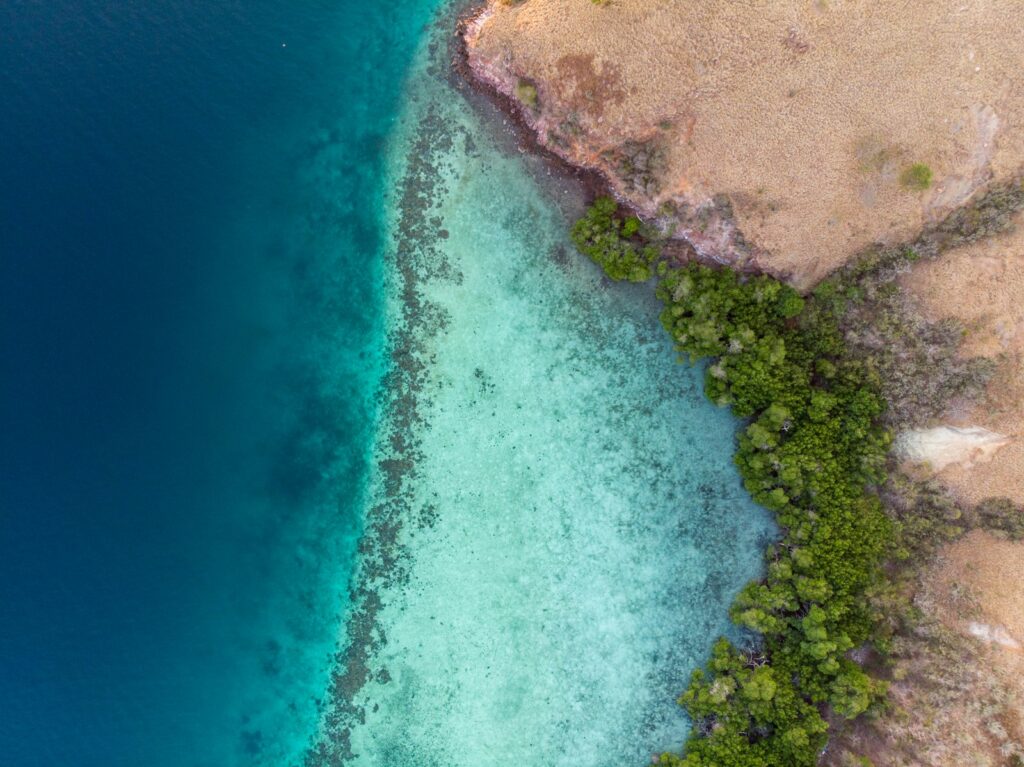
Yes — June is genuinely one of the better months to snorkel Komodo National Park. The dry-season southeast trade winds have established by June, surface chop on the Flores Sea settles to its annual low, and visibility across the central snorkeling corridor typically runs 20–25 m (typical reported range, last verified June 2026). Water temperature sits around 27°C — cooler than the 28–29°C of April and May, but perfectly comfortable for extended sessions without a wetsuit. That is the honest headline. What the headline does not tell you is that June also marks the start of peak-season crowds, that cheap shared-boat seats sell out days in advance, and that manta encounters at Karang Makassar are possible but far less reliable than the November–February plankton aggregation window. This piece works through all of it so you can decide whether June matches your specific trip.
What June Actually Looks Like at Sea
Early June is still recognisably shoulder season. July–August school-holiday demand has not hit full force yet, so the boats leaving Labuan Bajo harbour are full but not at maximum capacity, and availability on reputable operators is still reasonable with a few days’ notice. By mid-June that changes. European and Australian school holidays begin staggering in, and the good shared speedboat departures — 20-person maximum capacity, fixed itinerary, genuine guide-in-water — start filling a week ahead.
Sea conditions in June are consistent. The southeast trades push across the Flores Sea with enough regularity that morning cancellations are rare. Wind is not zero — you may feel chop on the transit to Manta Point or out toward Padar — but nothing like the swells that make November and December launches unpredictable. KSOP Labuan Bajo, the harbor authority, rarely issues closures in June. That is the meaningful difference from booking in, say, January.
Visibility figures for June come from resort climatology data reported by a single primary source, which I flag upfront as a limitation. The range cited — 20–25 m — is plausible and consistent with what I observe from the surface around Karang Makassar on calm mornings, where the plateau drops away clearly to at least 15–18 m before the water colour shifts. On exceptional mornings in early June, before a week of strong wind, it can look closer to the 25 m upper bound. After a few days of sustained southeast trades that stir surface turbulence, expect the lower end of the range.
The Crowd and Price Reality in June
No independent guide should pretend June is a quiet month. It is not.
Pink Beach and Taka Makassar are the two sites where crowd impact is most visible. Pink Beach sits in a semi-sheltered bay with easy beach entry, which makes it the natural stop where all operators anchor simultaneously. On a midweek June morning you may share the beach with three or four boats; by a Saturday in late June, double that. Taka Makassar — the sandbar — is smaller still, and at low tide when twenty snorkelers are standing on a patch of sand the size of a tennis court, the experience is very different from what the photos suggest.
This does not make these sites bad. Pink Beach coral, while variable in quality depending on micro-location, still produces good fish density and soft coral cover in the less-anchored sections. Taka Makassar at the right tide stage — on the bar itself at slack, before the current picks up on the eastern edge toward the manta channel — is genuinely beginner-friendly and visually striking. But go in knowing what the crowd looks like.
Prices in June track toward the peak band. The shared speedboat full-day itinerary (typically: Padar viewpoint, Pink Beach, Komodo island, Taka Makassar, Manta Point, and one coral garden stop) runs Rp 1.4–1.6 million per person at shoulder-season baseline, rising to Rp 1.5–1.8 million per person as June progresses and July approaches. Park fees are almost universally excluded from the tour price — budget separately for Rp 400,000–550,000 per person in cash for a full itinerary including Padar landing and a ranger-guided Komodo dragon visit (see the fee table below). The full-market span on day tours runs approximately USD 60–150, but the USD 60 end usually means a slow wooden boat with fewer snorkel stops and longer transit time.
Park Fees: What Snorkelers Pay in June 2026
Fee structures in Komodo National Park shifted in late 2024 when PP 36/2024 revised the KLHK tariffs, replacing the older PP 12/2014 structure. Operators protested the increase in October 2024. The figures below are secondary-source consensus from multiple 2026 booking platforms and operator sites; no official PP 36/2024 annex text has been independently verified. Last verified June 2026 — confirm with your operator before travel, as park fee structures change without advance notice.
- Foreign visitor base entrance fee (per person, per day)
- Rp 250,000 — applies whether you are snorkeling, trekking, or diving. High-confidence multi-source figure.
- Domestic visitor entrance fee (per person, per day)
- Rp 50,000 weekday / Rp 75,000 Sunday and public holidays. Medium confidence — two sources, no official text verified.
- Diving activity surcharge
- Rp 25,000 per diver per day. Snorkelers are exempt — one of the few financial advantages of snorkeling over diving here.
- Snorkeling activity fee
- No separate snorkeling fee appears in any 2026 fee table. The old Rp 15,000 snorkeling surcharge from the PP 12/2014 era is historical. Cannot confirm whether PP 36/2024 abolished it or whether operators bundle it; flagged “no separate snorkel fee itemized as of June 2026.”
- Harbor fee
- Rp 25,000 per person. High confidence.
- Conservation fee
- Rp 100,000 per foreign visitor reported by some operators, omitted by others. Contested — budget for it as a precaution.
- Ranger / naturalist fee (island landings only)
- Rp 200,000 per group of up to five people for Komodo or Rinca island. Rp 150,000 per group for Padar. Snorkel-only trips that do not land on an island may skip this entirely — confirm your itinerary.
- Realistic cash to carry (foreign visitor, full-day Padar + dragons + snorkel)
- Rp 400,000–550,000 per person. Have it in cash; card payment at park ticket points is not reliably available.
A note on the booking system: SiORA (Sistem Informasi Online Reservasi Wisata Alam) has been reported as the mandatory pre-booking platform since approximately April 2026, with walk-in sales reportedly ended. Most reputable operators handle SiORA booking on your behalf — confirm this when you book. Last verified June 2026.
Manta Rays in June: What to Expect, What Not to Expect
Manta rays at Karang Makassar — the flat rubble-and-sand plateau in central Komodo that operators call Manta Point — are present year-round. That sentence is literally true and also slightly misleading. Being present is not the same as being reliably encountered.
The highest-density aggregations happen during the plankton-rich northwest monsoon, roughly November through February. That is when feeding mantas concentrate in the top few metres of the water column at Karang Makassar, and when snorkelers floating at the surface have the best statistical chance of a close encounter. In June, plankton levels are lower. The mantas do not disappear — cleaning-station activity and feeding passes still occur — but encounter rates are not at their November–February peak. No operator publishes encounter-rate percentages, and any claim of “guaranteed manta sightings in June” is not reliable.
What snorkelers can realistically access in June: mantas feed in the top 0–5 m of the water column. On a calm morning at slack tide, with the guide timing entry up-current and the group drifting slowly across the plateau, surface encounters do happen. I have watched a reef manta pass within three metres of the surface on a mid-June morning, feeding in a wide lazy arc, completely unbothered by the group. That is not a guarantee. It is an illustration of what the site can produce when conditions align.
Karang Makassar is a drift site. Currents are described by operators and guides as strong, with the speed varying significantly by tide stage — my working estimate is 1–3 km/h on a running tide, though no instrumented data exists for the site. Operators sometimes skip the water entry entirely when current or swell is too strong. That is a good sign in an operator, not a failure of service. If you see a boat turn around at Manta Point without putting swimmers in the water, they made the right call.
Manta etiquette — the rules that protect the encounter
Indonesian law (KEPMEN-KP No. 4/2014) made all Indonesian waters a manta sanctuary. Harassment and capture are enforceable under fisheries law across approximately six million square kilometres of ocean — the world’s largest manta sanctuary by area. Within that legal framework, Manta Trust guidelines give snorkelers specific behavioural cues. These are not codified Indonesian law, but they are best practice and followed by reputable operators.
- Maintain 3–4 m from the manta’s body, 4–5 m from the tail.
- Approach from the side — never head-on, never from directly behind.
- Stay flat at the surface. Minimal fin kick. Let the manta set the approach angle.
- Never touch. Manta skin carries a mucus layer that protects against infection; human contact damages it.
- No chasing. No duck-diving into the manta’s path. Never position yourself between the manta and a cleaning station — that interrupts behaviour the animal specifically sought out.
- No flash photography. No selfie sticks extended toward the animal.
The practical reason to follow these rules beyond the ethical ones: a manta that is spooked by poor approach behaviour leaves. A manta that is given space often circles back, sometimes several times. Patience and stillness produce better encounters and better photographs than rushing does.
Which Spots Are Best in June? A Spot-by-Spot Verdict
June conditions — calm surface, 20–25 m visibility, 27°C water, moderate-to-strong currents at some sites — suit different spots in different ways.
Siaba Besar (Turtle City)
The strongest pick for June. Siaba Besar is a shallow, protected hard-coral reef, with the main snorkel band running 2–6 m. Current is rated mild to protected — you are not drifting across it, you are exploring at your own pace. Multiple green turtles per snorkel session is the norm here; density is unquantified but I have not been on a visit where the count was below three. With 20+ m visibility in June, the reef texture is clearly visible from the surface and turtle approaches are unhurried. Beginner-appropriate at most tide stages.
Kanawa Island
Consistently beginner-friendly with beach entry from approximately 1–2 m shallowing to 5–8 m (depth range inferred from dive-site documentation, not measured). Current is mild and the site is relatively sheltered. Coral cover here is among the more intact in the accessible day-trip circuit, and fish density is high. June visibility makes Kanawa look particularly good from the surface — the coral texture is visible well beyond arm’s reach. If your group includes non-swimmers or nervous first-timers, Kanawa is where to anchor your confidence early in the day.
Pink Beach (Pantai Merah)
Good for what it is; honest about what it is not. The reef condition at Pink Beach is variable depending on which section of the bay your boat anchors in — some areas show anchoring damage with reduced hard coral cover, while others retain reasonable coral structure. It is not the most pristine reef in the park. What Pink Beach does reliably well in June: the beach itself, the visibility for underwater photography, and the fish life in the mid-section of the bay. The pink coloration of the sand comes from fragments of red carbonate material — the foraminifera Homotrema rubrum and coralline algae are the better-supported explanation for the pink hue, rather than the “crushed red coral” shorthand that circulates in tour literature.
Current at Pink Beach is generally mild in the bay interior, but the headland edges have stronger flow. Stay inside the bay.
Taka Makassar
Tide-dependent more than current-dependent in June. On the sandbar at slack tide, this is one of the most photogenic and genuinely easy snorkel stops in the park — 0.5–2 m on the bar itself, clear water, good light. The eastern edge of the bar drops toward the manta channel and the current picks up on a running tide; that edge is not for beginners. Time your visit for slack water and the site works well. Rush it, or stay too long as the tide turns, and the edge becomes a hazard the tour briefing should flag explicitly.
Karang Makassar / Manta Point
Intermediate minimum, regardless of month. In June, the plateau is clear and the drift is manageable on the right tide stage. The experience is genuinely worthwhile for a confident snorkeler — drifting over open water at 20+ m visibility, watching the sandy bottom 10–15 m down, with the reasonable chance of a manta appearing mid-column. Non-swimmers and weak swimmers should use a life jacket and stay close to the guide; if your operator does not put a guide in the water at Manta Point, ask directly before entry whether one will be in the water with the group.
Mawan
A stronger site than it gets credit for in mainstream tour descriptions. Coral garden from 3–8 m sloping toward a sandy manta flyover area, with hawksbill turtles and occasional reef sharks alongside the manta possibility. The catch: current at Mawan is rated strong, and manta encounters here most reliably occur on rising tide. Not appropriate for unconfident swimmers. If your operator includes Mawan on the itinerary, ask the guide to assess the current before committing to entry. June conditions generally support a Mawan visit, but it is the most current-exposed standard day-trip site and deserves honest pre-entry assessment.
Shared Boat vs Private Charter in June: The Trade-Offs
The crowd pressure in June makes the shared-versus-private question more consequential than it is in, say, October.
| Factor | Shared Speedboat (up to ~20-22 pax) | Private Speedboat (2–6 pax) |
|---|---|---|
| Price (June 2026, park fees excl.) | Rp 1.5–1.8M per person | Rp 6–10M per day (small boat) or Rp 10–18.5M per day (larger/premium) |
| Itinerary flexibility | Fixed stops, fixed timing | Adjust stops and duration on the day |
| In-water time per site | Typically 20–40 minutes; guide manages group size | Stay as long as conditions allow; guide focus is your group only |
| Crowd at site | Multiple boats anchor simultaneously at popular stops | Same crowded sites — private boat does not get you a private reef |
| Guide-in-water | Varies by operator; ask before booking | Standard on reputable charters; negotiate explicitly |
| Gear quality | Variable; worn masks common on budget boats | Higher quality typical; confirm inclusions |
| Best for | Solo travellers, pairs, cost-conscious groups | Families with young children, mixed skill groups, any group wanting flexible stops |
One thing a private charter cannot buy you in June: an uncrowded Pink Beach or Taka Makassar. Every boat in the park on a June morning heads to the same six stops. Private means your boat’s timing and pacing are under your control — arrive at Taka Makassar at 08:30 before the main fleet, for instance, or spend an extra 25 minutes at Siaba Besar because the turtles are particularly active. That flexibility has real value. It does not make the park smaller.
If you are travelling as a family with children under ten, a private charter is worth serious consideration for June. The guide’s full attention is on your group, water entry timing is negotiable, and the boat can divert from a site that is running too strong a current without the group-consensus constraint of a shared departure. See the section below on family and beginner practicalities.
Gear Notes for June
Water temperature at 27°C means a rashguard plus leggings is sufficient for most snorkelers. You are unlikely to feel cold after a single water entry. After three or four entries spread across a full day — Manta Point drift, then Kanawa, then Siaba Besar — some people find the cumulative chill starts affecting comfort and focus. A shorty wetsuit (2–3 mm) removes that variable entirely. If you are prone to getting cold in pools at 28°C, bring one.
The specific gear reality on shared June boats: mask and snorkel are included in nearly all day-tour prices. Fins are sometimes included, sometimes not — confirm before booking if you care. What the inclusion does not tell you is mask quality. Budget and mid-range shared boats carry masks that range from serviceable to scratched-lens, tired-seal, and mismatched-to-your-face. At Karang Makassar with a 1–2 km/h drift, a poorly sealed mask floods every four minutes. That is not a safety issue but it is an annoying one that interrupts the encounter you came for.
Bring your own mask if you have one. If you do not own a mask, pick one up in Labuan Bajo before departure — several dive shops on the main strip stock basic snorkel sets at reasonable prices — and do a five-second fit check before purchase: press gently over your face, inhale through your nose, release. It should hold suction. If it does not, try the next size.
Sunscreen: as of June 2026 there is no Indonesian national law or Komodo National Park regulation banning oxybenzone or octinoxate in sunscreens (unlike Hawaii or Palau). Reef-safe mineral sunscreen — zinc oxide or titanium dioxide base — is strongly recommended as best practice for avoiding coral chemical stress. It is not a legal requirement. It is a reasonable thing to do when you are floating over reef at close range for several hours.
Children’s masks and fins are available on dive-centre-operated boats but are not reliably stocked on budget shared speedboats. If you are bringing a child, bring their mask. For any child under 10, bring a close-fitting personal flotation device from home — standard shared-boat foam vests are often adult-sized and fit children poorly.
June Safety: What the Conditions Actually Mean for Snorkelers
June is one of the lower-risk months in the park for surface conditions. That is true. It is not, however, a month without hazards, because the hazards in Komodo are mostly current-driven rather than weather-driven, and currents do not take the dry season off.
At Karang Makassar, the drift protocol applies year-round. Enter up-current on the guide’s signal, drift as a tight group, never swim against current, and let the boat shadow your position down-current for collection at the end. If the group separates: float, stay calm, raise one arm to signal. Operators skip the entry entirely when conditions are too strong — a good operator makes this call before anyone gets in the water, not after.
Taka Makassar’s eastern edge near the manta channel carries a tide-dependent current that can pull snorkelers off the bar and into deeper water quickly. The bar itself at slack tide is genuinely calm; the eastern edge is not. Stay on the bar, watch the guide’s positioning, and do not push toward the drop-off.
Indonesian law requires life jackets for all boat passengers. Shared day boats provide flotation vests, though these are typically basic foam construction rather than SOLAS-rated equipment. Guides commonly require life jackets for non-swimmers and weak swimmers entering the water — this is standard practice on reputable operators but is not a park-wide enforced regulation. Ask your operator directly before boarding: do guides enter the water at all snorkel sites? If the answer is no, or vague, that is information worth weighing before you commit to the booking.
Currents are the documented hazard in Komodo National Park. Snorkeler drift incidents and occasional drownings have been linked to currents, though no consolidated public incident database exists. The risk is real and manageable with a reputable operator, proper briefing, and honest self-assessment of your swimming ability. If you are not a confident swimmer, Siaba Besar, Kanawa, and the Pink Beach bay interior are the right sites. Karang Makassar and Mawan are intermediate-plus and should be approached accordingly.
Ready to match your June dates to the right tour? Use our planning form and we will help you weigh shared versus private, which sites suit your group, and what to budget for park fees. WhatsApp planning is available for faster back-and-forth if your travel window is close.
The Honest June Verdict: Who Should Book, Who Should Wait
June works well for: confident snorkelers and intermediate swimmers comfortable with drift conditions; couples and small groups prioritising visibility and calm sea surface; anyone who wants the best balance of conditions, tour availability, and value before July–August peak pricing fully bites; travellers for whom mantas are a hope rather than the primary goal.
June is less ideal for: anyone for whom a manta encounter is the single reason for the trip (November through February remains the more reliable window); budget travellers who need the cheapest shared seats at the lowest prices (July and August drive prices to the upper end and January–March gives the cheapest rates, though at worse sea conditions); snorkelers who genuinely dislike crowds on iconic beaches.
Early June — the first two weeks — threads the needle most cleanly. Dry-season conditions are established, visibility is at or near its June peak, the July–August crowd surge has not arrived in full force, and shared-boat availability is still reasonable with a few days’ advance booking. By late June and into early July, availability on the better operators tightens noticeably. Book the moment your dates are confirmed rather than waiting until the week before.
Frequently Asked Questions
Is June a good time to snorkel Komodo?
Yes. June sits in the dry season, with calm surface conditions on the Flores Sea, reported visibility of 20–25 m in central Komodo, and water around 27°C — comfortable for full-day snorkeling without a wetsuit for most people. The main tradeoffs are peak-season crowds at popular sites like Pink Beach and Taka Makassar, and shared boat prices trending toward the upper range of Rp 1.5–1.8 million per person. Manta encounters are possible at Karang Makassar but less reliable than the November–February plankton aggregation window. Early-to-mid June offers slightly more availability and marginally lower crowd pressure before school-holiday demand peaks in July. Last verified June 2026.
How much do park fees cost for snorkelers in June 2026?
The most consistent 2026 figure for foreign visitors is Rp 250,000 per person per day for the base entrance fee, plus Rp 25,000 harbor fee — so Rp 275,000 minimum. A Rp 100,000 conservation fee is reported by some operators but unconfirmed in all sources; budget for it to be safe. Ranger fees for island landings (Komodo or Rinca) are Rp 200,000 per group of up to five. Snorkelers do not pay the Rp 25,000 diving surcharge. For a full-day itinerary including Padar, Komodo island, and snorkel stops, carry Rp 400,000–550,000 per person in cash. These are secondary-source figures, last verified June 2026 — confirm with your operator before travel.
Can you see manta rays snorkeling in June?
Manta rays are seen at Karang Makassar (Manta Point) year-round, and June is included in that. Surface encounters happen on calm mornings at the right tide stage — mantas feed in the top 0–5 m of the water column, which snorkelers can access without diving gear. However, the aggregation density is not at its November–February plankton-season peak, and no operator publishes encounter-rate percentages. June gives you a real chance, not a guaranteed sighting. Any operator or booking platform that promises manta encounters in June is overstating the certainty. Go with a good operator, follow the guide’s timing cues, and treat any encounter as the bonus it is rather than the baseline expectation.
How busy is Komodo National Park in June, and how far ahead should I book?
June is the start of peak season, with crowd levels described as moderate-to-high and rising through the month. Pink Beach and Taka Makassar are the most congested stops. For shared speedboat day trips on reputable operators, book at least a week ahead in mid-to-late June and 3–5 days ahead in early June. Private charters have more flexibility but fill quickly for weekend departures. The SiORA park reservation system (mandatory pre-booking since approximately April 2026) is typically handled by your operator — confirm this when booking. Last verified June 2026.
Do I need a wetsuit for snorkeling in Komodo in June?
Not strictly necessary, but worth packing if you are sensitive to cold or plan multiple water entries across a full day. June water temperature in central Komodo is around 27°C. A rashguard and leggings handle that comfortably for most snorkelers on a single session. After three or four entries across a six-stop full-day tour, the cumulative effect registers for some people. A shorty 2–3 mm wetsuit removes that concern entirely and doubles as sun protection. Southern park sites run cooler — some reports cite 22–25°C from Indian Ocean upwelling — but those are primarily accessed on liveaboard itineraries rather than standard Labuan Bajo day trips.
Questions about which tour format suits your group, or whether June availability still looks strong for your dates? Start with our planning form or reach us on WhatsApp — we match group size, skill level, and budget to the right departure without pushing you toward anything that does not fit. Our editorial independence means no one can pay to change what we publish here; if you proceed with partner operator Komodo Luxury (a sister brand within Juara Holding Group, disclosed), they may pay us a referral fee at no extra cost to you.