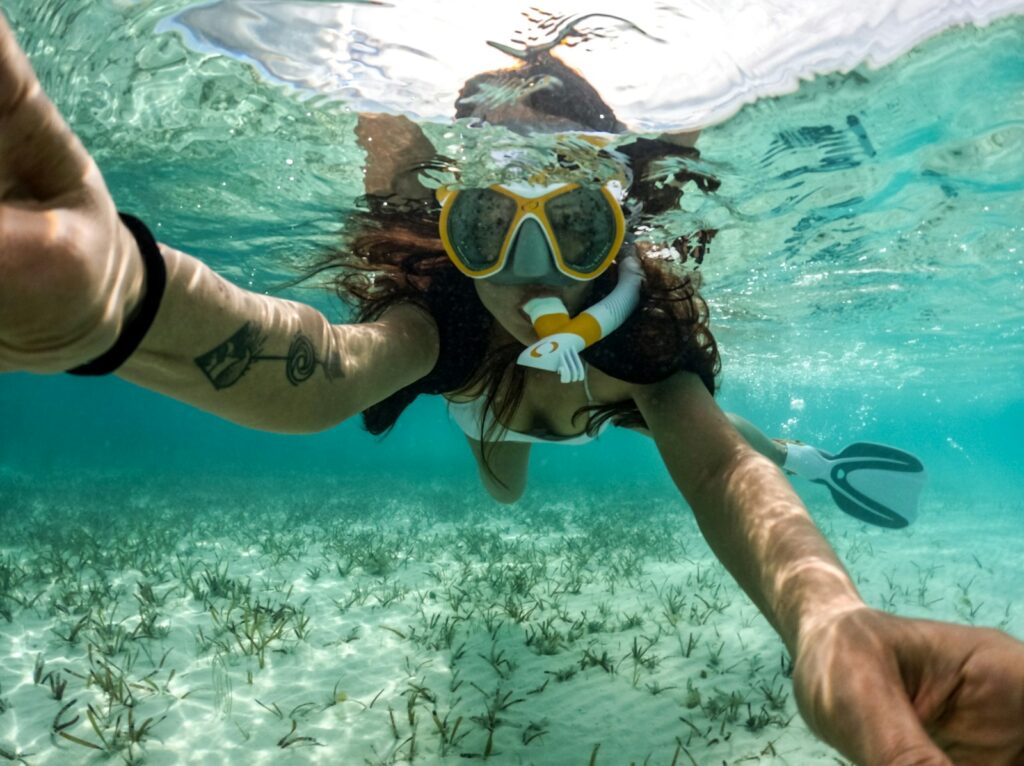
Knowing what to bring snorkeling in Komodo comes down to one practical truth: the basics are almost always provided, but the quality varies so much between boats that packing your own mask can be the difference between a clear, comfortable session at Karang Makassar and 45 minutes of adjusting a fogged lens while the manta rays pass beneath you. Nearly every day boat out of Labuan Bajo includes mask and snorkel in the tour price. Fins are sometimes included, sometimes not. A rashguard keeps you comfortable in 25-29°C water through most of the year. A dry bag protects your phone. And you will need cash — park fees are not covered in most tour prices, and the nearest ATM is back in town.
This guide walks through every item in order of priority. Some things you genuinely need to own. Others you can rent or borrow on the day, if you know what to check before you get in the water. We’ve guided snorkelers here through a lot of conditions — the gear questions that seemed minor on the briefing deck are usually the ones that surface (literally) mid-session.
The Mask: Bring Your Own or Test Carefully at the Dock
Mask quality is the single biggest gear variable on shared day boats. Budget operators carry scratched masks, worn-out silicone skirts, and straps that have been snapped and re-tied. A mask that leaks continuously at Siaba Besar, where the current is mild and you can stop and adjust, is a nuisance. The same mask at Manta Point, where you’re drifting and using your hands to manage position, is a problem.
The recommendation is straightforward: bring your own mask if you have one. A mid-range mask with a good silicone skirt and a properly-sized fit is one of the best investments a dedicated snorkeler makes. If you’re using a rental:
- Test the seal before leaving the dock. Press the mask to your face without using the strap — inhale gently through your nose and hold. If it stays suctioned, the skirt is intact. If it drops, find a different mask.
- Check the lens for deep scratches. Surface scratches scatter light in bright tropical conditions. Peer through it into a light source before you accept it.
- Check the strap buckles. They should click and hold without slipping. Old-style metal buckles can shear on entry. Plastic cam buckles with intact teeth are what you want.
- Anti-fog the lens. Rental masks rarely get properly defogged between trips. Spit generously on the dry lens interior, rub it around with your finger, and rinse briefly with salt water (not fresh — fresh water on a cold lens fogs faster). Baby shampoo works better if available on the boat.
A good mask costs USD 25-60 and lasts years. For a two-week trip to Komodo, that math is easy. For a one-day trip, at least run the seal test above before committing to a rental.
Prescription Masks
Some established dive shops in Labuan Bajo stock prescription insert lenses in common diopter ranges — ask ahead of time, because availability is operator-dependent and not guaranteed. Day boats do not carry prescription equipment. If you wear glasses, plan to either source a prescription mask through a dive shop in town before departure, or look at clip-in corrective lens inserts.
Kids’ Masks
Children’s mask sizing is a real issue on budget boats. Adult masks seal poorly on smaller faces, and a child who can’t clear a leaking mask will spend the session distressed rather than watching turtles. Dive-center-run boats are more likely to have kids’ sizing. On cheaper shared day boats, it’s genuinely unreliable. If you’re traveling with children, bring a child-size mask — it removes an unnecessary variable at what is already a stimulating, sometimes overwhelming experience for young snorkelers.
Snorkel and Fins: What Most Boats Actually Carry
The snorkel that ships with a rental mask is typically a basic J-tube — no purge valve, no splash guard. It works. A purge valve makes clearing easier if you take in water, and a flexible lower section is more comfortable for extended drifts. Again, if you own one that fits well, bring it. If not, the rental will do the job at most sites.
Fins are less consistently included than masks. The tour booking may say fins are provided; the reality on some shared boats is that there are two sizes of fin, and if your foot is between sizes or at either end, you get something awkward. Too-loose fins come off during a drift. Too-tight fins cramp within 20 minutes.
Open-heel adjustable fins with booties or thick socks give you the most reliable fit on rental gear. Full-foot fins in your exact size are lighter to pack and better for warm-water snorkeling if you can get the sizing right. If fins are not confirmed included in your booking, ask directly before departure — and bring neoprene socks if you’re using a medium-to-loose open-heel rental.
Wetsuit or Rashguard: Decide by Month and Site
Water temperature in the central Komodo area runs approximately 28-29°C from January through May, cooling to around 25-27°C from June through September, and recovering to 26°C through October (figures from typical reported ranges, flagged as last verified June 2026 — confirm with your operator for current conditions). Southern park sites near the Indian Ocean upwelling consistently run several degrees cooler, with some reports as low as 22-25°C.
Here’s how to match your thermal layer to actual conditions:
| Month | Typical Water Temp (Central Komodo) | Recommended Thermal Layer |
|---|---|---|
| Jan–Feb | ~28-29°C | Rashguard + leggings; shorty optional for long sessions |
| Mar–May | ~28-29°C | Rashguard + leggings — warmest water of the year |
| Jun | ~27°C | Rashguard fine; shorty worth considering for multiple sites |
| Jul–Sep | ~25-26°C | 2-3mm shorty wetsuit recommended — especially at southern sites |
| Oct–Nov | ~26-27°C | Rashguard + leggings; shorty for southern sites or cooler days |
| Dec | ~28-29°C | Rashguard + leggings adequate |
A 2-3mm shorty wetsuit is the most practical investment for July through September. You’re in the water at multiple sites over a full day — by the fourth entry at 25-26°C, a rashguard is not enough. The shorty also doubles as sun protection on the surface and adds modest buoyancy, which some snorkelers find reassuring at deeper sites.
For sites like Mawan or the outer reef edges at Taka Makassar, where you may be in cooler upwelling water longer than expected, the shorty is worth having year-round if space allows in your bag.
What About Rentals?
Some Labuan Bajo dive shops rent 3mm wetsuits for the day. Quality varies. Check the seams and the zipper before renting — a delaminating seam floods the suit, and a broken zip is difficult to deal with at the dock. Day boats rarely carry wetsuit rentals. Plan to sort your thermal layer in town the evening before departure.
Sunscreen: What’s Actually Legal and What’s Best Practice
There is no national Indonesian ban on oxybenzone or octinoxate sunscreens, and no Komodo National Park-specific restriction on chemical sunscreens, as of June 2026. Indonesia has not enacted legislation comparable to Hawaii’s (effective 2021) or Palau’s sunscreen ban. Stating otherwise would be inaccurate.
That said, the recommendation to use mineral-based sunscreen (zinc oxide or titanium dioxide as active ingredients) in Komodo is strong — not as legal compliance, but as the most defensible choice for reef ecology. Komodo National Park contains some of the most intact coral reef systems in Southeast Asia. Chemical UV filters have documented effects on coral larvae and coral reproduction in lab conditions, and the precautionary argument for mineral alternatives is solid.
Practically speaking:
- Apply 20-30 minutes before entering the water so it binds to your skin rather than washing off immediately into the water column.
- Cover exposed skin fully — the equatorial sun in Komodo in dry season is intense. A full-length rashguard reduces how much sunscreen you need in the water.
- Reef-safe mineral formulas are available in Labuan Bajo at pharmacies and some dive shops, but selection is limited and prices are higher than in major cities. Pack your preferred brand from home.
- Avoid spray sunscreen in the water — the dispersion is uncontrolled and the percentage that stays on your skin is lower than lotion.
Wearable sun protection — rashguard, leggings, and a wide-brim hat for the transit — genuinely reduces your sunscreen need and is more effective than relying on SPF alone in tropical conditions. The hat matters more than most snorkelers expect. Surface time between sites adds up to hours of direct sun exposure on a full-day run.
Dry Bag: Non-Negotiable
Open day boats are wet environments. Equipment stored on deck gets spray. Bags left near the ladder get saturated during water entries. A waterproof dry bag (5-10L is usually sufficient) protects your phone, camera, cash for park fees, documents, and medications. Roll-top dry bags that compress flat when empty pack easily.
If you’re bringing a GoPro or action camera, a floating wrist strap is worth adding. Cameras dropped in Karang Makassar — 5-15m over rubble and sand — are effectively gone. The strap adds no bulk and eliminates that particular loss scenario entirely.
Seasickness Medication
The boat ride from Labuan Bajo to the main snorkel circuit takes 1.5-3 hours depending on boat speed and destinations. In the wet season or early dry season, seas can be rough. In peak season (July-August), conditions are generally calmer but not always. The slow wooden boats used by budget operators pitch more than speedboats and generate more motion.
If you have any history of motion sickness — even mild — take medication before boarding. Dramamine (dimenhydrinate) works but causes drowsiness; non-drowsy alternatives like meclizine are worth seeking out. Scopolamine patches (behind the ear, 6-8 hours before departure) are effective for people who know they’re strongly susceptible. All of these are better sourced before you leave home or bought in Bali — availability in Labuan Bajo pharmacies is variable.
Practical timing: take oral medication at least 30-60 minutes before the boat departs. If you miss that window, fix your gaze on the horizon, stay on deck in fresh air, and avoid reading or looking at a phone below deck. The accounts from travelers who got seriously seasick on the return leg — already tired from a full day in the sun — are a recurring theme in trip reports. Prevention is much easier than recovery mid-sea.
Cash for Park Fees: The Number That Surprises Most Visitors
Park fees for snorkelers are almost never included in the standard day tour price. Operators tell guests to bring cash, but the total amount they mention varies — and the underlying fee structure has changed since the introduction of PP 36/2024 (new KLHK tariffs, late 2024). Here’s the current structure as best understood from multiple operator and booking sources, last verified June 2026:
- Komodo National Park entrance fee (foreigner)
- Rp 250,000 per person per day (high confidence, multi-source; no separate snorkeling activity surcharge appears in current 2026 fee tables — snorkelers pay base entry only)
- Harbor fee
- Rp 25,000 per person (high confidence)
- Conservation fee (foreigners)
- Rp 100,000 per person — reported by some 2026 sources, omitted by others; contested between sources — bring cash in case it applies
- Ranger/naturalist fee (island landings only)
- Rp 200,000 per group up to 5 (Komodo or Rinca), Rp 150,000 per group up to 5 (Padar); snorkel-only trips with no island landing may not pay this — confirm your itinerary
- Diving surcharge
- Rp 25,000 per diver per day — snorkelers are exempt; this is the practical fee difference between snorkeling and diving at Komodo
- Indonesian citizens (entrance)
- Rp 50,000 weekday / Rp 75,000 Sunday and holidays (medium confidence, two sources)
The realistic cash total for a foreign snorkeler on a full Padar + Komodo + manta point itinerary: bring Rp 400,000-550,000 per person. If the conservation fee applies and your group shares a ranger, you’ll be near the upper end. Operators commonly advise Rp 400-550k as the working figure for a full itinerary day.
All fee figures are from secondary sources. The official PP 36/2024 annex has not been independently verified in its original text. Figures carry a flag of last verified June 2026 — confirm exact current amounts with your operator before departure, as these figures have been volatile following the October 2024 operator protests over the fee increase.
ATMs: there are ATMs in Labuan Bajo town; none inside the park. Take out cash the evening before your trip. Some ATMs in Labuan Bajo run dry on peak-season mornings when multiple tour groups are all pulling cash simultaneously — don’t leave it to the last 30 minutes before boarding.
Park tickets are now managed through the SiORA system (Sistem Informasi Online Reservasi Wisata Alam), reportedly made permanent from April 2026 following a trial period. Most operators handle the booking on your behalf — confirm this when you book rather than assuming. Walk-in ticket sales at the park entrance are reportedly no longer available as of mid-2026, though this is based on secondary sources only (last verified June 2026; confirm with your operator).
A Complete Packing Checklist
Below is the practical list broken into what you should bring from home versus what you can source in Labuan Bajo if needed:
Bring From Home (or Sort in Bali)
- Your own snorkel mask (or plan to test-fit the rental at the dock)
- Rashguard — full UPF sleeves, fast-dry fabric
- Leggings or swim tights — sun protection for legs during surface intervals
- 2-3mm shorty wetsuit (July-September; or if visiting southern park sites in any month)
- Mineral reef-safe sunscreen (SPF 50+)
- Wide-brim hat for the boat deck
- Dry bag (5-10L, roll-top)
- Prescription mask or corrective lens inserts if you wear glasses
- Child-size mask and PFD if traveling with young children
- Seasickness medication (take 30-60 min before boarding)
- Underwater camera with wrist strap — or accept that you won’t have one
- Rehydration sachets and personal medications (pharmacies in the park do not exist)
Can Source in Labuan Bajo (With Caveats)
- Wetsuit rental — some dive shops rent 3mm; check condition before accepting
- Mineral sunscreen — available, but limited selection; pack your preferred brand
- Fins rental — confirm with your operator whether included in the tour price
- Cash for park fees — ATMs in town; withdraw the evening before
- Basic seasickness tablets — local pharmacy, but selection is narrower than major cities
What Day Boats Usually Provide (Check Your Specific Operator)
- Mask and snorkel — included on nearly all day boats; quality varies
- Life jackets — Indonesian law requires them; budget boats often carry basic foam vests
- Lunch and water — standard on most full-day tours
- Guide — confirm whether a guide enters the water with the group (operator-dependent)
GoPro and Underwater Photography
A GoPro Hero or comparable action camera is the most practical choice for snorkeling footage at Komodo. The mantas at Karang Makassar move through the surface layer and come within two to five meters of the surface — a GoPro on a wrist mount or short extension pole captures that well. Full underwater housings for larger cameras are cumbersome to manage in current.
A few practical notes for Komodo conditions specifically:
- Red filter: at depths below about 3m, footage turns blue-green. A snap-on red filter corrects this and is far cheaper than post-processing. Not needed at very shallow sites like the Taka Makassar sandbar or Siaba Besar’s 2-4m reef.
- Housing seals: check O-ring seals before every trip, not just before the season. The combination of heat, sand, and salt on a busy boat deck degrades seals faster than expected.
- Wrist strap, always. See the dry bag section above. This is the one piece of advice that saves cameras.
- No flash near mantas. This is an ethical point in the manta code of conduct, not just photography advice. Flash photography is discouraged near mantas — the abrupt light stimulus disturbs their behavior at cleaning stations. Natural light footage, even imperfect, is preferable.
What to Leave Behind
Some items are more trouble than they’re worth on a Komodo day boat:
- Drone: a drone permit inside Komodo National Park costs Rp 2,000,000 per unit per day (single source — verify before assuming this figure is current). Operating a drone without a permit is an enforceable violation. Leave the drone in Labuan Bajo unless you’ve specifically organized the permit in advance.
- Valuables: wallets, passports, and phones not in a dry bag are at genuine risk on a wet open boat. Use a dry bag or leave valuables at your accommodation.
- Gloves and booties: touching coral is a park code violation, and gloves make it more tempting. Booties for open-heel fins are reasonable if your rental fins require them, but standard bootie-and-fin diving setups are overkill for snorkeling.
One Final Point on Gear Hygiene
Rinse all rental gear — and your own — in fresh water after use. Salt crystallizes in mask skirts and snorkel tubes over time, degrading materials faster than the water itself. On multi-day trips, rinsing and air-drying overnight keeps borrowed gear in reasonable condition for the next session. It’s also considerate to the next person using it, which matters more than it sounds on a small boat.
If you’re planning a multi-day trip or want guidance on which sites match your swimming level before you pack, our planning form connects you with a Komodo Luxury concierge who can advise on current conditions and gear rental options in town. No one can pay to change what we publish here; if you proceed with a partner operator through our free guidance, they may pay us a referral fee at no extra cost to you.
Frequently Asked Questions
Is snorkel gear included in Komodo tour prices?
Mask and snorkel are included on nearly all day tours from Labuan Bajo as part of the tour price. Fins are sometimes included and sometimes not — confirm with your specific operator before booking. Quality is variable: budget shared boats often carry scratched lenses and worn straps. Bringing your own mask is the single highest-impact gear upgrade you can make for a Komodo snorkeling trip.
Do I need a wetsuit for snorkeling in Komodo?
A rashguard and leggings are sufficient for most snorkelers from January through June and in October-November, when central Komodo water temperatures run roughly 27-29°C. A 2-3mm shorty wetsuit is worth bringing for July through September, when temperatures drop to around 25-26°C in the central park and cooler at southern sites. These are typical reported ranges (last verified June 2026) — actual conditions on the day vary.
Is reef-safe sunscreen required by law in Komodo?
No — there is no Indonesian national law or Komodo National Park regulation banning chemical sunscreen ingredients such as oxybenzone or octinoxate as of June 2026. Indonesia has not enacted legislation comparable to Hawaii’s or Palau’s bans. That said, mineral-based sunscreen (zinc oxide or titanium dioxide) is strongly recommended as best practice for reef health. Use it because it’s the right choice for the ecosystem, not because it’s legally required.
How much cash should I bring for Komodo park fees as a snorkeler?
Foreign snorkelers should plan to bring approximately Rp 400,000-550,000 per person in cash for a full itinerary day (Padar + Komodo island + snorkel sites). This covers the park entrance fee (approximately Rp 250,000, last verified June 2026), harbor fee (Rp 25,000), a possible conservation fee (Rp 100,000 — contested between sources, bring cash in case), and a share of ranger fees for island landings. Confirm the current total with your operator — fees are paid in cash inside the park; the nearest ATM is in Labuan Bajo town.
Can I rent a wetsuit in Labuan Bajo?
Yes — some established dive shops in Labuan Bajo town rent 3mm wetsuits by the day. Availability is not guaranteed; call ahead or ask your operator to confirm. Day boats themselves do not carry wetsuit rentals. If visiting July through September or planning to snorkel southern sites where cooler upwelling water is common, sourcing a wetsuit in town the evening before departure is the reliable approach. Check the zipper and seams before accepting — delaminated neoprene floods quickly and defeats the purpose.
Ready to match your gear to the right sites? Plan your trip with us — we can help confirm what’s included on your specific boat and which sites suit your comfort level and experience. Reach out via WhatsApp for a faster response during peak season.