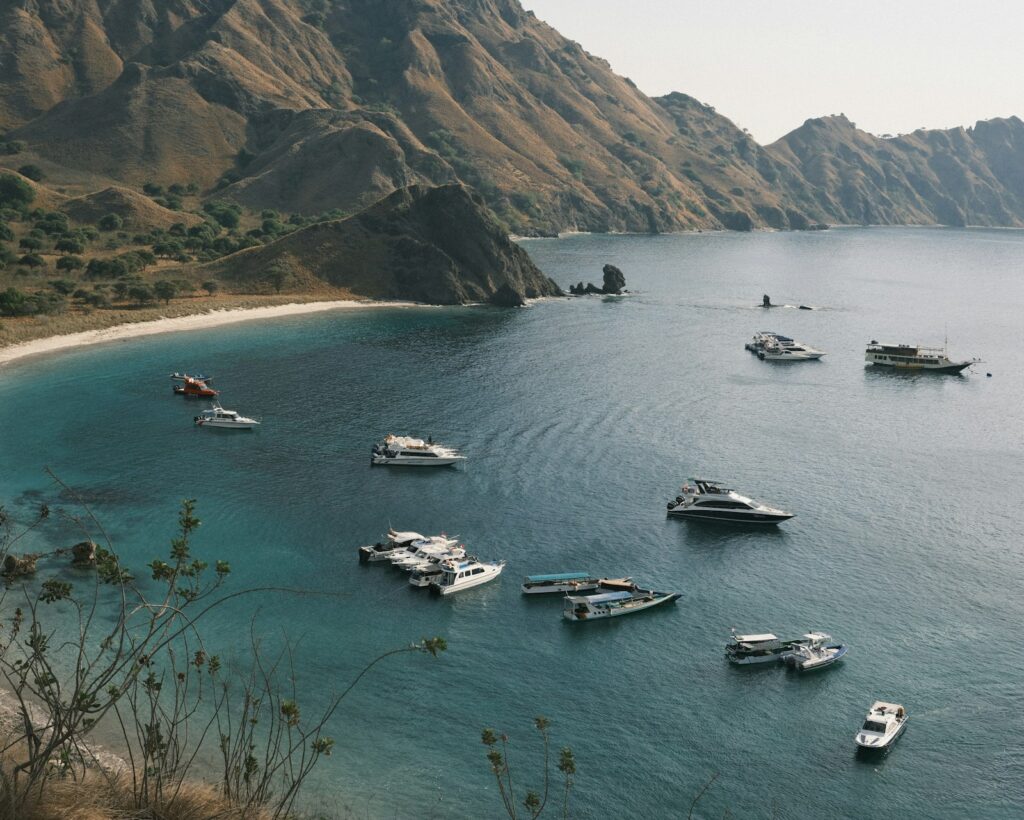
To book a Komodo snorkeling tour, you need more than a payment link. You need to match your swim level to the right spots, carry the right amount of cash for park fees, choose a boat format that gives you actual in-water time, and ask your operator the three safety questions before you board. This page walks through every step in the order it actually matters — so by the time you hit the enquiry form above, you already know what to ask for and why.
I guide snorkelers at Karang Makassar and across the park regularly. Most trip disappointments I see trace to a mismatch: wrong month, wrong boat format, or a shared day trip that spends four hours cruising and forty minutes in the water. The checklist below is how I’d advise a friend planning this trip from scratch.
Step 1: Choose Your Month
Not all months are equal. Visibility, current strength, manta reliability, and sea conditions all shift through the year, and the gap between a good month and a rough one is significant enough to change your experience completely.
April through November is the dry season and the primary snorkeling window. Visibility across central Komodo peaks in May at roughly 20–30 metres (typical reported ranges, last verified June 2026). June through October remains strong — 15–25 metres is realistic — with calmer seas and more predictable departure windows. Water temperature runs 25–27°C through July and August, which is comfortable with a rashguard but worth noting if you run cold.
June, July, and August are peak season. Boats fill early, prices drift to the upper band, and operators occasionally turn away last-minute walk-ins. If you are travelling in this window, plan at minimum three to five days ahead. Budget day trips trend toward Rp 1.5–1.8 million per person during peak weeks.
Manta timing is a separate question from general visibility. Mantas are present year-round at Karang Makassar. Aggregation tends to be strongest roughly November through February when plankton concentrations are high — but that period also brings the west monsoon, rough seas, and occasional KSOP Labuan Bajo port closures on short notice. If manta sightings are your primary goal and you can only travel in the wet season, build buffer days into your trip. For most travellers, April through June is the sweet spot: dry-season sea conditions, still-strong manta presence, and pre-peak prices. See the full month-by-month breakdown.
Step 2: Choose Your Format
There are three formats, and each involves a real trade-off. No single option is universally best.
- Shared speedboat day trip (most common)
- Typically covers Padar viewpoint, Komodo Island dragon trekking, Pink Beach, Taka Makassar sandbar, Karang Makassar (Manta Point), and one reef stop — six or more stops in a single day. Price range: Rp 1.4–1.6 million per person (~USD 85–100) on most established operators; the full market spans roughly USD 60–150 depending on boat quality and group size (last verified June 2026). Park fees are almost always excluded — budget Rp 400,000–550,000 cash on top. The honest limitation: with six stops, snorkeling time at any given site averages 30–60 minutes once you account for cruising, island walks, and lunch. If you are snorkeling-first, a standard six-stop circuit is a compromise.
- Shared slow boat (wooden boat / kapal kayu)
- Slower transit means fewer stops — usually three or four — but more relaxed time at each one. Price: approximately Rp 900,000–1.3 million per person (~USD 55–80). The trade-off is seasickness risk on choppier days and limited shade on some boats. Check whether the boat has a toilet before booking if that matters to your group.
- Private speedboat charter
- You control the itinerary, departure time, and pace. A small charter for two to six passengers typically costs Rp 6–10 million per day; larger or higher-spec boats run Rp 10–18.5 million. Split across four to six people, private works out close to shared-boat pricing per person with the significant advantage of waiting for conditions at your preferred spots. For families with young children or anyone with specific needs — a non-swimmer who needs the guide in the water, a photographer who wants to linger at a cleaning station — private is usually the right call.
Liveaboards are a fourth option for multi-day immersion: two-night shared boats typically run USD 220–350 per person; three-night trips reach USD 350 and above for comfortable phinisi. Liveaboards reach outer sites inaccessible on day trips. They are covered on our sister site — link coming.
Step 3: Shortlist Spots by Your Swim Level
This is where most planning guides go vague and yours should not. Current at Komodo sites is the documented hazard — not sea creatures, not depth. Every spot in the park behaves differently at different tides, and some require a guide in the water regardless of how confident you feel on a pool wall.
Beginner and non-swimmer friendly
Siaba Besar (Turtle City) is the clearest beginner recommendation in the park. The main coral band sits at two to six metres in a protected bay with mild current. Multiple green turtles per snorkel session is the norm. Life vests are fine here — the water is calm enough that you can float and watch without fighting anything. Kanawa Island is similarly forgiving: beach entry, visibility rated good, current described as mild to protected on most conditions. These two should anchor any beginner or family itinerary. Taka Makassar sandbar works at slack tide on the bar itself — half a metre of water at low tide, easy footing, photogenic — but the sandbar edges drop toward the manta channel and the current there is not beginner territory. Full graded hub for all sites.
Intermediate
Karang Makassar (Manta Point) is a drift site. You enter up-current on the guide’s signal, drift as a group over open water, and the boat shadows you and collects at the end. Estimated current of one to three kilometres per hour is typical — the exact figure is inferred from guide experience, not instrumented measurement. Operators sometimes skip entry entirely when tide runs wrong or swell builds; that call is always the right one. If you have never done a drift entry, brief your guide beforehand. Life vests are used by operators for weaker swimmers in water here, though strong swimmers typically go without. Pink Beach sits in a semi-sheltered bay and is manageable for most intermediate swimmers, but currents off the eastern headland are stronger than they look from the boat — stay inside the bay.
Experienced snorkelers only
Mawan offers coral at three to eight metres sloping into a sandy manta flyover, with frequent reef shark and hawksbill encounters — and current consistently rated strong. This site is not for unconfident swimmers and many operators will assess the group before committing to an entry. Kelor Island has a thin reef near the beach, but channels off the headland run harder than the calm-looking surface suggests.
Step 4: Budget the Fee Stack in Cash
Park fees for snorkelers are paid at the park, almost always in cash, and almost always excluded from the tour price. Budget for this separately and carry small denomination rupiah bills — Rp 50,000 and Rp 100,000 notes are easiest. ATMs in Labuan Bajo are available but queues run long during peak season.
| Fee Item | Foreign Visitor | Indonesian Citizen | Confidence |
|---|---|---|---|
| Park entrance (per person per day) | Rp 250,000 | Rp 50,000 (weekday) / Rp 75,000 (Sunday-holiday) | High — multi-source consensus |
| Harbor fee | Rp 25,000 | Rp 25,000 | High |
| Separate snorkeling activity surcharge | None itemized as of June 2026 | None itemized as of June 2026 | Medium — historical fee (PP 12/2014 era) not carried forward in 2026 tables |
| Diving surcharge (snorkelers exempt) | Rp 25,000 | — | High |
| Conservation fee (contested) | Rp 100,000 (reported by some operators) | Rp 10,000 | Low — present in some 2026 sources, absent in others; confirm with operator |
| Ranger/naturalist fee (island landing only) | Rp 200,000 per group up to 5 (Komodo/Rinca) / Rp 150,000 (Padar) | Same | High on amounts; snorkel-only trips with no landing skip this |
Practical cash figure: foreign visitors on a full Padar + dragons + snorkel itinerary should carry Rp 400,000–550,000 in cash for the fee stack including ranger shares. Snorkel-only loops with no island landings can get by on Rp 275,000 minimum (entrance + harbor), rising to Rp 375,000 if the conservation fee is collected. All figures are secondary-source consensus — no verified PP 36/2024 annex text has been independently confirmed. Confirm the current total with your operator at booking.
Park tickets are now handled via the SiORA online reservation system (reportedly mandatory from April 2026 — last verified June 2026, confirm with your operator as this process may still be evolving). Most established operators manage SiORA booking on your behalf. Full fee breakdown with WNI vs foreigner itemization.
Step 5: Pack the Right Gear
Masks and snorkels are included on nearly every day tour. What varies is the quality. Budget boats typically carry scratched masks with aging silicone that leaks on any face that does not happen to fit their standard size, plus worn fin straps that slip. None of this is catastrophic in flat water, but at Karang Makassar where you are dealing with a drift current and cannot stop to clear a leaking mask, fit matters.
My honest recommendation: bring your own mask. A well-fitted mask you have tested is worth more than any in-water briefing. It solves fogging, leaking, and the general distraction of fighting your gear when you should be watching a manta.
Fins are sometimes provided, sometimes not — ask at booking. If you have big feet or small feet, confirm a size is available before arriving at the dock.
Thermal protection: a rashguard and leggings are sufficient for most people in June through October when water runs 25–27°C. A shorty wetsuit (two to three millimetres) is worth considering for long in-water sessions, if you snorkel slowly, or if you plan to include southern park sites where Indian Ocean upwelling pushes temperatures several degrees cooler.
Sunscreen: there is no legal ban on chemical sunscreens in Indonesian waters or Komodo National Park as of June 2026. Reef-safe mineral sunscreen (zinc oxide or titanium dioxide base) is strongly recommended as best practice. Plan to reapply before every entry since saltwater strips product quickly at this latitude.
Families: children’s masks and fins are available on dive-centre-operated boats but not reliably on cheaper day boats. Bring child-size equipment. For children who are not confident swimmers, bring your own correctly fitted child PFD — most day boats carry adult foam vests only, and fit is critical. Full gear list and rental reality check.
Step 6: Confirm These Safety Questions Before Boarding
Ask these three questions before you pay the final balance. An operator who answers evasively or does not know is telling you something.
Will a guide get in the water with the group at current sites?
Guide-in-water is common practice on reputable boats and is particularly important at Karang Makassar for non-strong swimmers. It is not a park-wide enforced standard — it is operator-dependent. Some budget boats send the crew to watch from above while one guide stays on the boat. Know this before you book, not after.
What happens if the current at Manta Point is too strong on the day?
The correct answer is: we skip it, or we wait and reassess, or we find an alternative. Any operator who tells you they always enter regardless of conditions is not an operator I would trust with a group that includes beginners. Skipping a site when conditions are wrong is good seamanship. Ask what the fallback spot is.
Does the boat have children’s life jackets in the right size?
Indonesian law requires flotation for all passengers. Good operators carry life jackets. What varies is whether smaller sizes exist. If you have young children, confirm this in writing or bring your own SOLAS-grade PFD that you know fits.
If you are a non-swimmer or a weak swimmer, also ask directly: which stops on our itinerary do you recommend I sit out of the water or use a vest? A confident operator will give you a specific answer — something like, Siaba Besar is fine with a vest, Karang Makassar we keep you on the boat or very close to the swim ladder unless you are comfortable in open water.
Step 7: Enquire and Book
You have done the hard work. You know your month, your format, which spots match your group, how much cash to carry, what gear to bring, and what to ask the operator. Now you book.
Bookings through this site go via our partner Komodo Luxury, part of the same Juara Holding Group as this planning guide. We disclose that relationship clearly: no one can pay to change what we publish here, and if you use this guide and proceed to book through Komodo Luxury, they may pay us a referral fee at no extra cost to you. The reason we route bookings through them rather than a random aggregator is that their boats run the right itineraries for snorkeling-first guests and their guides are trained to handle the situations described in Step 6.
Use the enquiry form at the top of this page. Include your travel dates, group size, swim level (honest answer — it only helps us), whether you want shared or private, and any specific spots or concerns. A planner will respond, typically within one business day.
You can also reach the team directly on WhatsApp if your schedule is tight or you have a specific question before committing to a date. WhatsApp planning works well for peak-season availability checks and for families with particular requirements.
Peak-season note (June–August): good boats on good itineraries fill three to seven days ahead during this window. Do not wait until you land in Labuan Bajo. Check availability at the same time as you book your flights.
Frequently Asked Questions
How far in advance should I book a Komodo snorkeling tour?
In the shoulder season (April–May, September–November), two to three days ahead is usually enough for shared boats. In peak season (June–August), plan three to seven days ahead minimum — preferred departure slots and smaller private charters sell out first. If your dates are fixed and your budget allows private, book as soon as your flights are confirmed.
Are park fees included in the tour price?
Rarely. The overwhelming majority of Komodo day tours advertise prices that exclude park entrance and harbor fees. Budget Rp 400,000–550,000 per foreign visitor in cash for a full itinerary including island landings and ranger shares. Snorkel-only loops with no island stops can be closer to Rp 275,000–375,000. Ask your operator to itemize at booking — a good operator will tell you exactly what to bring.
Can non-swimmers or very weak swimmers snorkel in Komodo?
Yes, with the right spots and the right operator. Siaba Besar (Turtle City) and Kanawa Island are both feasible with a properly fitted life vest in calm conditions, and reputable operators will keep a guide nearby. Non-swimmers should book private or small-group tours where the crew-to-guest ratio is high enough to give individual attention. Karang Makassar (Manta Point) is a drift site with open-water current — most operators keep non-swimmers on the boat there, which is the correct call. Full guide to snorkeling in Komodo for non-swimmers.
What is the best single spot to prioritize if I only have one day?
That depends on what you want most. For marine diversity and beginner accessibility: Siaba Besar for turtles, then Kanawa for coral. For the signature Komodo experience and you are a confident swimmer: Karang Makassar (Manta Point) — understanding that mantas cannot be guaranteed on any given day. A private half-day focused on Karang Makassar and Siaba Besar gives you both without the rushed feeling of a six-stop circuit. A shared full-day covers more geography but less depth at any single site.
Do I need any certification or licence to snorkel in Komodo?
No licence or certification is required to snorkel. Anyone can join a licensed snorkeling tour regardless of swimming background. Scuba diving requires an Open Water certification at minimum; advanced dive sites in the park (Castle Rock, Crystal Rock, Batu Bolong) typically require Advanced Open Water plus logged dives. If your group is mixed — some divers, some snorkelers — confirm the boat itinerary visits spots where snorkelers have something worthwhile to see, not just dive-priority sites where the surface view is open water and bubbles.