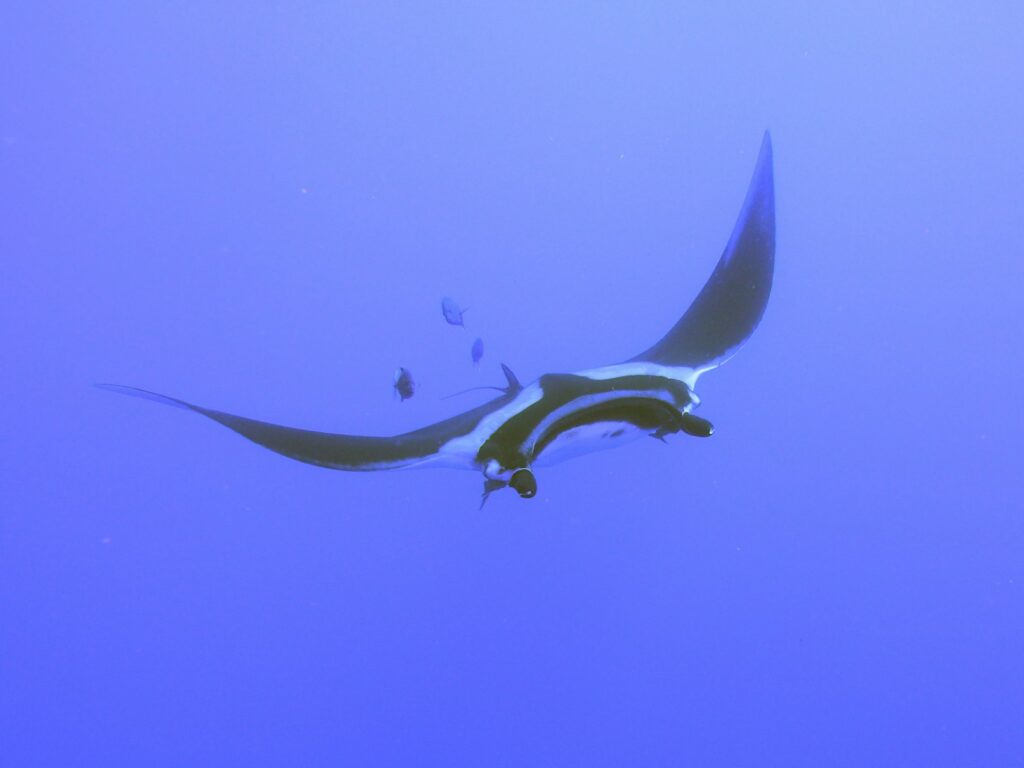
Is Manta Point safe for snorkelers? Yes — for swimmers who can handle open water and will follow a guide’s instructions, Karang Makassar is manageable. No — it is not safe for non-swimmers entering without a life jacket and an in-water guide, and it is not a beginner’s drift on a strong-current day. Everything below unpacks what the currents actually do, how a properly run drift works, what responsible operators do when conditions turn, and how to decide whether you personally should get in the water on the day you arrive.
What Kind of Site Is Karang Makassar?
Karang Makassar is a long rubble-and-sand plateau sitting roughly five to fifteen metres below the surface in central Komodo National Park. It is not a shallow, sheltered coral garden you wade into from a beach. Snorkelers float over open water — often with a visible drop-off at the edges — watching manta rays that feed in the top zero-to-five metres and sometimes break the surface on calm mornings.
The site is a drift snorkel by design. You do not anchor and hover. The current carries you along the plateau while mantas circle the cleaning stations below and pass through the water column above them. On a calm, slack-tide morning this feels effortless — you cover ground without a fin stroke and the mantas move through your field of view at their own pace. On a running tide it feels nothing like that.
Currents here are widely documented as strong and tide-dependent. No independently measured speed data exists for this site, but the consistent field description from guides, liveaboard operators, and trip accounts points to currents that can move a snorkeler off the plateau quickly, create unpredictable upwellings, and make swimming against the flow not just exhausting but effectively impossible. The estimate typically cited is a typical drift somewhere in the range of one to three kilometres per hour — that figure is inferred, not measured, so treat it as an order of magnitude rather than a precise speed. What it means practically: if you find yourself fighting the current, you will not win.
The Drift Protocol — What a Good Operator Actually Does
A well-run entry at Manta Point follows a specific sequence. Understanding it tells you more about the site’s risk profile than any single number.
Before Anyone Enters the Water
The guide reads the current from the boat — watching surface chop, any visible drift on the plateau, and the position of any mantas already circling. If conditions are acceptable, the boat positions itself up-current from the plateau. Snorkelers are briefed on the signal for entry, the direction they will drift, and the two rules that matter most: stay in a tight group, and never try to swim back against the current.
The Entry Signal
No one enters until the guide gives the go. This is not a formality. Timing the entry up-current means the group drifts across the best part of the plateau rather than washing off the edge before seeing anything. A guide who does not control the entry timing is a guide who is not running the site properly.
In the Water
The group drifts together as a unit. The guide stays in the water with the group — on reputable boats this is standard practice, though it is not a park-wide enforced rule. Weak swimmers and non-swimmers who do enter wear life jackets; the jacket keeps them horizontal and visible rather than fighting to stay afloat. No one splits off to chase a manta. No one ducks down into the manta’s path. The current takes the group; the group does not take the current.
The Boat Shadows Down-Current
The boat moves parallel to the group and stays down-current throughout. When the drift ends — either because the group has covered the plateau or because the guide ends the session — the boat comes alongside and everyone boards. If anyone is separated: float, stay calm, raise one arm high. The protocol for separation is not to swim harder. It is to be visible.
When Operators Refuse Entry — and Why That Is the Right Call
Operators sometimes skip Manta Point entirely, or reach the site and decide not to put anyone in the water. This happens when the current is running too strongly, when swell is too significant, or when the combination of both makes the drift unpredictable. Some guests find this frustrating. It should not be.
A crew that refuses entry when conditions are borderline is demonstrating exactly the judgment that separates a responsible operator from one that will put you in the water regardless of what the sea is doing. Currents are the documented hazard at Manta Point. There are no published consolidated incident statistics for the site — no public database that would let anyone give you a reliable incident rate — but snorkeler drift-offs and drownings linked to currents have occurred in Komodo National Park. The absence of a published number does not mean the hazard is theoretical.
If your operator skips Manta Point or pauses the entry while reassessing conditions, that is not a failure. It is the mark of a crew worth trusting for the rest of the trip.
Who Should Get In the Water — and Who Should Think Twice
Here is a practical breakdown based on swimmer type, not on optimism about what might happen on a calm day.
| Swimmer Type | Can Snorkel Manta Point? | Conditions Required |
|---|---|---|
| Confident adult swimmer, comfortable in open water | Yes | Guided group, mild-to-moderate current, guide in water |
| Intermediate swimmer — can swim but not strong in current | Yes, with caution | Life jacket recommended, stay close to guide, no entry if current is strong on the day |
| Weak swimmer or non-swimmer | Only with life jacket AND guide in water | Slack tide or very mild current; operator must confirm guide-in-water policy before booking |
| Non-swimmer, no life jacket | No | Stay on deck; mantas are sometimes visible from the boat |
| Children under approximately 8 years old | Not recommended at this site | Current-prone sites like Manta Point are restricted for young children by most operators — ask specifically before booking |
Indonesian maritime law requires life jackets for all boat passengers. Day boats provide flotation, but quality varies — budget boats commonly carry basic foam vests rather than SOLAS-grade personal flotation devices. If you are traveling with a child, bring a properly fitted child PFD from home; children’s sizes are unreliable on budget boats. This matters more at a drift site than anywhere else on the standard itinerary.
What About Seeing Mantas Without Getting In?
This is worth being direct about. Mantas feed in the top zero-to-five metres of the water column at Karang Makassar, and on calm mornings they sometimes break the surface altogether. When the boat is stationary over the plateau and the water is clear, you can see them from the deck. It is not the same as being in the water — perspective, proximity, and the absence of glass between you and the animal are all different — but it is a genuine sighting. If conditions push an operator to refuse entry, or if you decide the water is not for you on that day, watching from the boat is a real option, not a consolation prize.
Divers who go to depth can get closer to the cleaning stations at eight to fifteen metres, and Manta Alley in the park’s southern sector adds another deep encounter site. But snorkelers at the surface genuinely see mantas at Karang Makassar. No certification is needed. The question is only about current management, not about whether the surface position works at all.
Manta Etiquette in the Water
Manta rays have been a fully protected species in Indonesian waters since KEPMEN-KP No. 4/2014 made all Indonesian seas a manta sanctuary — roughly six million square kilometres, the largest such protection in the world. Harassment and capture are enforceable under Indonesian fisheries law. The following conduct standards are Manta Trust best practice; they are not all codified in Indonesian law, but they are the standard good operators enforce on their boats:
- Keep at least three to four metres from the manta’s body and four to five metres from the tail.
- Approach from the side — never head-on or from behind.
- Stay flat at the surface; minimise fin movement; let the manta choose to approach you, not the other way around.
- No touching. The mucus layer that protects the manta’s skin does not grow back quickly. One touch removes it.
- No chasing, no riding, no duck-diving into the manta’s path, no hovering directly above a cleaning station that blocks the manta’s access.
- No flash photography. No selfie stick extended toward the animal.
On a well-run boat, the guide will repeat most of these before entry. If your briefing skips them, ask. A group that spooks the mantas away affects every snorkeler behind them for the rest of that morning.
Boat protocol matters too. Engines should be in neutral or off when snorkelers are in the water, and boats hold well clear of visible mantas — typically ten to thirty metres, though this is operator standard operating procedure rather than a published legal distance. If your boat’s captain is gunning the engine while the group is in the water, that is a sign worth noting about the rest of the trip.
Manta Sightings — Seasonality and Honesty
Mantas are present at Karang Makassar year-round. Sightings are more reliable during the plankton-rich season from roughly November to February, when feeding aggregations are strongest. That said, they are genuinely encountered in every month including the peak dry-season months of June, July, and August. No encounter-rate percentage is published for any season — anyone claiming a specific percentage is making it up. What can be said honestly: June through August is peak tourist season, mantas are still seen with reasonable frequency, and the drier, calmer seas of this period generally make the drift protocol more manageable for intermediate swimmers than the rougher west-monsoon months of December through February.
If a manta sighting matters deeply to you and you want to maximise the chance, the November-to-February window has the strongest historical association with plankton blooms and feeding aggregations. But plan extra buffer days in December and January — the west monsoon brings storms, rough seas, and KSOP Labuan Bajo harbor closures that can cancel departures at short notice. No public statistics exist on how often closures happen, but experienced operators advise a two-day buffer for travel in and out of Labuan Bajo in those months.
Ready to plan a snorkeling trip that actually puts you in the water at the right site for your skill level? Plan your trip with our concierge — no cost, no obligation, and our partner Komodo Luxury can handle logistics while you focus on the part that matters. If you use our help and book through a partner, they may pay us a referral fee at no extra cost to you; no one can pay to change what we publish.
What to Ask Your Operator Before You Book
Manta Point current conditions change tide by tide. A booking made two weeks in advance cannot guarantee what the sea will do on the morning you arrive. What you can establish in advance is whether your operator has the judgment and protocols to manage it well. Ask these questions directly:
- Does a guide enter the water with the snorkeling group at Manta Point?
- Reputable operators with trained guides do this. If the answer is vague or no, ask why before committing.
- What happens if current is too strong to snorkel on the day?
- A good answer is: we skip entry, observe from the boat, and adjust the itinerary. An evasive answer is a warning sign.
- Are life jackets provided, and what type?
- Basic foam vests are standard on budget boats. SOLAS-grade or hybrid inflatables are not. If you are a weak swimmer, confirm the vest type and whether the guide will be in the water alongside you.
- What are your guides’ minimum qualifications?
- Dive-centre-run snorkel boats sometimes staff guides with rescue diver certification — a meaningful baseline. Ask what yours has.
- Do you carry oxygen and a first-aid kit on board?
- This should be a yes. If it is not, reconsider the operator.
Manta Point in the Context of the Full Snorkel Circuit
The standard day-trip from Labuan Bajo typically visits Manta Point as one stop among several — Padar Island, Pink Beach, a Komodo dragon viewing, Taka Makassar sandbar, and either Kanawa or a similar site. Karang Makassar is the most demanding water stop on that circuit. Taka Makassar is beginner-easy on the bar itself at slack tide, though its edges drift toward the manta channel on a running tide. Kanawa has a protected house reef rated mild-to-moderate and is genuinely comfortable for most swimmers. Siaba Besar, sometimes called Turtle City, is a shallow protected reef at two to six metres with mild current — the top choice in the park for families and first-time snorkelers.
Knowing the current grade of each stop helps you pace expectations for the day. Manta Point earns its intermediate-plus rating not because the site is inherently hostile but because the drift dynamic requires confidence in the water and compliance with the group protocol. Arrive with those two things and the conditions cooperate, and it is one of the more extraordinary hour-long experiences available to any snorkeler, anywhere.
Thinking through which stops suit your group? Our planning form lets you tell us your swimming level and what matters most — whether that is manta odds, calm water for kids, or maximum time actually in the ocean rather than on deck — and we can steer you toward the right itinerary and operator via WhatsApp.
Frequently Asked Questions
Is Manta Point safe for non-swimmers?
Not without a life jacket and an in-water guide. Non-swimmers on reputable boats typically wear a life jacket and are accompanied in the water, which makes a brief, supervised drift feasible — but operators sometimes refuse entry entirely when current runs strong. If you cannot swim at all, confirm the operator’s in-water guide policy before booking, and accept that on some days you will watch from the deck rather than enter the water. Mantas are sometimes visible from the boat on calm days, so staying on deck is not always an empty option.
What happens if the current is too strong to snorkel at Manta Point?
A responsible operator skips the water entry and either observes mantas from the boat, adjusts to a calmer stop, or both. Currents at Karang Makassar are tide-dependent and can change between a morning and afternoon trip — conditions that looked manageable at the dock may look different by the time the boat arrives at the site. The operator’s willingness to make that call on the day, rather than push snorkelers in regardless, is one of the most reliable indicators of a well-run boat.
Can children snorkel at Manta Point?
Most operators set an informal minimum of around eight to ten years old for current-prone sites like Manta Point, and some refuse entry for younger children regardless of parental consent. There is no park-wide regulation setting a minimum age, so policies differ by operator — ask explicitly when booking. For younger children and families, Siaba Besar (shallow, protected, turtles) and Kanawa (mild current, good visibility) are the standard recommendations within the same day-trip circuit. Bring a properly fitted child PFD from home; children’s sizes are not reliably stocked on budget day boats.
Do you need to be a diver to see manta rays in Komodo?
No. Manta rays feed in the top zero-to-five metres of the water column at Karang Makassar, and snorkelers at the surface genuinely encounter them. No dive certification is required — only a willingness to follow the drift protocol and stay with your group. What divers get that snorkelers do not is close access to the cleaning stations at eight to fifteen metres depth, and encounters at deeper southern sites like Manta Alley. But the surface view at Karang Makassar is a real encounter, not a distant glimpse.
How should I behave if a manta ray approaches me while snorkeling?
Stay still. Let the manta control the interaction. Keep your fins calm and your body horizontal at the surface. Maintain at least three metres from the body and four metres from the tail. Do not reach out, do not dive toward it, and do not block its path. Indonesia protects manta rays under national law (KEPMEN-KP No. 4/2014), making harassment and capture illegal across all Indonesian waters. Beyond the law, mantas that are repeatedly chased or touched at popular sites stop returning to those sites — the etiquette protects future encounters for every snorkeler who comes after you.