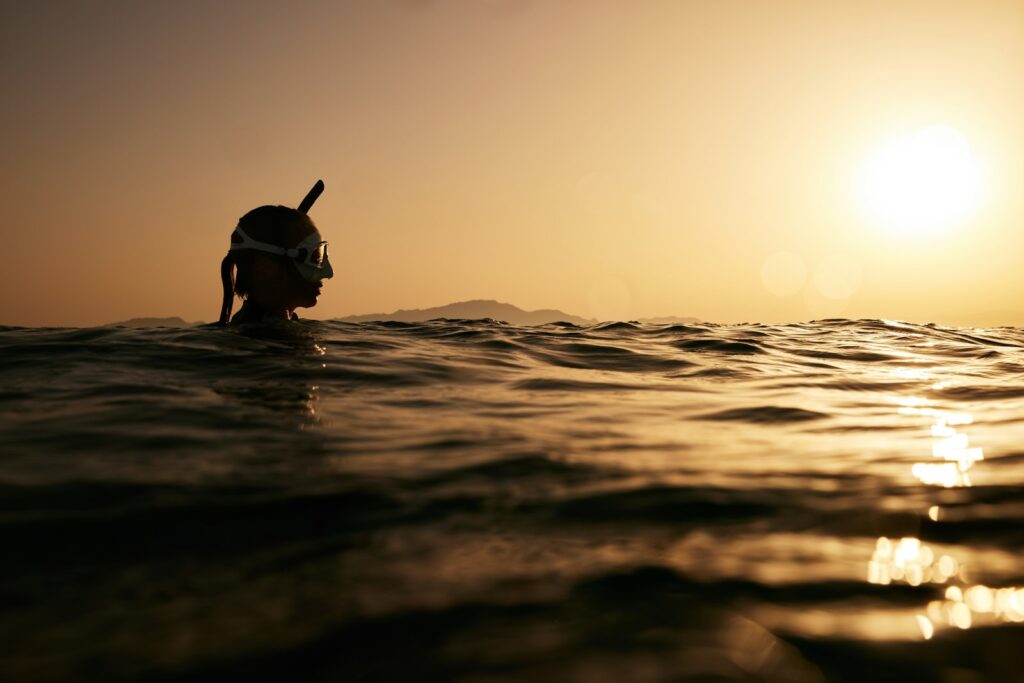
Komodo snorkeling for non-swimmers is genuinely possible, and I want to be direct about that from the start. You do not need to be able to swim to float over a green turtle at Siaba Besar, watch a manta ray glide beneath you at Karang Makassar on a calm morning, or drift through the shallows at Taka Makassar sandbar at slack tide. What you do need is a life jacket that fits, a crew that puts a guide in the water with you, and an operator honest enough to tell you when a site is not appropriate for non-swimmers that day — and then actually skip it.
That last part is the hinge. The difference between a safe, memorable day and a frightening one almost always comes down to the operator’s judgment, not the park’s rules. So this guide exists to help you ask the right questions before you board.
What Non-Swimmers Can Realistically Expect
A life jacket changes everything in terms of safety, but it also changes your experience in ways worth understanding before you go. With a vest on, you float face-down easily. You will see what is beneath you. At Siaba Besar — often called Turtle City — the main reef band sits at roughly two to six metres. Green turtles graze close to the surface, often within a metre or two of your mask. A non-swimmer with a life jacket at Siaba Besar will have a genuine, unhurried encounter. At Kanawa, beach entry leads you over a house reef starting at one to two metres, deepening to five or eight metres offshore; the current there is typically mild. These are real sites with real marine life — not consolation prizes.
At Karang Makassar (Manta Point), mantas feed in the top zero to five metres, and on mornings when they are actively working the plankton, you watch them from directly above — a life jacket does not impair that view at all. What it does affect is your ability to duck-dive to follow one down, and your lateral mobility against any current. The drift entry protocol at Manta Point requires more from you than passive floating, which is exactly why the section below on when to stay on the boat matters.
The Three Spots That Work Best for Non-Swimmers and Weak Swimmers
Siaba Besar — the first-choice site
Shallow protected hard-coral reef, current rated mild to protected, consistent turtle density. This is the site I recommend most confidently for anyone with limited swimming ability. The entry is straightforward, the water is calm on most days, and the payoff — multiple green turtles in a single session — is as reliable as anything gets in this park. If you visit only one site all day without getting in the water anywhere else, Siaba Besar is the one to save your energy for.
Kanawa Island — protected bay entry
Beach entry from a sheltered bay, coral reef from one or two metres deepening gradually, visibility typically good. The current is mild and the entry gentle. Non-swimmers with life jackets are well-served here; I have seen families spend the better part of an hour in this water and come up happy. It is not the most dramatic site in the park, but dramatic is not what a non-swimmer needs on their first time in this water.
Taka Makassar sandbar — at slack tide only
This one comes with a clear condition. The sandbar itself sits at half a metre to two metres at low tide; standing depth in places, knee-deep in others. On the bar, at slack water, even a non-swimmer can stand and look down at the reef edge. The problem is the edges: as the tide runs, the water moving past Taka Makassar pushes toward the manta channel and the current picks up fast. A good operator watches the tide table, times the visit to coincide with slack, and keeps non-swimmers away from the drop-off edges. If your operator arrives mid-tide without discussing this, ask before you enter.
The Site You Should Not Enter if You Cannot Swim: Karang Makassar
I want to be honest here rather than vague. Karang Makassar — the site most people call Manta Point — is a drift snorkel. You enter up-current on the guide’s signal, you drift as a group, and the boat collects you at the far end. Estimated drift currents run roughly one to three kilometres per hour, though no one has instrumented this precisely; what I can tell you from experience is that on strong days, you work to stay with the group even as a confident swimmer.
Non-swimmers can enter Karang Makassar in calm conditions with a guide in the water beside them. Some do, and some have genuinely good encounters. But two things have to be true: conditions have to be mild enough that the drift is gentle, and you have to be honest with yourself about anxiety in open water. Being swept off from the group at a current-prone pelagic site is the documented hazard in this park. If your crew reads the conditions and decides non-swimmers should stay on the boat that day, that is a correct decision, not a failure of your trip. From the boat deck at Manta Point you can often see the mantas from above — they come close to the surface. That view costs you nothing and risks you nothing.
Skipping the water entry at Manta Point is not a consolation. It is sensible. Any operator who tells you otherwise is prioritising your momentary disappointment over your safety.
Life Jackets: Law, Reality, and What to Bring
Indonesian maritime law requires life jackets for all passengers on day boats. That is the legal baseline. The gap between the law and what you actually find on budget boats is worth understanding.
- What the law requires
- Flotation for every passenger; vessels operating in park waters are subject to KSOP Labuan Bajo harbour authority oversight and have faced tightened manifest and safety-gear enforcement after broader Indonesian maritime incidents.
- What budget boats commonly provide
- Basic foam vests — sometimes sun-damaged, occasionally ill-fitting. These vest provide positive buoyancy and will keep you afloat. They are not SOLAS-grade offshore life jackets, but they do what matters: they float you.
- What reputable operators provide
- Better-quality vests, and crew who actively fit them on non-swimmers and weak swimmers rather than leaving them in a pile at the bow.
- Children’s vests
- Unreliable on budget boats. A child’s vest needs to fit snugly — an adult vest on a six-year-old is worse than no vest in terms of position in the water. Bring your own child PFD if you are travelling with young children. This is the single piece of gear I recommend bringing from home above all others.
Ask your operator directly: Do you have foam vests or SOLAS-grade jackets? Will a guide enter the water with non-swimmers? Who decides whether non-swimmers enter at each site? If the answers are vague, that tells you something about how the day will be managed.
Guide-in-Water: Operator Standard, Not Park Law
This is the point most operators do not advertise clearly. There is no park-wide, legally enforced requirement that a guide must enter the water with non-swimming guests. What exists is a widespread operator practice on reputable boats — crew get in the water, position themselves near less-confident snorkelers, and stay close. On quality boats it functions as a reliable safety layer. On the cheapest open-trip boats, it may not happen at all, or the “guide in the water” may be one crew member spread across twenty guests.
Before you book, ask this exact question: Will someone from the crew be in the water with me at each snorkeling stop? A good operator answers this without hesitation. If you get an evasive response, or “yes, someone will be nearby,” that is worth pressing on.
Do I Have to Get in the Water?
No. This question comes up more often than you might expect, and the answer is straightforward: you are never obligated to enter the water on a Komodo boat tour. Some guests watch from the boat at every stop and still have a full day — Padar’s ridge view, the dragon encounter at Komodo or Rinca, the pink sand at Pink Beach — none of those require you in the water. Other guests enter at the gentle sites and stay on the boat at the current-exposed ones. You set the terms of your own comfort level.
What matters is choosing an operator who will not pressure you in. A crew that makes you feel obligated to enter when you are uncertain is a crew prioritising headcount over individual safety. Good operators brief non-swimmers before each entry on what to expect, give a clear opt-out, and mean it.
Park Fees for Snorkelers (Last Verified June 2026)
The fee structure changed under PP 36/2024, which replaced the older PP 12/2014 tariffs. The figures below are drawn from multiple operator and booking sources as of June 2026; the official regulation annex text has not been independently verified, so treat these as reliable working numbers and confirm with your operator before travel.
| Fee Item | Foreigner | Indonesian (WNI) | Notes |
|---|---|---|---|
| Park entrance (per person, per day) | Rp 250,000 | Rp 50,000 weekday / Rp 75,000 holiday | Applies whether snorkeling, trekking, or diving. High-confidence multi-source figure. |
| Snorkeling activity surcharge | None itemized | None itemized | The old Rp 15,000 snorkel fee (PP 12/2014 era) does not appear in any 2026 fee table. Confirm with operator — may be bundled. |
| Diving surcharge | Rp 25,000/day | Rp 25,000/day | Snorkelers are exempt — this is one concrete financial advantage of snorkeling over diving at the park-fee level. |
| Harbor fee (PNBP) | Rp 25,000/person | Rp 25,000/person | High confidence. |
| Conservation fee | Rp 100,000 | Rp 10,000 | Reported by some 2026 sources, absent from others. Contested — flag as unconfirmed. |
| Ranger/naturalist fee (island landings) | Rp 200,000/group up to 5 (Komodo or Rinca); Rp 150,000/group up to 5 (Padar) | Same as foreigner | Only applies if your itinerary includes island landings. Snorkel-only tours with no landing may skip these. |
The practical total for a foreign snorkeler on a full-day trip (entry, harbor, and ranger share for one island landing) sits between Rp 275,000 at the minimum and Rp 375,000 or more if the conservation fee applies. Operators commonly advise bringing Rp 400,000 to Rp 550,000 cash for a full Padar-plus-dragons-plus-snorkel itinerary that includes ranger fees shared across the group. Most day-tour operators handle the booking and payment through the SiORA online reservation system (reported as mandatory for pre-booking since April 2026 — last verified June 2026, confirm with operator); the cash is your share of what the crew pays at the gate.
Snorkel Gear: What You Will Find and What to Bring
Mask and snorkel are included free on nearly all day tours. Fins are sometimes included, sometimes not. The quality range is wide.
Budget shared-speedboat tours typically provide scratched masks with tired straps, mismatched fins in a random pile, and no wetsuit options. The masks work in flat water. In current, a mask that does not seal wastes your entire entry on clearing water out. If you have ever snorkeled before and had a leaky mask, you already know how much this affects enjoyment. The single most useful item to bring from home is your own mask — a properly fitted, de-fogged mask changes the experience more than anything else. Bring the snorkel from the same set; bite-fit matters too.
For water temperature: the main park sites run 27–29°C from April through June, dropping to 25–26°C in July and August when the southern Indian Ocean upwelling pushes colder water in. A rashguard and leggings are sufficient for most people in the warm months. If you are visiting in July–September, especially at southern park sites, a 2–3mm shorty wetsuit is worth it for sessions longer than forty-five minutes. Some established Labuan Bajo dive shops stock common prescription mask diopters — budget day boats do not, so bring your own corrective mask if you need one.
Reef-safe mineral sunscreen is strongly recommended. There is no legal ban on oxybenzone or octinoxate in Indonesian waters as of June 2026 — it is not the law here the way it is in Hawaii or Palau — but the reef at Siaba Besar and Kanawa is what makes these sites worth visiting. Mineral sunscreen is the better practice.
Real Prices for Snorkeling Day Trips (Last Verified June 2026)
Pricing in Labuan Bajo is volatile by season and highly dependent on group size and boat type. These are honest working ranges, not fixed tariffs.
| Boat Type | Typical Price Range (per person) | Park Fees | Realistic Group Size |
|---|---|---|---|
| Shared speedboat, full day (Padar + Komodo + Pink Beach + Manta Point + Taka Makassar) | Rp 1,400,000–1,600,000 (~USD 85–100); budget seats as low as USD 60, premium USD 120–150 | Almost always excluded — bring Rp 400,000–550,000 cash | Up to 22 pax on larger boats; 8–15 more common |
| Shared slow/wooden boat, full day | Rp 900,000–1,300,000 (~USD 55–80) | Excluded | 10–20 pax; fewer stops, longer transit time between sites |
| Private speedboat charter (2–6 pax) | Rp 6,000,000–10,000,000/boat/day | Excluded, paid per person | 2–6 pax; you set the itinerary and in-water time |
| Private premium/larger charter | Rp 10,000,000–18,500,000/boat/day | Excluded | Up to 10–12 pax; most relevant for families or groups |
July and August are peak season. Cheap shared-trip seats sell out early, and remaining prices drift toward the upper end of each range — expect Rp 1,500,000–1,800,000 for shared speedboat slots when available. Typical inclusions: hotel pickup, lunch, drinking water, and mask-plus-snorkel (fins not always guaranteed). Excluded almost universally: park and ranger fees, towels, tips, and travel insurance.
For non-swimmers travelling with family, a private charter is worth the cost difference. On a shared boat with eighteen guests, the crew’s attention is distributed. On a private charter with five of you, the guide who enters the water is effectively your personal safety layer at each stop. The math changes when you split the boat cost across a family group.
If you want to compare options and plan your itinerary around your group’s swimming confidence, use our planning form or reach out via WhatsApp — our partner Komodo Luxury, a Juara Holding Group operator, can advise on which tours suit your group. If you use their service, they may pay us a referral fee at no extra cost to you; no one can pay to change what we publish here.
Manta Etiquette: What Non-Swimmers Need to Know
Under KEPMEN-KP No. 4/2014, all Indonesian waters are a manta sanctuary — approximately six million square kilometres, the world’s largest. Harassment and capture are enforceable under Indonesian fisheries law. The practical code of conduct in the water is based on Manta Trust guidelines:
- Keep three to four metres from the manta’s body, four to five metres from the tail. This is best practice from Manta Trust; it is not codified in Indonesian law, but it is how responsible operators brief their guests.
- Approach from the side. Never position yourself directly in front of or directly behind the animal.
- Lie flat at the surface. Minimal fin movement. Let the manta set the course.
- No touching under any circumstances — mantas have a mucus layer that protects them from infection; one hand contact can damage it.
- No chasing, no duck-diving into its path, never position yourself hovering over a cleaning station (mantas at cleaning stations at eight to fifteen metres are mainly accessible to divers, but the principle holds in shallow encounters too).
- No flash photography. No selfie sticks extended toward the animal.
- Boats should approach at no-wake speed in aggregation zones, with engines neutral or off when swimmers are in the water, holding roughly ten to thirty metres from visible mantas. This is operator SOP, not a published legal distance.
For a non-swimmer in a life jacket, the most important rule is also the easiest one: stay still. A manta ray that is feeding in the surface plankton layer is not alarmed by a calm, floating person. It is alarmed by splashing, sudden movements, and people trying to close the gap. The guests I have seen get the longest, closest manta encounters are almost always the ones doing the least.
Questions to Ask Before You Book
Print these or screenshot them. A good operator will answer all of them directly and without irritation.
- What life jacket type do you provide — basic foam or SOLAS-grade? Either will float you, but the answer tells you about the boat’s overall safety standards.
- Will a guide enter the water with non-swimmers at every snorkeling stop? Ask what ratio — one guide in the water for twenty guests is not the same as one guide staying close to your group.
- What is your policy when current at Manta Point is too strong for non-swimmers? If the answer is “we always let everyone in,” that is the wrong answer.
- Which stops on today’s itinerary are suitable for a non-swimmer? Any operator worth your money will tell you this honestly, including which ones to watch from the boat.
- Does the boat have a ladder for re-entry from the water? A non-swimmer who is tired and disoriented in a life jacket needs a ladder, not a rope off the stern.
- What is the maximum number of guests on the boat? Fourteen guests with two crew in the water gives you a very different safety ratio than twenty-two guests with one.
Honest Spot Grades by Skill Level
| Site | Current | Non-Swimmer (with life jacket) | Weak Swimmer | Notes |
|---|---|---|---|---|
| Siaba Besar | Mild–protected | Recommended | Recommended | Top choice. Shallow reef, turtles, gentle conditions. |
| Kanawa Island | Mild–protected | Recommended | Recommended | Beach entry, gradual depth. Good visibility. |
| Taka Makassar (bar, slack tide) | Minimal at slack | Suitable at slack tide only | Suitable at slack tide only | Avoid edges and running-tide entry. Time with operator. |
| Pink Beach | Variable — semi-sheltered bay, micro-location dependent | Conditional — ask crew about current that day | Conditional | Entry point matters. Variable reef condition. Some anchoring damage. |
| Karang Makassar (Manta Point) | Strong drift, tide-dependent | Conditional — calm days with guide in water only; boat deck is a real option | Conditional | Drift protocol; operator should assess conditions before entry. Never guaranteed entry. |
| Mawan | Strong | Not recommended | Experienced guides only | Strong current, not on standard non-swimmer itineraries. |
| Kelor Island | Variable — stronger off headlands | Conditional — calm lee-side only | Conditional | Better known for hike. Snorkeling dependent on positioning. |
A Note on Manta Sightings — and Honest Expectations
No operator can guarantee a manta ray encounter. Any that claims otherwise is lying, and that lie should make you question their other claims. What the evidence supports: mantas are present at Karang Makassar year-round, with aggregation and feeding activity running strongest in the plankton-rich months of roughly November through February. They are regularly seen on calm mornings during the June–August dry season as well. The cleaning stations at eight to fifteen metres depth are more reliably accessed by divers; surface snorkeling at Karang Makassar catches mantas when they feed in the top zero to five metres, which is a real and regular occurrence, not a rare one.
The honest framing is this: if you visit Karang Makassar on a calm morning during dry season with a crew that times the tide properly, the odds are good. You can improve those odds by spending more time at the site and less time rushing between the six standard stops on a high-turnover shared day trip. That is an argument for choosing an itinerary that prioritises water time over photo stops — something worth discussing with any operator before you book.
Ready to think through the options for your group? Plan your trip with our free concierge service, or reach out on WhatsApp — tell us your group’s swimming confidence, travel dates, and whether you want to prioritise mantas, turtles, or gentle reef snorkeling. We will match you with the right itinerary and operator for your group.
Frequently Asked Questions
Can a complete non-swimmer join a Komodo snorkeling tour?
Yes. With a life jacket and a guide in the water, a non-swimmer can safely snorkel at Siaba Besar (turtles), Kanawa Island, and Taka Makassar sandbar at slack tide. The open question is not whether you can join the tour — you can — it is whether the specific operator has a guide who will enter the water with you and the judgment to keep you off sites with strong drift current. Ask those questions before you book.
Will I be forced to get in the water at Manta Point if I am not confident?
A good operator will never pressure you into the water. At Karang Makassar specifically, the crew should read the current and conditions at the site and brief the group on whether non-swimmers should enter. On strong-current days, the correct answer is for non-swimmers to remain on the boat — and you can still see mantas from the deck when they surface. If your crew pressures you to enter when you are uncomfortable, that is worth noting and pushing back on.
What park fees do snorkelers pay compared to divers?
As of June 2026, foreign snorkelers pay the standard park entrance fee of Rp 250,000 per person per day plus a Rp 25,000 harbor fee — no separate snorkeling activity surcharge is itemized in current 2026 fee tables. Divers pay an additional Rp 25,000 diving surcharge per day. If your itinerary includes island landings (Komodo, Rinca, Padar), ranger fees apply per group regardless of whether you snorkel or dive. Bring Rp 400,000–550,000 cash for a full itinerary. These figures are last verified June 2026; confirm with your operator as fees have changed recently and may change again.
Do I need to bring my own snorkel gear for a Komodo day trip?
Mask and snorkel are included on nearly all day tours. The quality is variable — budget boats often have worn, scratched masks that leak in current. The most useful item to bring from home is your own mask. For children, bring a child-size PFD (personal flotation device) if using a budget boat, as their provided vests may not fit properly. Prescription masks are available at some Labuan Bajo dive shops but are not carried on day boats.
What is the best Komodo snorkeling site for a complete beginner or someone afraid of deep water?
Siaba Besar, without hesitation. The reef starts shallow, current is consistently mild, green turtles are the norm rather than the exception, and the entry and exit are manageable for anyone in a life jacket. Kanawa Island is the second choice — calm beach entry, gentle reef, good visibility. Both of these sites give you genuine marine life encounters without the drift dynamics that make Karang Makassar unsuitable as a first experience for non-swimmers.