Independent guide: Komodo Snorkeling Tour is an editorial planning guide — not a tour operator and not the official Komodo National Park website. Prices and park fees change with season and regulation, and marine-life sightings are never guaranteed; confirm the current total with your operator before paying. Operators cannot pay to change what we publish. Komodo Snorkeling Tour and operator Komodo Luxury are sister brands within Juara Holding Group — relationship disclosed in full here; bookings through Komodo Luxury may carry referral value to the group at no extra cost to you.
Komodo snorkeling currents are a defining feature of the park, not a footnote — the same upwellings that sweep cold, nutrient-dense water through the straits are precisely what pull manta rays, reef sharks, turtles, and dense schools of fish to these reefs. Strong current is the reason Komodo’s underwater world is exceptional. It is also the reason that snorkeling here demands more honest preparation than most tropical destinations. This guide grades each main site by current strength and skill level, explains what happens when a drift goes wrong, and gives you the questions to ask before you board any boat.
Why Komodo’s Currents Are So Strong — and Why That Matters
Komodo National Park sits between the Flores Sea to the north and the Savu Sea to the south, with the Indian Ocean pushing through from the west. Tidal exchanges funnel through narrow channels between Komodo, Rinca, and the surrounding islands, accelerating flow the way a river quickens through a gorge. Speed varies dramatically with tidal phase — a site that is calm at slack water can become a fast drift within thirty minutes of a tidal shift. No public instrumented-speed database exists for individual snorkel sites, so any guide that quotes specific knot figures is inventing them. What can be said honestly is this: sites range from calm and protected to genuinely strong drift zones, and the difference between those categories is not trivial for a swimmer.
The marine life density is a direct consequence of that flow. Plankton concentrates at convergence zones, mantas follow the plankton, reef fish cluster where current delivers food. Siaba Besar’s turtles graze on seagrass beds sheltered from the main channel. Karang Makassar’s mantas patrol a rubble plateau where north and south currents collide. The biology and the hydrodynamics are the same system. Respecting one means benefiting from the other.
Per-Spot Current Grades for Snorkelers
The grades below reflect the consensus of operator briefings, liveaboard accounts, and published site reviews as of June 2026. They are qualitative — strong / moderate / mild / protected — because no measured data exists. Actual conditions on any given day depend on tidal state, season, and local weather. Always defer to your guide’s assessment on the morning of the dive.
| Site | Current Grade | Skill Level | What Snorkelers See | Key Caveat |
|---|---|---|---|---|
| Karang Makassar (Manta Point) | Strong — drift site | Intermediate+ | Manta rays feeding near the surface (0–5 m); rubble plateau below | Weak swimmers only with life jacket + guide in water; entry may be skipped in heavy flow |
| Mawan | Strong — especially on rising tide | Experienced snorkelers only | Mantas, hawksbill turtles, reef sharks on coral garden edges | Not suitable for unconfident swimmers; guided snorkelers only |
| Taka Makassar (sandbar) | Calm on the bar at slack; moderate–strong at edges | Beginner-safe on the bar at slack tide only | Vivid reef fish in the shallows; tide-dependent photo stop | Edges drift toward the manta channel — hazardous on a running tide |
| Kelor Island | Moderate — stronger off headlands | Intermediate (calm lee side at mild tide) | Shallow fringing reef, reef fish; site better known for the hill hike | Thin documentation — conditions vary; ask your guide about the current reef state [low-evidence site] |
| Pink Beach (Pantai Merah) | Semi-sheltered bay — generally mild, point hazard at headland | Beginner-friendly in the bay interior; intermediate near the rocky point | Colourful reef fish, variable coral condition; sand pink from carbonate fragments | Rocky headland to the east generates a pull — do not round it; anchoring damage has affected parts of the reef |
| Siaba Besar (Turtle City) | Mild–protected | Beginner — top family pick | Multiple green turtles in 2–6 m hard-coral reef (density is high; no guarantee of a specific count) | Best current-free snorkel stop in the standard day-trip circuit |
| Kanawa Island | Mild–protected house reef | Beginner | Clear water, good visibility, coral and reef fish from 1–2 m to 5–8 m | One of the most reliable calm-water entries in the park |
Manta Point: The Drift Protocol in Detail
Karang Makassar is the site where most current-related incidents occur, and also the site every snorkeler most wants to visit. Understanding the drift protocol is not optional here.
How a well-run manta drift works
Your guide reads the current direction from the water surface and positions the boat up-current of the manta feeding zone. On the guide’s signal — not before — the group enters together. You do not swim against the flow at any point. You drift as a tight group, facing down, minimising fin kicks to avoid disturbing the mantas. The boat moves with you, staying down-current to collect swimmers at the end of the drift. A guide who enters the water with the group is a good sign; on reputable operators, at least one crew member is in the water with snorkelers at Manta Point.
If you get separated
Float. Do not fight the current — swimming against a strong flow exhausts you fast and moves you very little. Stay calm, turn face-up to conserve energy, and raise one arm straight in the air. This is the universal signal and it is visible from a significant distance. The boat crew is watching for it. Stay in the same position rather than swimming in unpredictable directions that make you harder to track. Currents in the park are documented as the main hazard in snorkeling incidents — drift-offs and, on rare occasions, drownings have occurred. No consolidated public incident database exists and we will not invent statistics, but the risk is real and the protocol above is what experienced operators train their crew to execute.
When the operator skips the entry
On some days — particularly mid-tidal flow or after unseasonal weather shifts — the captain announces that Manta Point is not safe to enter. Some travelers feel this is cutting the trip short. It is not. A captain who reads the conditions and refuses entry when the current or swell is too strong is doing exactly what a good operator should do. The mantas will still be there on calmer days. A swimmer swept well away from the boat in a strong channel current is a serious emergency. The skip is a sign of competence, not a ripoff.
Pink Beach: The Point Hazard That Most Briefings Miss
Pink Beach sits in a semi-sheltered bay and the interior is generally mild — fine for beginners and children who can swim. The hazard is the rocky headland at the eastern end of the bay. A pull develops there even when the bay itself feels calm, and the water is deeper and faster beyond the rocks. This is the spot where snorkelers who wander from the group sometimes find themselves in unexpected current. The briefing rule is simple: stay inside the bay, away from the headland. If your operator does not mention this specifically, ask.
One other honest note on Pink Beach’s reef: anchoring damage has affected sections of the coral, and reef condition varies by micro-location within the bay. The pink sand is genuine — the colour comes from carbonate fragments, likely including material from the reef-building organism Homotrema rubrum and coralline algae, not simply crushed coral as tour literature often describes. The colour is real; the reef in parts has seen better days.
Life Jackets: The Law, the Reality, and What to Do
What Indonesian law requires
Indonesian maritime law requires all passenger vessels to carry life jackets for every person on board. Day boats operating in Komodo National Park are legally required to provide flotation. This is not optional for the operator.
What you actually get on most boats
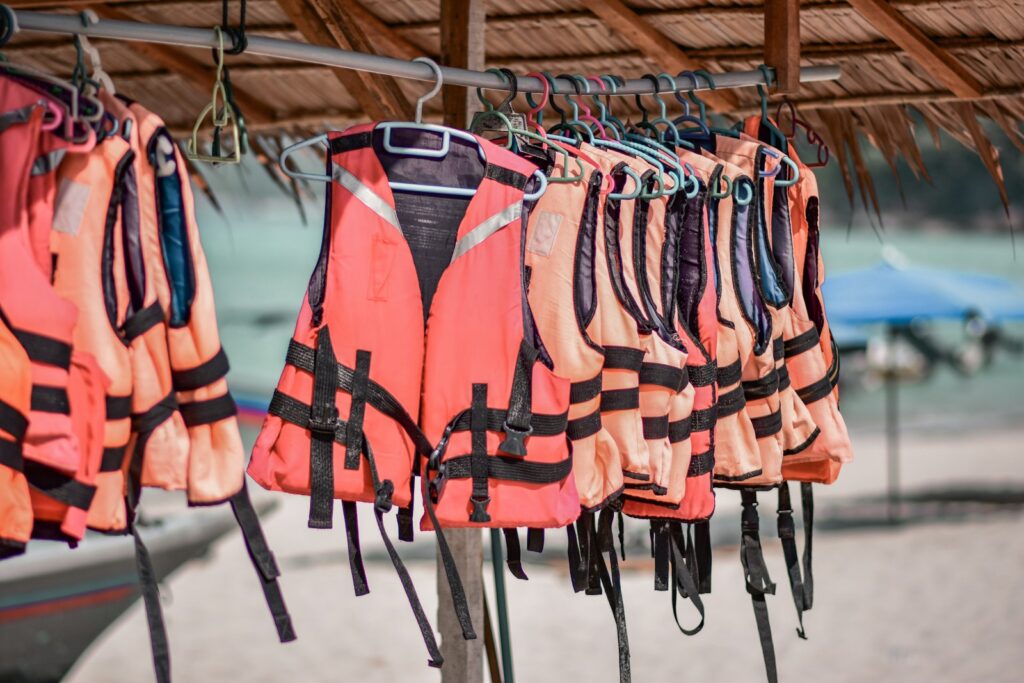
The gap between legal requirement and practical quality is wide. The majority of day boats — particularly at the budget end — carry basic foam flotation vests, not SOLAS-certified personal flotation devices. These vests provide buoyancy, but they are not always in good repair, and the fit range does not reliably include child sizes. On reputable operators, guides commonly require life jackets in the water for non-swimmers and weak swimmers. On cheaper boats, enforcement is inconsistent.
What this means for families and weak swimmers
If you are travelling with children or if any member of your group is a weak swimmer, do not assume the boat will have a well-fitting child PFD. Bring your own. A properly fitted child life jacket is the single most important piece of gear for a family Komodo trip, and it is not something you want to discover is unavailable after you have already cast off from Labuan Bajo harbour. For adults who are not confident swimmers, confirm with your operator before departure that they provide life jackets in the water at Manta Point — not just on deck — and that a guide enters the water with your group.
Ready to plan a trip that matches your group’s skill level? Plan your trip with our planning form or reach us by WhatsApp — we can help match you to an operator with the right safety practices for your party.
Gear Reality: What Boats Carry and What to Bring Yourself
Mask and snorkel are included on nearly all day tours at no extra cost. Fins are sometimes included but not always — check before booking. The quality on shared boats varies considerably. Budget operators often carry worn masks with scratched lenses, tired silicone straps, and fins that come in two or three sizes rather than a proper range. A mask that does not seal properly is worse than no mask in current — you will be clearing water constantly while trying to hold position in a drift.
The practical advice: bring your own mask if you have one. The seal and field of view of your own correctly fitted mask make a material difference at current-exposed sites. If you must use rental gear, test the seal on your face before entering the water. Press the mask against your face without the strap, inhale lightly through your nose, and let go — it should hold for a few seconds. Reject any mask that falls away immediately.
On water temperature: July through September, when you are most likely to visit during peak season, water runs 25–26°C in the central park and can drop to around 22–25°C at southern sites where Indian Ocean upwelling is strongest (temperatures from resort climatology data, last verified June 2026 — treat as typical reported ranges). A rashguard and leggings are sufficient for most people in the north; a shorty wetsuit of 2–3 mm is worth packing for southern sites or long sessions in peak season cold water. It also provides sun protection, which matters when you are face-down for extended periods.
On sunscreen: as of June 2026, Indonesia does not have a legal ban on oxybenzone or octinoxate in Komodo National Park, unlike Palau or Hawaii. Reef-safe mineral sunscreen (zinc oxide or titanium dioxide) is strongly recommended as best practice for coral health, but it is not a legal requirement — we will not claim otherwise.
Manta Etiquette: What the Code of Conduct Actually Requires
All manta rays in Indonesian waters have been protected since 2014 under KEPMEN-KP No. 4/2014 — Indonesia declared all its waters, approximately six million square kilometres, a manta sanctuary. Harassment or capture is enforceable under fisheries law.
The Manta Trust code of conduct, which most reputable Labuan Bajo operators follow, specifies behaviour that goes beyond Indonesian law:
- Maintain at least 3–4 metres from the body, 4–5 metres from the tail. Mantas move faster than they appear to; the tail generates significant force.
- Approach from the side. Never come at a manta head-on or from directly behind. Let it see you.
- Stay flat at the surface. Minimal fin movement. The aim is to be neutrally present, not to chase.
- Do not touch. The mucus layer that protects a manta’s skin is damaged by contact, leaving it vulnerable to infection.
- No flash photography. Do not use a selfie stick in a way that intersects with the animal’s path.
- Do not duck-dive into a cleaning station or block the manta’s approach path to one. Cleaning stations — where wrasse remove parasites from the manta at depths of 8–15 m — are particularly important to leave undisturbed. Divers get closer views of cleaning stations; snorkelers observe mantas at or near the surface, which is where they also feed.
- No chasing. If a manta moves away from you, let it go.
These guidelines are best practice, not codified Indonesian law except where they overlap with the sanctuary regulation. They are worth following strictly, both for the manta’s wellbeing and because group behaviour that disturbs feeding animals reduces encounter quality for everyone in the water.
One honest note on manta sightings: no operator can guarantee an encounter. Mantas are wild animals in open water. Sighting rates at Karang Makassar are among the highest of any accessible site in Indonesia — mantas are seen here year-round, with aggregation strongest roughly from November through February when plankton density peaks (figures from secondary sources, last verified June 2026). But on any individual day, at any time of year, the mantas may simply not be there. Any operator who promises a sighting is overstating what they can deliver.
Snorkeling Incidents in Komodo: What We Know and What We Do Not
Currents are the documented hazard for snorkelers in Komodo National Park. Drift-offs — where swimmers are separated from their boat — have occurred. Drownings linked to current exposure have occurred. There is no public consolidated incident database, no publicly reported annual statistics, and no park authority data we can cite. We will not invent numbers.
What is documented and useful to know: KSOP Labuan Bajo (the harbour master authority) has the power to close the port in bad weather, and does so in the west monsoon season from around December through February. Storm swells during that period are unpredictable. National enforcement of passenger manifests and safety equipment checks on Labuan Bajo boats has tightened in recent years following Indonesian maritime incidents. Whether there is a specific current 2025–2026 regulation in place for Komodo specifically is not verified in any official text we have found — if your operator claims a new rule applies, ask them to show you the document rather than accepting it as fact.
Questions to Ask Your Operator Before You Board
A good operator will answer these without hesitation. Evasiveness is information.
- Does a guide enter the water with us at Manta Point?
- The answer should be yes, or a clear explanation of when a guide is and is not in the water.
- What is the procedure if a snorkeler gets separated from the group?
- They should describe the float-and-signal protocol. If they say it won’t happen, that is not an answer.
- Do you have life jackets in child sizes?
- Relevant for any group with young children. If the answer is uncertain, bring your own.
- Will you skip a site if the current is too strong?
- The answer should be yes, without hesitation. Any operator who says they always enter regardless of conditions is not one you want to be in the water with.
- What is the itinerary order, and which stops are swim stops versus on-land stops?
- Helps you understand how much time you will actually spend in the water versus on Padar or at dragon viewpoints.
- Is Siaba Besar or Kanawa on the itinerary?
- For groups with children, weak swimmers, or first-time snorkelers, these calm-water stops matter. Some budget day trips omit them in favour of Manta Point and the dragon sites.
- Are park fees included or separate?
- They are almost always separate on day boats. You will need to bring cash — see the fee section below.
- How many passengers will be on the boat?
- A shared speedboat carrying 22 people has significantly less guide-to-swimmer ratio than a private charter carrying 4–8.
Park Fees for Snorkelers: What to Bring in Cash
Fees are paid on entry into the park and are almost never included in day-tour prices. The current structure (last verified June 2026, based on secondary sources — no official PP 36/2024 annex text has been independently verified) is approximately:
| Fee Type | Foreign Visitor | Indonesian Citizen | Notes |
|---|---|---|---|
| Park entrance (per person, per day) | Rp 250,000 | Rp 50,000 weekday / Rp 75,000 Sunday & holiday | High confidence multi-source figure; verify with operator |
| Harbor fee | Rp 25,000 | Rp 25,000 | High confidence |
| Diving surcharge | Rp 25,000 | Rp 25,000 | Snorkelers are exempt from this fee |
| Conservation fee | Rp 100,000 (reported) | Rp 10,000 (reported) | Contested between sources — bring it as a contingency |
| Ranger fee (if landing on Komodo or Rinca) | Rp 200,000 per group up to 5 | Rp 200,000 per group up to 5 | Padar: Rp 150,000/group; snorkel-only trips with no island landing may skip this |
Practical guidance: foreign snorkelers on a full-day itinerary (Padar, Komodo, Pink Beach, Manta Point) should bring Rp 400,000–550,000 cash per person to cover entry, harbor, and ranger shares. Domestic visitors: the entry fee is significantly lower, but bring Rp 150,000–200,000 to be safe on the full itinerary. Card payments are not accepted at most park entry points. The SiORA booking system (Sistem Informasi Online Reservasi Wisata Alam) has reportedly handled mandatory pre-registration for park entry since early 2026 — most reputable operators manage this on your behalf, but confirm when you book. (SiORA’s mandatory status is reported by multiple secondary sources but has not been confirmed against official park authority text as of June 2026.)
Snorkelers pay the base park entry fee. There is no separate snorkeling-activity surcharge itemized in current 2026 fee tables — the old Rp 15,000 snorkeling fee was a feature of the previous regulatory regime (PP 12/2014). Divers pay an additional Rp 25,000 surcharge that snorkelers do not. This is one of the few concrete financial advantages of snorkeling over diving in Komodo.
Plan with Someone Who Knows the Conditions
Reading this guide is preparation. It is not a substitute for talking to a local operator who was at these sites last week, knows which boat captains read current well, and can match your group to an itinerary that puts you in the water at the right spots at the right tidal window. Use our planning form or message us on WhatsApp — we work with Komodo Luxury, our operator partner within the same group, and we can connect you with a trip that fits your skill level, group size, and timing. Our editorial independence means no one can pay to change what we publish; if you proceed with a partner through our recommendation, they may pay us a referral fee at no extra cost to you.
Frequently Asked Questions
Are Komodo snorkeling currents dangerous for beginners?
They can be, at certain sites. Karang Makassar (Manta Point) and Mawan are drift sites where even confident swimmers need to follow the guide’s protocol closely. Siaba Besar and Kanawa Island have mild, protected conditions that are genuinely suitable for beginners and non-swimmers with a life jacket. The key is matching your group to the right sites and using an operator who will skip entries when conditions are unsafe — not one who enters regardless.
What should I do if I get swept away by a current while snorkeling?
Stop swimming against it — you will exhaust yourself and move very little. Turn onto your back to float, conserve energy, and raise one arm straight up. This is the universal distress signal. Stay in place rather than swimming in random directions; your boat crew is watching and a stationary, signaling swimmer is far easier to locate than a moving one. If you are wearing a life jacket, let it do the work. Panicking and fighting the current is the main cause of rapid exhaustion in drift incidents.
Is Pink Beach safe for snorkeling?
The interior of Pink Beach bay is generally mild and suitable for beginners. The hazard is the rocky headland at the eastern end of the bay, where a current pull develops even when the bay interior feels calm. Stay well inside the bay, away from the point, and do not attempt to round the headland. Your operator’s briefing should specifically mention this; if it does not, ask before entering the water.
Do Komodo snorkeling boats provide life jackets?
Indonesian law requires all passenger vessels to carry life jackets for every person on board, so yes — day boats are legally required to provide them. In practice, most carry basic foam flotation vests rather than SOLAS-certified PFDs. On reputable boats, guides require life jackets in the water for non-swimmers and weak swimmers. Child sizes are not reliably available on budget boats. If you are travelling with children or weak swimmers, bring your own properly fitted child PFD rather than assuming the boat will have an appropriate size.
When an operator skips Manta Point due to current, is that a sign of a bad trip?
No — it is the opposite. A captain who reads the conditions and cancels an entry when current or swell is too strong is exactly the kind of decision-maker you want running your boat. The mantas are wild animals in open water and will not be at the surface every day regardless; entering when current is dangerously strong to avoid disappointing guests is a sign of poor judgment, not good service. If the entry is skipped, a well-run operator will offer the best alternative the conditions allow — often more time at a calmer site like Siaba Besar or Kanawa.