A Komodo snorkeling spots map is essentially a transit-time problem: the six main snorkel sites spread roughly 10 km to 70 km from Labuan Bajo harbour, and which ones you reach — and how long you spend in the water at each — depends almost entirely on your boat type and departure time. This guide walks through the circuit from closest to furthest, flags honest transit estimates (sea-state dependent, not marketing guarantees), and explains why no standard day boat covers them all.
Reading the Circuit: How Distance Shapes Your Day
Most visitors picture Komodo National Park as a compact dot on a map. The reality is a 1,733 km² marine national park scattered across three large islands — Komodo, Rinca, Flores — and dozens of smaller ones. Labuan Bajo sits on the northeastern edge. The nearest snorkel stop is under 30 minutes away by speedboat; the furthest worthwhile one is closer to two hours on a fast vessel, longer on a slow wooden boat.
That distance gap is the core reason itineraries cluster the way they do. Operators running full-day trips to Manta Point or Pink Beach are already spending three to four hours in transit round-trip on a speedboat. Add two or three island landings — Padar hike, Komodo dragon trek — and the in-water snorkel time at any single spot compresses fast. A slower wooden boat on the same route can mean five to six hours of transit for a seven- or eight-hour day. That is not a complaint about the operators; it is just the geography, and it is worth understanding before you book.
The six spots covered below are the ones that appear consistently on day-trip and liveaboard itineraries accessible from Labuan Bajo. Transit times are typical in calm dry-season conditions (April–November); the west monsoon (December–February) lengthens crossings and sometimes forces cancellation or rerouting. All figures should be treated as bands, not timetables — ask your operator what to expect on your specific date.
The Spots: Closest to Furthest From Labuan Bajo
Kelor Island — 20–35 minutes (speedboat)
Kelor Island snorkeling is as close as it gets. A small island just west of Rinca, Kelor sits roughly 20–35 minutes from Labuan Bajo harbour by speedboat, 45–60 minutes on a wooden day boat. It appears on almost every full-day circuit as the first or last stop — which makes logistical sense, since tacking it onto a longer run costs relatively little transit time.
The snorkeling itself is shallow fringing reef, mostly 1–3 metres near the beach. Documentation on Kelor’s underwater scene is thinner than for the deeper park sites, and the reef quality is uneven; the island is better known among tour groups for its hill hike and panoramic view than for what is below the surface. Current is manageable in the sheltered lee on mild tides, but the headland channels can run stronger — timing and entry point matter. It is a reasonable warm-up stop for beginners, not a destination snorkel in its own right.
Cluster note: Kelor pairs naturally with Kanawa (see below) on shorter western-circuit itineraries, or with Rinca as an add-on to a dragon-trek day. Neither pairing gets you to Manta Point — they are different geographic halves of the park.
Kanawa Island — 30–50 minutes (speedboat)
Kanawa Island snorkeling is the strongest beginner reef in the northern zone. Transit from Labuan Bajo runs roughly 30–50 minutes by speedboat, 60–90 minutes by slow boat. The house reef wraps around a small private-island resort; you enter from the beach and drop into 1–2 metres immediately, with the reef slope extending to 5–8 metres at its deeper edges (depth ranges inferred from site-grade data, not measured).
Current at Kanawa is rated mild to protected — the island’s orientation gives it a sheltered profile in the prevailing south-to-southeast dry-season wind. Visibility runs with park-wide patterns: good to very good from April through October, softer in the wet months. Green turtles are sighted regularly, coral cover is intact across most of the reef, and the entry is easy enough that snorkelers with no experience can manage it with a life jacket. It is one of the few spots in the park that genuinely suits all ability levels, not just the intermediate-and-up crowd.
Cluster note: Kanawa pairs with Kelor on shorter day trips, and it appears as the “easy bookend” on some longer circuits where operators want to give families or weaker swimmers a safe stop before or after the more demanding central-park sites. It does not cluster naturally with Manta Point on a standard day run — the transit geometry pushes those stops apart.
Siaba Besar — 45–70 minutes (speedboat)
Siaba Besar snorkeling — called Turtle City by almost every operator running there — sits in the central western part of the park, roughly 45–70 minutes from Labuan Bajo by speedboat. The reef is shallow, protected hard coral from about 2 to 6 metres, and current is consistently rated mild. What it offers that no other spot in this circuit matches is reliable green turtle density: multiple turtles per snorkel session is the norm, not the exception. Exact numbers are not quantified anywhere — no scientific turtle count has been published for this site — but the sighting rate is the highest of any spot accessible to day-trippers.
For families, beginners, and non-swimmers using a life jacket, Siaba Besar is the single best recommendation in the park. The shallow reef, calm conditions, and turtle encounters deliver an experience that does not require skill, experience, or comfort in current. It is also accessible enough that operators frequently include it on trips targeting multiple audience types — one group can watch turtles while more confident swimmers explore the outer reef edge.
Cluster note: Siaba Besar clusters well with Taka Makassar and Karang Makassar (Manta Point) geographically — all three sit in the central park zone. A day boat can reasonably hit all three if it is disciplined about transit and keeps island landings short. That combination — Siaba Besar for turtles, Taka Makassar for the sandbar photo stop, Manta Point for mantas — is the snorkeler’s ideal central-park circuit, and it is achievable on some itineraries.
Taka Makassar (Sandbar) — 60–90 minutes (speedboat)
Taka Makassar snorkeling is the most misunderstood stop on the circuit. It is a white-sand cay that exposes at low tide — beautiful in photographs, genuinely striking in person — but it functions more as a photo and wading stop than a reef snorkel. The immediate shallows on the bar run 0.5–2 metres; the edges slope toward the manta channel and can reach 5–10 metres (inferred, not measured).
The key word is tide. At slack water around low tide, the sandbar is accessible and calm — you can walk on it, wade, and snorkel the shallow edges in mild current. As the tide runs, the edges drift toward the Karang Makassar manta channel, and conditions become hazardous for casual snorkelers. Operators who know the site time arrival carefully. If yours does not mention tidal timing when discussing this stop, ask. It is a detail that separates a good central-park operator from a rushed one.
Cluster note: Taka Makassar and Karang Makassar/Manta Point are functionally adjacent — most operators who go to one stop at the other. They are roughly 1–3 km apart (exact distance varies by source). The transit between them is minutes, not the limiting factor. The limiting factor is the tide window at Taka Makassar versus the swell and current at Manta Point.
Karang Makassar — Manta Point — 60–100 minutes (speedboat)
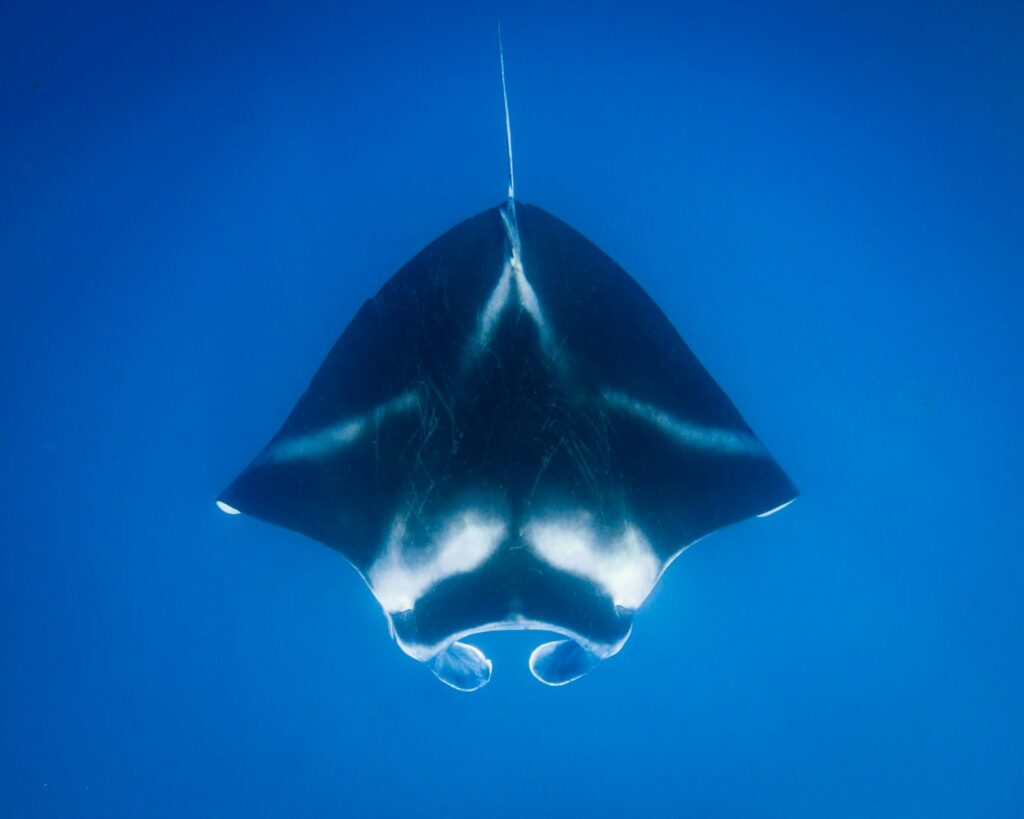
Karang Makassar manta snorkeling is the site most people are thinking of when they book a Komodo trip. Transit from Labuan Bajo by speedboat typically runs 60–90 minutes in calm conditions, occasionally stretching to 100 minutes depending on sea state and route. Slow boats take 2–2.5 hours each way, which means a slow-boat day trip with Manta Point on the itinerary is largely a transit exercise — in-water time at the site compresses to 30–45 minutes if you are lucky.
The site is a long rubble-and-sand plateau at roughly 5–15 metres depth. It is not a coral garden — do not expect lush reef structure. What it has is current, open water, and a cleaning-station ecosystem that draws reef manta rays (Mobula alfredi) year-round. Mantas feed in the top 0–5 metres of the water column, which means snorkelers floating at the surface can and do encounter them face-on or watch them banking below. Cleaning stations sit at 8–15 metres, closer to divers than snorkelers, but on a good morning a large manta may rise to within a few metres of the surface.
Manta sightings are most reliably reported from roughly November through February, when plankton concentrations peak. They are possible in every month of the year — encounters in June, July, and August are documented regularly. No operator publishes encounter-rate statistics, and no one should guarantee a sighting. If your operator does guarantee one, treat that as a red flag about their honesty on other things, too.
Current is strong. This is a drift snorkel: you enter up-current on the guide’s signal, drift as a group, and the boat collects you at the downstream end. Weak swimmers or non-swimmers should skip the water entry here and watch from the boat — several operators enforce this sensibly, and it is the right call. The drift is not dangerous if you follow the guide’s protocol; it becomes dangerous if you panic, swim against it, or get separated.
Cluster note: Karang Makassar pairs with Taka Makassar (adjacent) and Siaba Besar (30–40 minutes closer to Labuan Bajo). It does not pair efficiently with Pink Beach — the two sites sit on opposite sides of Komodo Island, meaning a day boat that visits both spends most of its day in transit.
Pink Beach (Pantai Merah) — 80–120 minutes (speedboat)
Pink Beach snorkeling sits on the southeastern coast of Komodo Island, which makes it the furthest main snorkel stop from Labuan Bajo on most standard circuits. Speedboat transit runs 80–100 minutes in calm conditions; rough weather or a southern swell can push that to two hours or force a route change entirely. Slow-boat access on a single day is marginal — some operators include it, but the transit eats the day.
The beach earns its name from the pink-tinged sand, produced by fragments of red coralline algae and the foraminifera Homotrema rubrum mixed with white carbonate. The scientific explanation is more interesting than the “crushed red coral” shorthand that appears in most tour brochures. Snorkeling is directly off the beach in a semi-sheltered bay. Reef condition varies by micro-location — anchoring damage has affected some sections; there is no published coral-cover survey for the site. Visibility follows park-wide patterns, typically 10–25 metres in the dry season.
Current at Pink Beach is not uniformly calm. The bay has sheltered sections, but the headlands on either side generate stronger flow, and at least one published trip report documents a snorkeler being swept in unexpected current at a point that looked benign. Entry point selection matters here — a good guide will show you where to go in and where to stay out of.
Cluster note: Pink Beach is usually grouped with Komodo Island dragon treks on full-day trips — geographically it makes sense, since both stops are on or near Komodo Island. The combination Padar + Komodo dragons + Pink Beach + Manta Point is the most commonly advertised itinerary, and it is also the one that compresses snorkel time the most aggressively. Five stops across a 100+ km circuit on a single day means roughly 20–40 minutes in the water per snorkel stop once landings, lunch, and transit are accounted for.
Transit Times at a Glance
| Spot | Speedboat from Labuan Bajo (typical) | Slow/wooden boat (typical) | Skill grade | Best for |
|---|---|---|---|---|
| Kelor Island | 20–35 min | 45–60 min | Beginner–Intermediate | Warm-up, add-on stop |
| Kanawa Island | 30–50 min | 60–90 min | All levels | Beginners, families, first-timers |
| Siaba Besar | 45–70 min | 90–120 min | All levels | Turtles, children, non-swimmers |
| Taka Makassar | 60–90 min | 120–150 min | Beginner (slack tide only) | Photo stop, wading, calm-water snorkel |
| Karang Makassar / Manta Point | 60–100 min | 120–150 min | Intermediate+ (drift) | Manta rays, experienced snorkelers |
| Pink Beach | 80–120 min | 150–180 min | Beginner–Intermediate | Komodo Island combo days, coral variety |
Transit times are typical in calm dry-season sea conditions. Actual crossings vary with weather, sea state, and boat speed. Verify with your operator. Last verified June 2026.
Why No Day Boat Reaches Everything
The arithmetic is unforgiving. Pink Beach and Karang Makassar sit on opposite sides of Komodo Island, separated by roughly 40–50 km of open water when routed around the island. Reaching both from Labuan Bajo and returning in a single day means approximately 200–230 km of total boat travel on a fast speedboat, with the central-park sites in between. Throw in a Padar hike (30–60 minutes) and a Komodo dragon trek (45–75 minutes), and you have a day where half or more of the waking hours are transit or land activities — not water time.
This is not a secret, but it is rarely stated plainly. The standard advertised “6-stop full-day” itinerary — Padar, Pink Beach, Komodo Island, Taka Makassar, Manta Point, Kanawa or Kelor — is a geography tour that includes snorkeling, not a snorkeling trip that includes some land stops. If in-water time is your priority, the honest choice is a shorter itinerary focused on the central-park cluster (Siaba Besar, Taka Makassar, Manta Point) or a liveaboard that anchors overnight and snorkels at dawn before the day-tripper boats arrive.
Liveaboards solve the transit problem by sleeping on the water. A two-night trip anchored near Karang Makassar or Siaba Besar gives you early-morning drifts before the crowd arrives and afternoon sessions at the same sites in different light conditions. For snorkelers who want quality over quantity-of-stops, that matters far more than the badge of having checked six GPS coordinates in ten hours.
Ready to work out which circuit matches your group’s priorities? Plan your trip with our concierge — share your dates, group size, and whether turtles, mantas, or easy reef are the priority, and we will suggest the right itinerary. WhatsApp planning is available for quick questions and operator referrals.
Natural Itinerary Clusters on Real Trips
Operators in Labuan Bajo have converged on a handful of itinerary shapes that make geographic sense. Understanding which cluster a given trip belongs to helps you evaluate whether it matches your goals.
Cluster A: Northern Easy Circuit (half-day or short full-day)
Kelor + Kanawa. Total transit: 60–90 minutes each way at the outer extreme. This is the itinerary that puts the most time in calm, beginner-accessible water. It does not reach any manta sites or the turtle-dense areas of the central park. Best for first-timers, young children, or travelers who want a low-intensity introduction to the park reefs without committing to a full 8-hour day.
Cluster B: Central Snorkel Focus
Siaba Besar + Taka Makassar + Karang Makassar. This is the highest-value snorkel combination in the park — turtles, a sandbar photo stop, and manta potential, all within a relatively tight geographic corridor. A speedboat can cover all three and return to Labuan Bajo in a full day with reasonable in-water time at each stop if the boat skips island landings entirely. Some operators offer this as a snorkel-focused itinerary; most standard packages dilute it with Padar or Rinca.
Cluster C: Classic Full-Day Sightseeing
Padar + Komodo Island (dragons) + Pink Beach + Taka Makassar + Manta Point + Kanawa or Kelor. The most-advertised combination. Maximum geography, minimum per-stop water time. Good for travelers who want the full visual experience of the park — landscapes, wildlife, reef — in a single day. Less good for anyone whose primary goal is quality snorkeling time.
Cluster D: Komodo Island Focus
Komodo Island dragon trek + Pink Beach + Padar (or skip). Oriented toward the southern end of the park. Pink Beach snorkeling is a genuine highlight here, and the dragon encounter is the park’s signature non-aquatic experience. Manta Point is sometimes added, though the transit between Pink Beach and Karang Makassar eats time.
Park Fees and the Booking System
One practical note for planning: park fees are almost never included in day-trip prices, regardless of which circuit you book. The current foreigner entrance fee under the post-2024 tariff structure runs approximately Rp 250,000 per person per day (last verified June 2026, multi-source consensus — no official PP 36/2024 annex text independently confirmed). Add the harbour fee of roughly Rp 25,000 per person. A conservation fee of Rp 100,000 is reported by some 2026 sources and absent from others — bring cash to cover it either way. Ranger fees (Rp 200,000 per group of up to five) apply on island landings at Komodo or Rinca; snorkel-only trips with no island stop may avoid these.
A realistic cash budget for a foreign snorkeler on a full-day itinerary with island landings is Rp 400,000–550,000 in park-related fees on top of the tour price. This is separate from tips, personal spending, and any gear rental. Operators commonly bundle these fees or ask guests to pay on arrival at the park gate — confirm the breakdown with your operator before departure so you carry the right amount. The park’s online booking system, SiORA, has been operating since early 2026; walk-in ticket sales have reportedly ended, and booking 2–3 days ahead is advisable (last verified June 2026 — confirm current status with your operator, as this is a secondary-source report not verified against official park communications).
See the full breakdown of Komodo park fees for snorkelers, including the snorkeling vs. diving fee distinction, the weekday/Sunday difference for domestic visitors, and what to do if an operator quotes an all-inclusive price that omits them.
Seasonal Notes for the Map
The circuit’s geography does not change by season, but the conditions at each spot shift considerably. April through November is the broad dry-season window when all six spots are reliably accessible. The clearest visibility tends to occur from April to June (reported ranges of 20–30 metres at the best sites in May, per resort climatology — single-source figure, treat as typical rather than guaranteed). July to September brings slightly cooler water in the central and southern park — 25–26°C at the surface, and notably cooler at the southern sites where Indian Ocean upwelling pushes cold water north. A 2–3 mm shorty wetsuit is worth packing for sessions in July and August, particularly at Manta Point where you may be drifting in open water for 30–40 minutes.
December through February is the west monsoon. Karang Makassar and Manta Point can see high manta activity during this period — plankton concentrations peak, and aggregation reliability is arguably better than the dry season at the best sites. But the sea conditions are rougher, transit times stretch, and harbour closures can occur with little notice. If you are planning a trip in these months specifically to maximize manta encounters, build buffer days into your schedule. A cancellation on a 3-night trip from a 4-night stay is a manageable inconvenience. A cancellation on a 1-night trip with no buffer is a wasted flight.
The full month-by-month breakdown of visibility, water temperature, manta odds, and crowd levels is on the best time to snorkel Komodo page.
Plan Your Route
The clearest decision framework for most travelers is this: choose your highest-priority encounter first — manta rays, turtles, easy reef for the family, or simply the most in-water time per day — then build the itinerary outward from there, rather than starting from a pre-packaged list of stops and hoping the snorkeling falls in. The spots closest to Labuan Bajo (Kelor, Kanawa) are easy to add without eating the day. The central-park cluster (Siaba, Taka Makassar, Manta Point) is the heart of any snorkel-first trip. Pink Beach is a long but worthwhile detour if Komodo Island is already on the agenda.
No single day boat reaches all of it well. That is not a failure of the operators — it is the park’s scale, and it is a reason liveaboard and multi-day formats exist. Understanding the map makes the tradeoffs visible before you book.
Our planning concierge can help you match an operator and itinerary to your specific group. Use our planning form or reach us on WhatsApp — no obligation, and if you proceed with a partner operator through our recommendation, they may pay us a referral fee at no extra cost to you.
Frequently Asked Questions
Can I visit all six snorkeling spots in one day?
In practice, no. Kelor, Kanawa, Siaba Besar, Taka Makassar, Karang Makassar, and Pink Beach span roughly 10 km to 120+ km from Labuan Bajo harbour, with Pink Beach and Karang Makassar on opposite sides of Komodo Island. A speedboat day trip can hit three to four of these stops in around eight hours if it skips or shortens island landings. Attempting all six results in 20–30 minutes of in-water time per stop at best, and more realistically means some snorkel sites get dropped or reduced to brief wading stops.
Which spots cluster together on a realistic itinerary?
The central-park trio — Siaba Besar, Taka Makassar, and Karang Makassar (Manta Point) — sit in the same geographic corridor and combine naturally on a snorkel-focused day. Kelor and Kanawa cluster in the northern zone near Labuan Bajo and suit shorter or half-day trips. Pink Beach groups naturally with Komodo Island dragon-trek days. Mixing northern and central-park stops on one day is possible by speedboat; mixing central-park and Pink Beach on one day is possible but tight on in-water time.
How long does it take to reach Manta Point from Labuan Bajo?
By speedboat in calm dry-season conditions, typically 60–100 minutes one way. Slow wooden boats take 2–2.5 hours each way. Sea state matters significantly — a light chop that adds 15 minutes to a speedboat crossing can double a slow-boat crossing time. Always ask your specific operator for their estimate based on current conditions and the boat they are running.
What is the best snorkeling spot for beginners near Labuan Bajo?
Kanawa Island is the strongest beginner reef in the accessible northern zone — beach entry, mild current, coral from 1–2 metres down, and reliable visibility. Siaba Besar, while further (45–70 minutes by speedboat), is the park’s best beginner site overall: shallow protected reef, consistently calm, and virtually guaranteed green turtle sightings. For families with young children, Siaba Besar and Taka Makassar (at slack tide) are the two recommended stops on any itinerary.
Do park fees change depending on which snorkeling spots I visit?
The base entrance fee — approximately Rp 250,000 per foreign visitor per day, last verified June 2026 — applies to the whole national park regardless of which spots you snorkel. You do not pay a per-spot fee for visiting Manta Point versus Kanawa, for example. Ranger fees (around Rp 200,000 per group of up to five) apply only if you land on Komodo or Rinca islands for a dragon trek. Snorkel-only itineraries that stay on the water skip those. Confirm all fee components in cash with your operator before departure — the figures above are secondary-source consensus and should be treated as planning estimates, not official figures.