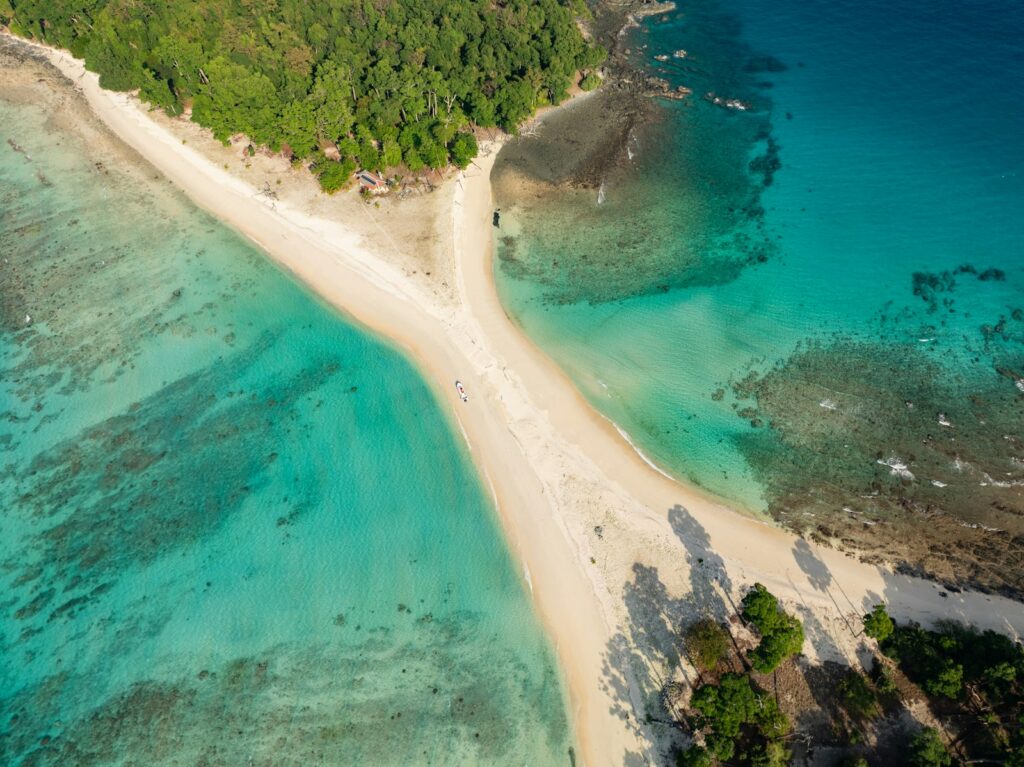
Taka Makassar snorkeling takes place at a low-tide sandbar cay in central Komodo National Park, roughly midway between Labuan Bajo and the open Flores Sea. The spot is famous for its photograph — a crescent of white sand rising from turquoise water with no other land in sight — and that reputation is accurate. What is less often said plainly: at its core, Taka Makassar is a photo stop and a shallow wading pool, not a reef snorkel. Once you know that going in, the experience delivers exactly what it promises, and on the right tide it is genuinely lovely.
What Taka Makassar Actually Is
The sandbar itself sits exposed at low tide, white and ankle-deep, surrounded by pale shallows that run roughly 0.5–2 m in the immediate approach area. Those depths are inferred from site observations rather than published instrumented surveys, but they match what any snorkeler will see the moment they enter: a sandy, sun-lit floor close enough to touch with an outstretched arm. There is no coral reef on the bar. The sand is clean and the water is usually clear enough to see the bottom from above without a mask.
Move away from the bar — toward the deeper water to the south and east — and the bottom drops more steeply. Edge depths of roughly 5–10 m have been reported at the channel side (again, inferred, not measured). That edge faces directly toward Karang Makassar, the manta-ray cleaning site. Here is where the site’s character changes. The same oceanographic conditions that make Karang Makassar productive for mantas — strong tidal currents funnelling plankton-rich water through the channel — run right past Taka Makassar’s deeper edge. On a running tide those currents are hazardous for snorkelers, particularly anyone near the exposed southern side of the bar.
The honest summary: stay on the bar itself at slack tide, and Taka Makassar is beginner-friendly, photogenic, and calm. Drift toward the edges on a rising or falling tide and you are in a different kind of water altogether.
Spot Grade and Who It Suits
- Overall snorkel grade
- Beginner (bar, slack tide) to Intermediate+ (channel edge, any tide)
- Reef quality
- Minimal — sandy substrate, scattered rubble; not a coral-garden destination
- Current risk
- Low on the bar at slack; Moderate–Strong at the channel edge on a running tide
- Visibility
- Tracks park-wide ranges: typically 10–15 m Jan–Feb, rising to 20–25 m Apr–Oct (typical reported ranges; last verified June 2026)
- Depth on bar
- 0.5–2 m (inferred)
- Depth at channel edge
- ~5–10 m (inferred)
- Non-swimmer suitability
- Yes, on the bar with a life jacket; no on the channel edge
- Kids suitability
- Strong — one of the best stops for young children in the park (calm, shallow, wading)
- Best tide window
- Slack low — roughly ±45 minutes around low water; consult your operator
- Pair with
- Karang Makassar (Manta Point) — usually the preceding or following stop
Stronger swimmers who want coral and fish density should not come to Taka Makassar expecting Siaba Besar or Kanawa. Those sites have living reef. Taka Makassar has sand, light, and space. The reward is photographic and atmospheric, not ecological. That is not a criticism — it is just useful information that tour pages rarely give you.
The Tide-Timing Rule
This is the single most important practical thing to understand about taka makassar snorkeling.
The sandbar only appears above water at low tide. At high tide it is largely submerged. Most day-trip operators time their Taka Makassar stop around low water, which is also the safest window: current through the channel is at its weakest, the bar is exposed for photographs, and the shallows are genuinely calm. The window either side of slack water is roughly 45 minutes. Operators who have been running these routes for years know when to arrive, and a well-timed stop feels effortless.
When the tide turns — and it can run strongly in this stretch of the park — conditions on the open-water side of the bar change fast. The same current that carries mantas past Karang Makassar a short distance away does not stop at the sandbar’s edge. Any snorkeler who drifts off the shallow platform and into the channel-facing water on a running tide will feel it immediately. Guides at reputable operators are trained to watch for this. Guests who wander are the ones at risk.
Practical rule: stay within sight of the boat or your guide at all times. The sandy bar is the safe zone. The deep blue beyond it is not the same spot.
If you arrive and the current is already running, a good operator will shorten the stop or keep guests on the bar only. That is a reasonable call, not a failure. For the drift snorkeling experience — mantas, cleaning stations, open-water reef fish — the Karang Makassar stop that almost always accompanies this one is where that happens.
What You Will and Won’t See Underwater
On the bar and in the immediate shallows, you will see: sand ripple patterns, occasional small reef fish moving through, possibly a passing turtle depending on the day (Taka Makassar is not a turtle site the way Siaba Besar is, but the animals travel through this whole area). The water is clear enough that even a slow snorkeler with a basic mask gets a good view of the bottom.
What you will not see: coral formations, significant fish density, or mantas from the bar itself. Mantas feed and clean at Karang Makassar, 0.5–1 km away in the channel. They do not reliably cruise the Taka Makassar shallows. On rare calm mornings a manta may pass close to the bar, but building expectations around that would be misleading. Your manta window is the dedicated Karang Makassar stop.
The underwater photography at Taka Makassar is genuinely good — clear, lit, with the white sand floor acting as a natural reflector. Snorkelers who want topside and underwater photos from the same stop get exactly that here. The aerial-style photo from the water line, sandbar in the background, is one of the most reproducible beautiful shots in the park and requires exactly zero dive experience.
Taka Makassar vs Karang Makassar: Not the Same Stop
These names confuse a lot of people planning their first Komodo trip, and they appear back-to-back on nearly every standard day-trip itinerary. They are distinct places with very different characters.
| Feature | Taka Makassar | Karang Makassar (Manta Point) |
|---|---|---|
| Type | Tidal sandbar / cay | Rubble/sand plateau, open water |
| Depth | 0.5–2 m on bar; ~5–10 m edge (inferred) | ~5–15 m (inferred); open water snorkeling |
| Main draw | Scenery, photography, wading, kids | Manta ray encounters |
| Snorkel skill needed | Beginner (on bar, slack tide) | Intermediate+; life jacket strongly advised for weaker swimmers |
| Current risk | Low on bar; Moderate–Strong at edge | Often strong; operators skip entry when conditions are dangerous |
| Marine life | Occasional fish, rare passing turtle or ray | Manta rays (year-round; peak roughly Nov–Feb), reef fish |
| Non-swimmers | Yes — stand on the bar | Possible with life jacket + guide in water; operator-dependent |
On a full-day Padar–Komodo–Pink Beach–Taka Makassar–Manta Point itinerary, these two stops are typically sequenced together in the middle of the day around the tidal window. The standard 6-stop day trip does not leave enormous time at each location — expect 30–60 minutes at Taka Makassar, including the boat approach and departure. If maximising in-water snorkeling time is your priority, a private or snorkel-focused charter will serve you better than the full sightseeing circuit.
Taka Makassar for Families and Young Children
This is where Taka Makassar earns genuine praise that most spot guides miss. The bar is one of the most reliably safe stops in the park for families with young children, precisely because of the limits that make it underwhelming for experienced snorkelers. Shallow water, firm sand underfoot, nothing to get swept into if you stay on the bar — it is the kind of stop where a six-year-old can wade in knee-deep water and a four-year-old can be carried by a parent in waist-deep water, and both have a memorable time.
No park regulation sets a minimum age for boat passengers or snorkeling, but operator norms typically put the practical floor at around 4–6 years old for boat trips and 6–8 years for water entry (with parent in water and a mandatory life jacket). Always confirm with your specific operator, as these vary. On the bar at slack water, even the most cautious family will feel comfortable.
Two things to note for family trips: children’s life jacket sizes are unreliable on budget shared boats. If you are traveling with a child under 10, bringing a properly fitted child PFD from home is the only way to guarantee a correct fit. Reputable dive-centre-run boats are more likely to carry child sizes, but verify before you book. The kids and family page on this site covers the full picture of which Komodo stops suit different ages — Taka Makassar sits alongside Siaba Besar and Kanawa as the three consistently calm picks.
Park Entry Fees: What Snorkelers Pay
Taka Makassar sits inside Komodo National Park, so standard entry fees apply. The fee structure below reflects the most consistent figures from multiple 2026 sources, but all fee data is secondary-source consensus — no official PP 36/2024 regulation text has been independently verified. Confirm current amounts with your operator before departure.
| Fee item | Foreign visitor | Indonesian citizen | Notes |
|---|---|---|---|
| Park entrance | Rp 250,000/person/day | Rp 50,000 weekday / Rp 75,000 Sunday & holiday | High confidence, multi-source 2026; last verified June 2026 |
| Harbor fee | Rp 25,000/person | Rp 25,000/person | High confidence |
| Snorkeling activity fee | None itemized | None itemized | Old Rp 15,000 fee (PP 12/2014 era) not carried forward in 2026 fee tables; confirm with operator |
| Diving surcharge | Rp 25,000/diver/day | Rp 25,000/diver/day | Snorkelers exempt — a practical cost advantage |
| Conservation fee | Rp 100,000 (reported) | Rp 10,000 (reported) | Contested between sources — some operators include it, some do not; flag as unconfirmed |
| Ranger fee (island landings only) | Rp 200,000/group up to 5 (Komodo/Rinca) / Rp 150,000/group (Padar) | Same | Only if you land on a ranger-guided island; snorkel-only stops like Taka Makassar do not trigger this |
Taka Makassar is a water stop, not a ranger-guided island landing. A stop here does not add a ranger fee to your bill. The realistic foreign snorkeler total for a full day (park entrance plus harbor) is a minimum of Rp 275,000, rising to around Rp 375,000 if the conservation fee is applied by your operator. On full itineraries including Padar and a Komodo or Rinca dragon walk, operators often advise bringing Rp 400,000–550,000 cash for all fees combined, including shared ranger costs. Fees are paid cash; ATMs in Labuan Bajo are your best preparation.
Since late 2024, bookings inside the park have shifted toward SiORA (Sistem Informasi Online Reservasi Wisata Alam), the official online reservation system. Walk-in ticket sales have reportedly ended under this system, which requires pre-booking 2–3 days ahead. Most established operators handle the SiORA registration on your behalf. This is strongly reported from multiple sources but has not been verified against official park authority announcements as of June 2026 — confirm the current process with your operator when booking.
Tour Prices and What Taka Makassar Costs You
Taka Makassar appears on nearly every shared speedboat day trip from Labuan Bajo as a standard stop within the central-park circuit. It is not a destination that commands a premium on its own — the boat price covers the full itinerary.
Shared speedboat full-day (typically: Padar, Komodo dragon walk, Pink Beach, Taka Makassar, Manta Point, and a beach or island stop) runs roughly Rp 1.4–1.6 million per person (approximately USD 85–100 at mid-2026 rates), with the full market range spanning USD 60–150 depending on operator, boat size, and season. Park fees are almost always excluded from this price — budget an additional Rp 400,000–550,000 per person in cash for the full itinerary including ranger shares.
If you specifically want to spend more time in the water at each stop and less time cruising, a private speedboat charter (typically Rp 6–10 million per day for a small 2–6 person boat; Rp 10–18.5 million for larger or premium vessels) allows you to dictate pace and cut stops you don’t need. Families with young children often find private charters worth the cost because you control rest time, swimming time, and departure back to Labuan Bajo if a child is tired or seasick. All price figures are last verified June 2026 and are volatile — treat them as planning brackets, not confirmed tariffs.
In July and August peak season, the cheaper seats on shared boats sell out early and boats run close to capacity. Price tends to drift toward the upper end of the range. Book a few days ahead at minimum during this window.
Ready to figure out which tour format suits your group? Plan your trip with our concierge — or reach us on WhatsApp for a quick question. We don’t sell tours; if you go ahead with a partner operator, they may pay us a referral fee at no extra cost to you.
Gear Advice for This Stop
For Taka Makassar specifically, gear requirements are light. The shallows are clear, the floor is sand, and there is no current on the bar to fight. A basic mask and snorkel is all you need for the bar itself.
That said, shared day-boat gear is inconsistent across the market. Budget boats commonly carry scratched masks, tired fin straps, and mismatched sizes. A mask that leaks on a current-free sandy bottom is merely annoying; the same mask at Karang Makassar, when you need both hands to manage buoyancy, becomes a real problem. If you are traveling with snorkeling as a priority, bringing your own mask makes a measurable difference in comfort across all stops on the day.
For the paired Karang Makassar stop where you will likely be in deeper water: a life jacket is available on all legal Indonesian day boats (required by law for passengers), and guides at reputable operators will require weak swimmers to wear one in the water. If you are not a confident open-water swimmer, wearing it at Karang Makassar is the right call — not just safe, but it keeps you at the surface where manta rays actually feed. You do not need to be submerged to watch a manta.
Thermal protection: water temperature at central Komodo sites runs 27–29°C from roughly April through June, dropping to 25–26°C in July–September as the dry-season upwelling kicks in. A rashguard and leggings are sufficient for most people in warm months. A 2–3 mm shorty wetsuit is worth considering for July–September, particularly if you plan multiple water entries on a liveaboard or long private charter day.
Reef-safe mineral sunscreen is strongly recommended. There is no Indonesian national law banning chemical sunscreens in Komodo as of June 2026, unlike Hawaii or Palau, but the case for avoiding oxybenzone on coral reefs is well-established. Taka Makassar’s bar has minimal coral, but the stops before and after it do not, and the same sunscreen you apply before boarding covers every stop on the day.
Pairing Taka Makassar with Other Spots
Taka Makassar rarely makes sense as a standalone destination. Its value is as part of a day or half-day that moves between different types of experience: the bar for photographs and family wading, Karang Makassar for the manta encounter, and one of the coral sites — Kanawa or Siaba Besar — for actual reef snorkeling.
Karang Makassar (Manta Point) is the pairing that appears on essentially every day trip that includes Taka Makassar. The sites are close; operators time the circuit to hit Taka Makassar at or near slack tide and move to Karang Makassar shortly after as the current builds enough to interest mantas but before it becomes too strong for safe snorkeler entry. When conditions align, this sequence — sandbar photos followed by open-water manta drift — is one of the most satisfying morning sequences in the park. Read the full Karang Makassar snorkeling guide for the manta encounter details, current grades, and the honest non-swimmer assessment.
Siaba Besar is the park’s best turtle site and the most beginner-friendly reef snorkel — shallow protected hard-coral, roughly 2–6 m depth, mild current, and multiple green turtles per session as the norm. If your group includes young children who want to see something alive underwater, a Taka Makassar plus Siaba Besar morning is the most reliably successful combination. Pair the bar for photos and wading with Siaba for the reef experience and you have covered both without pushing anyone into conditions they aren’t ready for.
Kanawa offers beach entry into a house reef that runs from about 1–2 m to 5–8 m, with current typically rated mild to protected and good visibility. It suits genuine reef snorkeling and is one of the easier entries in the park for anyone not comfortable jumping off a boat. If your day includes Taka Makassar and you want a proper coral experience, Kanawa is the natural pairing when Siaba is not on the route.
Safety: Staying on the Right Side of the Sandbar
The currents at Taka Makassar’s deeper edge are the documented hazard, not the bar itself. Several practical rules apply:
Stay on the bar or in water shallow enough that you can stand. The sandy platform is safe. Where the bottom starts to drop away and the colour shifts from pale blue to deep blue, you are entering channel-adjacent water, and the current dynamics change. If you cannot see the sandy bottom, you are off the bar.
Follow your guide’s entry and exit signals. Operators who run this route regularly will tell you where to enter, when the window is right, and when to return to the boat. The guides are managing tide timing in real time, not just standing on the boat looking decorative.
If you feel a current pulling you, do not swim against it. Move laterally toward the bar, toward shallow water, toward the boat. Raise your arm if you need assistance — the crew will be watching.
Children should be within arm’s reach on the bar. Wading depth is the operating zone. Water shoes are worth having if your child is sensitive to the sand texture, though the bar is generally clean.
Non-swimmers and very weak swimmers are completely comfortable on the bar itself. They should not attempt the channel edge. A life jacket in waist-deep water on a sandbar is not embarrassing — it is sensible and means you can focus on the photos instead of the water.
The Honest Verdict
Taka Makassar is not Komodo National Park’s best snorkeling site. If you came to the park for coral gardens, go to Siaba Besar or Kanawa and spend your time there. If you came for manta rays, Karang Makassar is your stop. Taka Makassar is for the photograph, for the children, for the person in your group who wants to wade in warm water and feel briefly like they are on a private island in the middle of the sea — because at low tide, with the bar white and the water pale blue in every direction, that is almost exactly what it is.
Knowing that going in is what turns a potentially disappointing “there’s no reef here” into a genuinely good stop. The operators who pair it well with Karang Makassar and time it to the tide are running a thoughtful itinerary. The ones who rush through at high tide on a running current are not doing the site justice.
Questions about how Taka Makassar fits into a snorkeling itinerary for your group — including whether a private charter makes sense for a family, or how to sequence this with Karang Makassar given current timing — are exactly the kind of things our planning service handles. Use our planning form or drop us a message on WhatsApp and we will give you a straight answer based on the time of year and your group’s experience level.
Frequently Asked Questions
Is Taka Makassar good for snorkeling if I am a beginner?
Yes — on the bar itself, at slack tide, it is one of the more beginner-friendly stops in the park. The water is 0.5–2 m deep (inferred), the floor is sand, and current on the bar at slack water is minimal. The caveat is that the edges of the bar, where the bottom drops toward the manta channel, carry moderate-to-strong current on a running tide and are not suitable for beginners. Stay on the bar, follow your guide’s instructions, and you will be comfortable.
Can non-swimmers go to Taka Makassar?
Yes. The sandbar is shallow enough to stand on at low tide, and non-swimmers can wade in waist-to-chest-deep water without snorkeling at all. A life jacket is available on all legal Indonesian day boats and can be worn in the water if you prefer. The bar is one of the stops in the park where the question “do I have to get in the water?” has the most relaxed possible answer — you can do as much or as little as you like.
Will I see manta rays at Taka Makassar?
Unlikely. Mantas are not a reliable feature of the Taka Makassar bar itself. They feed and clean at Karang Makassar (Manta Point), the separate site approximately 0.5–1 km away through the channel, which appears on the same day-trip itinerary. Very occasionally a manta passes close to the bar on calm mornings, but that is not something to plan around. Your manta encounter happens at Karang Makassar, not here. No operator can guarantee manta sightings at any site.
What is the best time to visit Taka Makassar?
The best time within the day is at or near low tide — the bar is exposed, current is at its weakest, and the shallows are calm. The best season is the dry season, roughly April through November, when visibility at central Komodo sites runs 20–25 m on average and sea conditions are more reliably calm. During the west monsoon (January–February) visibility drops to 10–15 m and rough seas can interrupt or cancel trips. Visibility and temperature figures are typical reported ranges last verified June 2026 — always confirm current conditions with your operator.
How does Taka Makassar compare to Karang Makassar for snorkeling?
They are very different stops that happen to appear together on most itineraries. Taka Makassar is a photo stop and wading spot — shallow, sandy, calm on the bar, very little marine life. Karang Makassar (Manta Point) is an open-water drift snorkel over a rubble plateau with strong current and the genuine possibility of manta rays from the surface. Taka Makassar suits absolute beginners and families with young children. Karang Makassar suits intermediate snorkelers or anyone willing to wear a life jacket and follow a guide. Most day trips do both in sequence, which is the right way to experience them.