Drift snorkeling in Komodo means you enter the water up-current and let the ocean carry you across a site — you do not swim to the reef, you float over it. At Karang Makassar, the long rubble and sand plateau known as Manta Point, that sensation is unlike anything most first-timers have experienced: mask down, arms loose at your sides, the current pulling you across open blue water at a pace you cannot match with a fin stroke. For the uninitiated it can feel disorienting within seconds. Read this before you board.
What Karang Makassar Actually Looks Like Underwater
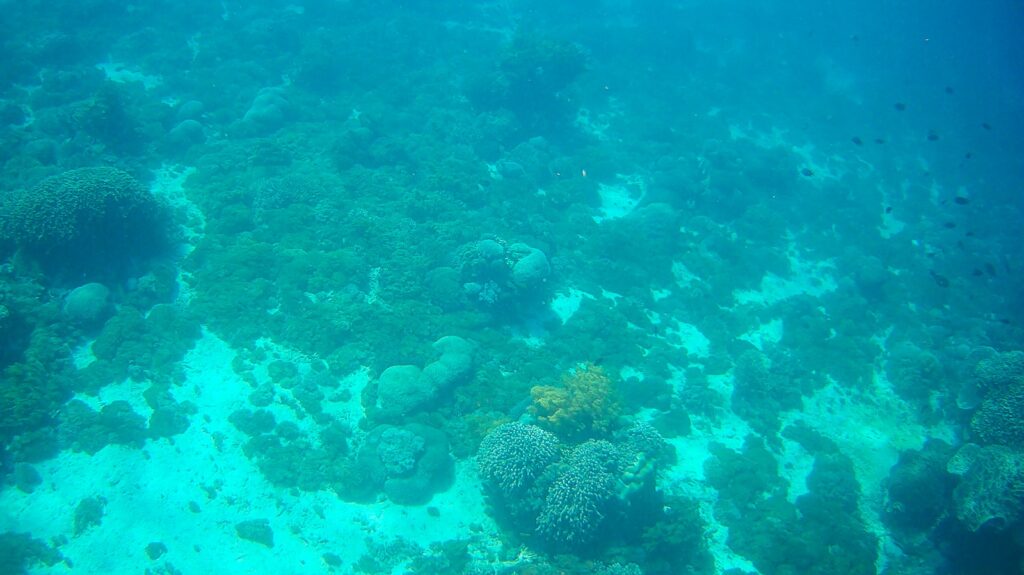
First, shed the postcard image of a dense coral garden. Karang Makassar is a plateau of rubble, sand patches, and scattered coral bommies sitting roughly five to fifteen metres below the surface. It is not shallow. There is a lot of open water between you and the bottom. The cleaning stations where manta rays hover — typically eight to fifteen metres down — are closer to divers than to snorkelers.
What snorkelers genuinely see is different and, on the right morning, spectacular in its own right. Manta rays feed in the top zero to five metres of the water column on plankton blooms. In calm conditions, particularly on mornings when plankton is dense near the surface, mantas will come right up to you. You may watch a wingspan pass under your mask. You may hear the gentle suction of water through a filtering mouth. The cleaning station at depth is not the whole story.
That said, no operator can guarantee a sighting. Encounter rates are not published anywhere. Mantas are present year-round at Karang Makassar, with aggregation strongest roughly from November to February when plankton levels peak, but they appear during the dry season too. "Peak reliability" does not mean certainty on any single day.
The Drift: What It Physically Feels Like
The current at Karang Makassar is driven by tidal flow through the channels around Komodo and Rinca. No instrumented speed data exists for this site — guides assess it qualitatively as weak, moderate, or strong on the day, and that judgement is the only reliable guide you will get. Estimates in operator literature suggest a typical drift of perhaps one to three kilometres per hour, but treat that figure as orientation rather than fact.
What first-timers consistently describe is a feeling of flying. You enter at a designated point up-current, face down, arms relaxed, and the water does the work. The plateau moves beneath you. Fish that are hovering in the current appear stationary while you glide past. On a moderate drift, you cover the plateau in ten to twenty minutes without a single fin stroke.
On a strong-current day the sensation shifts. The water is no longer benign transport — it has direction and force. You may feel yourself accelerating, or being pulled sideways toward a channel edge. This is when technique matters and when being in the water without proper guidance is genuinely dangerous.
How Group Entry Works — and Why the Signal Matters
Operators with sound safety practice do not let guests enter the water at Karang Makassar one by one. The entry is coordinated. The guide — and on well-run boats a second guide or crew member is already in the water — positions the group at the rail, explains the current direction, and gives a single signal (usually a verbal count or a hand gesture, depending on the crew) before everyone goes in together.
The reason for mass entry is simple: if the first guests enter and drift while others are still climbing down the ladder, the group immediately splits. A split group means the boat must collect from two separate positions. In a strong current that is a more complex operation. Enter together, stay tight for the first thirty seconds, and the drift works as a collective experience rather than a scattered search-and-rescue exercise.
Once in the water, stay close to the guide. You are not swimming a course — you are floating a drift together. The boat moves in parallel, shadowing the group down-current, and collects everyone at the end of the drift. The crew will have identified a collection point before you entered.
The Rule You Must Not Break: Never Fin Against the Current
First-timers who feel the current and get anxious do the instinctive wrong thing: they fin against it. This burns energy very quickly, achieves almost nothing in a strong tidal flow, and can lead to exhaustion within two or three minutes. A fatigued snorkeler in open water with a running current is a real emergency.
The counterintuitive truth about drift snorkeling is that relaxing is the technique. Keep your body horizontal, breathe steadily through the snorkel, and let the current do exactly what it is going to do regardless of your fins. If the current feels overwhelming, turn face-up, float on your back, and signal the guide. You are in open water, not a river — the current moves in one direction and so does the boat collecting you.
If You Separate: Float, Signal, Wait
Separation happens. A guest drifts wider than the group, or a small surge pushes someone off to the side. On reputable boats this scenario is anticipated and the crew is positioned to deal with it. Knowing the protocol before it happens is the difference between a quick recovery and a panic.
If you find yourself separated from the group:
- Stop finning. Do not chase the group. The current is faster than you.
- Float on your back. This is the most energy-efficient position in open water and keeps your airway clear.
- Raise one arm straight up and hold it. This is the universal snorkel-distress signal. The boat crew watches for exactly this.
- Stay calm. The boat collects down-current. It will come to where you are drifting, not to where the group was.
This is not a worst-case scenario — it is a normal occurrence on a current-driven site that well-prepared crews handle as routine. The danger arises when a separated guest panics, tries to swim against the current, and exhausts themselves. The protocol removes the need to panic.
When the Crew Skips the Entry Entirely — This Is a Good Sign
Some first-timers feel frustrated when the boat sits at Karang Makassar, the guide looks at the water for a minute, and the captain announces there is no entry today. Understand what is actually happening: a professional is making a risk judgement in your favour.
Current strength is assessed on the surface by watching water movement, foam patterns, and the pull on the anchor line. On days when the guide judges the conditions too strong — either too fast for a controlled drift, or running in an unpredictable direction — the correct decision is to not enter. There is no publicly available threshold that defines "too strong." It is a qualitative call made by someone who reads this water regularly.
A crew that skips the entry in strong conditions is demonstrating exactly the kind of judgement you want from people responsible for your safety. It is not incompetence or over-caution. The honest framing is this: the conditions on any given tide window are determined by physics, not by how much you paid for the tour.
Skill Level and Who Should Think Twice
Karang Makassar is graded as intermediate-plus. Confident swimmers who are comfortable in open water and relaxed with their faces in the water for extended periods will enjoy it fully. Non-swimmers and weak swimmers can participate — operators should require a life jacket in the water, and a guide should be in the water alongside you — but you need to be honest with yourself and your guide about your comfort level before entry, not after.
Young children and guests with anxiety around open-water depth should consider whether this site is the right starting point. The calm alternatives — Siaba Besar (shallow protected reef, two to six metres, mild current, regular green turtle sightings) and Kanawa (beach entry, protected bay, genuinely beginner-friendly) — offer a real Komodo underwater experience without the open-water drift component. Our non-swimmer and weak swimmer guide goes through those options in detail.
What Gear Actually Matters at This Site
Day tour boats almost universally include a mask and snorkel. Fins are sometimes included, sometimes not — ask when booking. What the gear reality looks like on the average shared speedboat: masks with scratched lenses, tired silicone straps, and varying seal quality. A mask that leaks in still water will flood on a drift entry when you hit the surface at current speed.
If drift snorkeling at Karang Makassar is the main reason you are on the water, bring your own mask. A mask that seals reliably to your face is the single most important piece of equipment you own at this site. The current is not the hazard — a flooded mask you are clearing every thirty seconds while drifting in open water is a far more common source of distress.
Thermal considerations: water temperature here runs roughly 25–29°C depending on season (last verified June 2026). A rashguard and leggings cover most of the year. In July to September, water temperatures at central Komodo sites can drop to 25–26°C; a shorty wetsuit or 2mm fullsuit makes a longer session noticeably more comfortable. Southern Komodo sites run several degrees cooler still from Indian Ocean upwelling.
Park Fees — the Quick Summary for Snorkelers
- Foreign national entrance fee (per person per day, 2026)
- Rp 250,000 — applies whether you snorkel, trek, or both. Last verified June 2026; confirm with your operator.
- Indonesian citizen entrance fee
- Rp 50,000 weekday / Rp 75,000 Sunday and public holiday. Medium confidence, two sources; confirm with operator.
- Separate snorkeling activity surcharge
- None itemized in 2026 fee tables. The old Rp 15,000 snorkel fee is from the pre-2024 regulation era. Snorkelers are not charged an extra activity fee on top of the entrance fee as of June 2026.
- Diving surcharge
- Rp 25,000 per diver per day. Snorkelers are exempt.
- Harbor fee
- Rp 25,000 per person.
- Conservation fee
- Rp 100,000 (foreigner) / Rp 10,000 (domestic) — reported by some 2026 sources, absent from others. Flag as unconfirmed; bring cash to cover it.
- Ranger fee (island landings only)
- Rp 200,000 per group of up to 5 (Komodo or Rinca), Rp 150,000 (Padar). Snorkel-only trips with no island landing may not incur this.
- Realistic day total — foreigner, full itinerary with Padar and dragons
- Rp 400,000–550,000 cash. Bring this amount regardless of what your tour includes, as park fees are almost always excluded from the ticket price.
Park fees are paid through the SiORA online reservation system (Sistem Informasi Online Reservasi Wisata Alam), which became the official booking platform in early 2026. Walk-in ticket sales are reported to have ended. Most reputable operators handle the booking on your behalf. Last verified June 2026 — confirm current procedure with your operator before arrival.
Ready to plan the detail around your Karang Makassar drift? Use our planning form or reach out on WhatsApp and we will match you with the right boat and departure time for the tide window. There is no charge for the planning help — if you proceed with one of our partner operators, they may pay us a referral fee at no extra cost to you.
Common First-Timer Questions
Do I need any certification or swimming ability to drift snorkel at Karang Makassar?
No certification is required to snorkel anywhere in Komodo National Park. Swimming ability matters more than qualifications: you need to be comfortable floating face-down in open water and calm enough not to panic when you feel the current. If you are a non-swimmer or weak swimmer, tell your guide before boarding. Reputable boats will have you in a life jacket and keep a guide in the water alongside you.
What if the current is too strong on the day we visit?
The guide makes a live assessment at the site. If conditions are too strong, the crew will skip the entry. This is standard practice and a sign of professionalism, not failure. On the same day trip you will still visit other sites — Siaba Besar, Kanawa, Pink Beach, Taka Makassar — where conditions are typically milder. No tour can pre-guarantee a Manta Point entry because current is tide-dependent and non-negotiable.
Is there a specific best time of day to be at Manta Point?
Slack tide — the window when tidal flow is weakest between direction changes — makes entry safest and the drift most controlled. The timing varies daily with the lunar cycle and is site-specific; your operator should factor this into the itinerary order. Early morning departures generally have the advantage of calmer seas before afternoon wind picks up, though slack timing is independent of wind. Ask your operator what time they plan to hit Manta Point.
Will I see manta rays when I drift over Karang Makassar?
Possibly. Mantas are present year-round at Karang Makassar, with the highest aggregation reported roughly from November through February during plankton season (last verified June 2026 — sources on exact peak months differ). The dry season from April through November also produces regular sightings. No operator can guarantee an encounter on a specific day, and anyone who claims otherwise is overpromising. If mantas are present and feeding near the surface, a surface drift gives you a genuine chance of watching them at very close range.
Can kids drift snorkel at Manta Point?
Current-prone sites like Karang Makassar are generally restricted for young children. Operator norms vary — many set an informal lower limit of around eight years for this specific site, with mandatory life jackets and parent-in-water requirements. These are operator policies rather than park-wide regulation, so ask directly before booking. For families with younger children or kids still building water confidence, Siaba Besar and Kanawa are the appropriate starting sites. See our snorkeling with kids guide for the full age-by-spot breakdown.