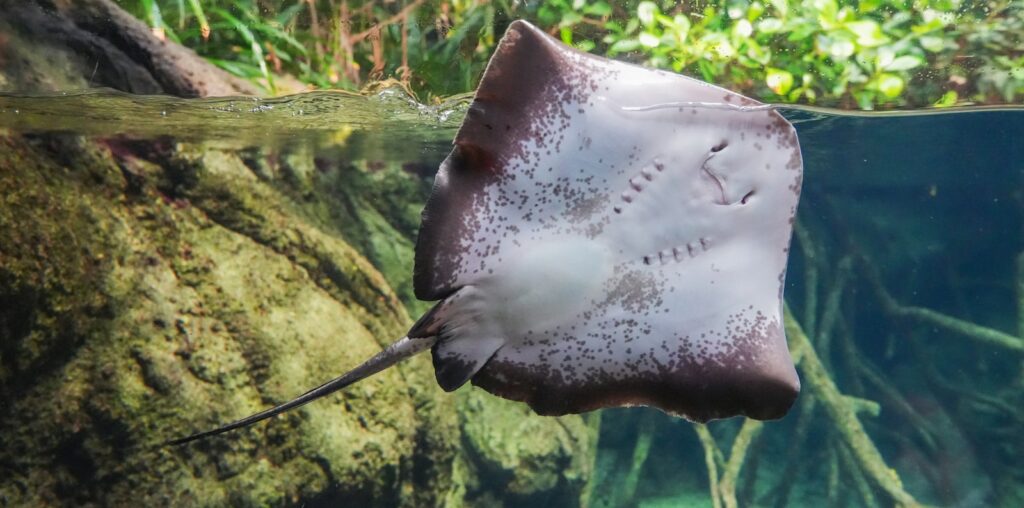
At Manta Point — the rubble plateau at Karang Makassar in central Komodo National Park — snorkeling versus diving is not the lopsided contest most people assume. Snorkelers floating at the surface watch mantas at close range because reef manta rays feed in the top 0-5 metres and regularly break the surface on calm mornings; divers hold an edge at the 8-15 metre cleaning stations where mantas hover almost motionless. Neither side dominates; the better experience depends on timing, current, and exactly what behaviour you are hoping to catch.
That is the short answer. What follows is the longer, more honest one — drawn from what the site actually looks like, what the currents do to both groups, and what you genuinely miss or gain at each depth.
What Manta Point Actually Looks Like
Karang Makassar is not a photogenic coral garden. It is a long, exposed plateau of rubble and sand sitting roughly 5-15 metres deep, punctuated by scattered bommies that function as cleaning stations. There is very little to look at if no mantas show up. Visibility, on a typical dry-season day, runs somewhere between 15 and 25 metres (last verified June 2026; figures drawn from resort climatology data — treat as typical reported ranges, not hard guarantees). The setting is open water: big, blue, slightly vertiginous for anyone who prefers a reef wall to lean against.
Snorkelers float over this scene from the surface. Divers drop into it. Both positions have merit, and both carry the same fundamental uncertainty: mantas are wild animals. No sighting is guaranteed, ever, regardless of depth or method.
The Snorkeler’s Actual Advantage
Here is the thing that surprises people who arrive expecting diving to be categorically superior: reef manta rays at Karang Makassar frequently feed in the uppermost layer of the water column, where plankton concentrates near the surface. On calm mornings — low wind, minimal chop — it is not unusual to watch a manta barrel-rolling through the surface film three or four metres away. At that moment, the snorkeler sees more than a diver does, because the diver is deeper and looking up at a silhouette.
Feeding behaviour is surface-oriented. Cleaning behaviour is depth-oriented. Mantas visit the 8-15 metre cleaning stations to have parasites removed by cleaner wrasse; they hold position there for minutes at a time, tilting and banking in slow arcs. That stillness, and that proximity, is the diver’s advantage — a cleaning manta is far easier to photograph and observe in detail than a feeding manta that is actively moving through the water column.
In practice, most snorkel sessions at Manta Point involve drifting over open water and watching mantas moving below and at the surface simultaneously. The sensory experience — the scale of the animal, the wing-beat pattern, the sheer silence of it — translates very well from the surface. What snorkelers lose is the close-up of the cleaning station interaction and the ability to hold position without fighting the current.
The Diver’s Actual Advantage
Depth is the defining factor when mantas are at the cleaning stations. At 8-15 metres, a diver with good buoyancy control can hold a respectful position (3-4 metres from the body, per Manta Trust best practice) and watch a manta parked in place for several minutes. That kind of extended, detailed observation is simply not available from the surface.
Divers also manage the current more actively. At Karang Makassar, the current runs persistently and is widely described as strong — estimates run around 1-3 km/h on a typical drift, though no instrumented speed data has been published for this site specifically. A diver can fin against a modest flow, or descend below a surface rip to find calmer water mid-column. A snorkeler at the surface takes the full force of whatever is running.
And divers get access to the deeper parts of the Komodo system that snorkelers simply cannot reach. Batu Bolong’s wall action starts below 15 metres. Castle Rock and Crystal Rock — where schools of sharks and schooling pelagics gather — are primarily 20-30 metre experiences. Manta Alley in the south of the park involves deeper channels and cooler, upwelled water that requires a wetsuit and Open Water certification minimum, usually Advanced certification with logged dives for the more demanding sites. None of that is available to a snorkeler, and this guide will not pretend otherwise.
No Licence Needed to Snorkel
This distinction matters more than most people realise when planning a trip. Snorkeling Manta Point requires no certification, no training beyond basic water confidence, and no equipment beyond what your operator provides or you bring yourself. Diving requires at minimum an Open Water certification from a recognised agency; the more technical sites in Komodo demand Advanced certification plus documented dives. For a mixed group — some certified divers, some not — this is the practical reason snorkeling tends to win at the planning stage.
Operators run shared boats that carry both divers and snorkelers to Karang Makassar. Snorkelers enter the water and drift the plateau; divers descend to their planned depth. Both groups can see mantas. The experience diverges in quality depending on where the mantas happen to be behaving that morning.
Current Reality for Snorkelers at Manta Point
The current at Karang Makassar is the main variable and the main hazard. Reputable operators run a specific drift protocol: you enter up-current on the guide’s signal, drift as a tight group, never attempt to swim against the flow, and the boat shadows the group down-current to collect everyone at the end. If you become separated, the trained response is to float, stay calm, raise one arm, and wait — not to swim.
Operators sometimes skip the entry entirely when conditions are too strong or when swell is running. This is the correct decision. A cancelled manta entry is not a failure; it is evidence of a responsible operator. If a company has never once skipped Manta Point in bad conditions, that is worth asking about before you board.
For weak swimmers, Manta Point is rated intermediate-plus at best. Most reputable operators require non-swimmers to wear a life jacket in the water; many require one for all guests regardless of swimming ability. A guide in the water is common practice on quality boats, though it is not a park-wide enforced standard — it depends entirely on the operator. Ask explicitly before booking whether a crew member enters the water at current-prone sites.
Children and very anxious swimmers generally should not be in the water at Karang Makassar. The calm family sites — Siaba Besar for turtles, Kanawa Island for coral, the sandbar at Taka Makassar at slack tide — are the appropriate alternatives for that demographic.
Snorkeling vs Diving: A Direct Comparison
| Factor | Snorkeling (0-5m) | Diving (8-15m) |
|---|---|---|
| Manta feeding behaviour (surface) | Excellent — close range, eye-level | Moderate — looking up at silhouette |
| Manta cleaning station behaviour | Distant view from above | Excellent — close, stationary observation |
| Certification required | None | Open Water minimum; Advanced for deeper sites |
| Current management | Drift only; no counter-swimming | Can fin against mild flow; descend below rip |
| Access to Batu Bolong / Castle Rock | No | Yes (with appropriate cert + experience) |
| Manta Alley (south park) | No | Yes (cooler water, Advanced recommended) |
| Park fee difference (foreigner) | Rp 250,000 entrance + no dive surcharge | Rp 250,000 entrance + Rp 25,000 dive surcharge |
| Suitable for beginners | Intermediate-plus at Manta Point; easier at other sites | Open Water min; experience matters at current sites |
| Sighting guarantee | None — ever | None — ever |
The park fee difference is real but modest. As of June 2026, foreign visitors pay approximately Rp 250,000 per person per day as a base entrance fee — whether snorkeling, diving, or trekking. Divers pay an additional Rp 25,000 surcharge per day. Snorkelers are exempt from this surcharge; as of June 2026, no separate snorkeling activity fee is itemised in the current tariff structure (the old Rp 15,000 snorkel fee dates to the previous PP 12/2014 era and appears to have been superseded). All figures should be confirmed with your operator before departure — last verified June 2026, and the fee structure has changed in recent years.
Manta Seasonality: When Does It Matter?
Manta rays at Karang Makassar can be encountered year-round. That said, sighting reliability is generally stronger from roughly November through February, when plankton blooms peak and feeding aggregations are more consistent. The dry season — April through November — brings better visibility and calmer seas, which improves the quality of any sighting you do get, even if the probability is slightly lower than the plankton-peak months.
June through August, when most visitors come, is not a bad window for mantas. They are present. Visibility runs 15-25 metres typically during this period, which is excellent for surface observation. Water temperature drops slightly — 25-27°C in the central park versus the warmer 28-29°C of the January-May period — so a rashguard or thin wetsuit makes a long session more comfortable.
The January-February window offers the highest manta density but comes with the west monsoon: rough seas, periodic storms, and occasional harbour closures at short notice. If you are chasing the peak aggregation, build buffer days into your itinerary. Cancellations are real and unpredictable in that window.
Whatever month you visit, treat any operator or blog that promises manta sightings as a red flag. Komodo’s mantas are genuinely wild. Encounter-rate percentages are not published for any site in the park, and anyone quoting a specific figure is speculating.
Manta Etiquette at the Surface
Indonesian law — KEPMEN-KP No. 4/2014 issued by the Ministry of Marine Affairs and Fisheries — designated all Indonesian waters a manta sanctuary, making the harassment or capture of mantas a legal offence across approximately six million square kilometres, the world’s largest such protected zone. The law is enforceable. Take it seriously.
The practical conduct code for snorkelers, aligned with Manta Trust best practice, runs as follows:
- Keep at least 3 metres from the manta’s body and 4-5 metres from the tail.
- Approach from the side only — never head-on, never from behind.
- Stay flat at the surface and minimise fin movement. Let the manta come to you rather than pursuing it.
- Never touch the animal. The mucus layer that protects a manta’s skin from infection is disrupted by contact, even brief contact.
- Do not duck-dive into a manta’s path or hover directly above a cleaning station from the surface — both behaviours interrupt feeding or cleaning behaviour.
- No flash photography. No selfie sticks extended toward the animal.
- If a manta is clearly moving away, it is signalling that your group is too close or too active. Back off.
The distance guidelines above reflect Manta Trust best practice; they are not codified as specific metre-distances in Indonesian national park regulation, but violation of the spirit of the law — harassing or disturbing protected species — is actionable. Your guide will enforce these on the water. If a guide does not, that tells you something about the operator.
This is also worth remembering: a snorkeler at the surface, floating quietly with minimal fin movement, is often less intrusive to a feeding manta than a diver producing a stream of bubbles at closer range. The two approaches are different, not one-better-than-the-other.
If You Plan to Dive — A Note
This site covers Komodo from the snorkeler’s perspective. If you hold a dive certification and want the full technical breakdown of Komodo’s dive sites — Batu Bolong, Castle Rock, Crystal Rock, Manta Alley, and the logistics of dive-oriented liveaboards — the diving sister site within the same planning network covers that comprehensively. For dive-intent readers, following that resource will serve you better than anything we can offer here.
For those on the fence about whether to learn to dive before a Komodo trip: it is worth it for the right person and the right timeline. But there is no reason to feel that snorkeling Komodo is a consolation prize. The manta interactions at Karang Makassar from the surface are genuinely excellent on the right morning, and the turtle density at Siaba Besar and the coral gardens at Kanawa require no depth at all.
Ready to plan your route? Plan your trip with our free planning form — or reach us via WhatsApp if you want to talk through timing, skill level, and which operators are genuinely snorkel-first rather than dive-trips with snorkelers bolted on. No one can pay to change what we publish; if you use our help and proceed with a partner operator, they may pay us a referral fee at no extra cost to you.
Gear Notes for Snorkelers at Manta Point
Mask fit matters more at Manta Point than at any other site on the standard Labuan Bajo day circuit. In a drift current, you cannot pause to clear a flooding mask without falling behind the group. Budget shared-boat rental masks are often scratched, with tired silicone skirts that do not seal reliably on faces with higher cheekbones or facial hair. If you have your own mask, bring it. If you are relying on rental, test the fit before you enter the water — press the mask to your face without the strap, inhale through your nose, and confirm it holds without air leaking in for several seconds.
Fins are not universally included in day-tour packages — confirm before booking. At a drift site you are not kicking hard, but fins allow you to hold position laterally as the current carries you, which matters for keeping the group together and for controlling your angle of observation.
Thermal comfort: water at Manta Point runs 25-27°C in June through September, cooler than the 28-29°C typical of March through May. A rashguard is the minimum; a 2-3mm shorty wetsuit is worth considering for anyone who runs cold or plans multiple water entries across a full day. Southern park sites can reach 22-25°C from Indian Ocean upwelling — notably colder than the figures above.
On sunscreen: as of June 2026, there is no Indonesian national law or specific Komodo National Park regulation banning oxybenzone or octinoxate (unlike Hawaii or Palau). Reef-safe mineral sunscreen is strongly recommended as best practice for protecting the coral ecosystem, but it is not currently a legal requirement. Apply before you board — not at the water’s edge.
Planning Your Manta Point Visit
A few practical details before you go:
- Park entry fee (foreign visitors, 2026)
- Approximately Rp 250,000 per person per day — entrance only, no separate snorkel surcharge currently itemised. Divers pay an additional Rp 25,000/day. Bring Rp 400,000-550,000 cash for a full itinerary including Padar, Komodo, and ranger shares. Last verified June 2026 — confirm with your operator.
- Booking system
- As of April 2026, the park reportedly runs pre-booking through the SiORA system (Sistem Informasi Online Reservasi Wisata Alam) and walk-in ticket sales have reportedly ended. Most operators handle the booking on your behalf. Confirm this with whoever you book through — last verified June 2026 via secondary sources only.
- Day tour price range (shared speedboat, park fees excluded)
- Rp 1.4-1.6 million per person is typical for a full-day Labuan Bajo circuit including Manta Point; the broader market spans roughly USD 60-150 depending on boat quality, group size, and inclusions. Private charters run Rp 6-18.5 million per day depending on boat size and specification. Prices last verified June 2026 — volatile, especially in peak season (July-August).
- Timing within the day
- Calm mornings — before the wind builds and surface chop increases — give snorkelers the best chance of the classic feeding-surface interaction. Most Labuan Bajo day tours reach Manta Point mid-morning. The window matters.
If you want personalised help matching your group’s skill level, budget, and travel dates to the right operator and itinerary, use our free planning form or connect via WhatsApp. Our concierge works through Komodo Luxury, a sister brand within Juara Holding Group — disclosed so you know how the relationship works.
Frequently Asked Questions
Can snorkelers actually see manta rays at Manta Point, or is it only for divers?
Yes — snorkelers genuinely see mantas at Karang Makassar. Reef manta rays feed in the top 0-5 metres of the water column, sometimes breaking the surface on calm mornings, which puts a surface snorkeler at close range during feeding behaviour. What snorkelers miss is the 8-15 metre cleaning station experience, where mantas hold position for extended periods and divers can observe them closely with good buoyancy control. Neither method guarantees a sighting; mantas are wild animals.
Do I need a diving licence to snorkel Manta Point?
No. Snorkeling requires no certification or training beyond basic water confidence. You can join a licensed day-tour operator and enter the water at Karang Makassar without any dive qualification. Diving at Manta Point and the rest of Komodo National Park requires at minimum an Open Water certification; more technically demanding sites require Advanced certification with documented logged dives.
Is Manta Point safe for snorkelers who are not strong swimmers?
Manta Point is rated intermediate-plus for snorkelers due to the persistent drift current. It is not recommended for weak swimmers without a life jacket and a guide in the water. Non-swimmers and anxious swimmers are generally better suited to Siaba Besar (turtles, protected, mild current), Kanawa Island (good visibility, mild current), or the Taka Makassar sandbar at slack tide. Ask your operator directly about their guide-in-water policy at current-prone sites before booking.
When is the best time of year to snorkel with mantas at Komodo?
Manta rays are present at Karang Makassar year-round. Sighting reliability is generally higher from roughly November through February, when plankton blooms peak and feeding aggregations are denser. The dry season (April-November) offers better visibility — typically 15-25 metres in the central park — and calmer seas, which makes any encounter more enjoyable even if raw probability is slightly lower than the peak plankton months. June through August visitors have a reasonable chance; December-February visitors have the highest manta density but must contend with the west monsoon and potential cancellations. All of this is reported consensus, last verified June 2026 — no encounter-rate statistics are published for any Komodo site.
What is the manta ray conduct code for snorkelers?
Indonesian law (KEPMEN-KP No. 4/2014) protects all manta rays in Indonesian waters — harassment or capture is a legal offence. The Manta Trust best-practice guidance for snorkelers: keep at least 3 metres from the body and 4-5 metres from the tail; approach from the side only, never head-on or from behind; stay flat and quiet at the surface; never touch the animal; do not duck-dive into the manta’s path or block cleaning stations from above; no flash photography. These distance guidelines reflect best practice rather than codified park regulation, but the underlying protection law is enforceable.