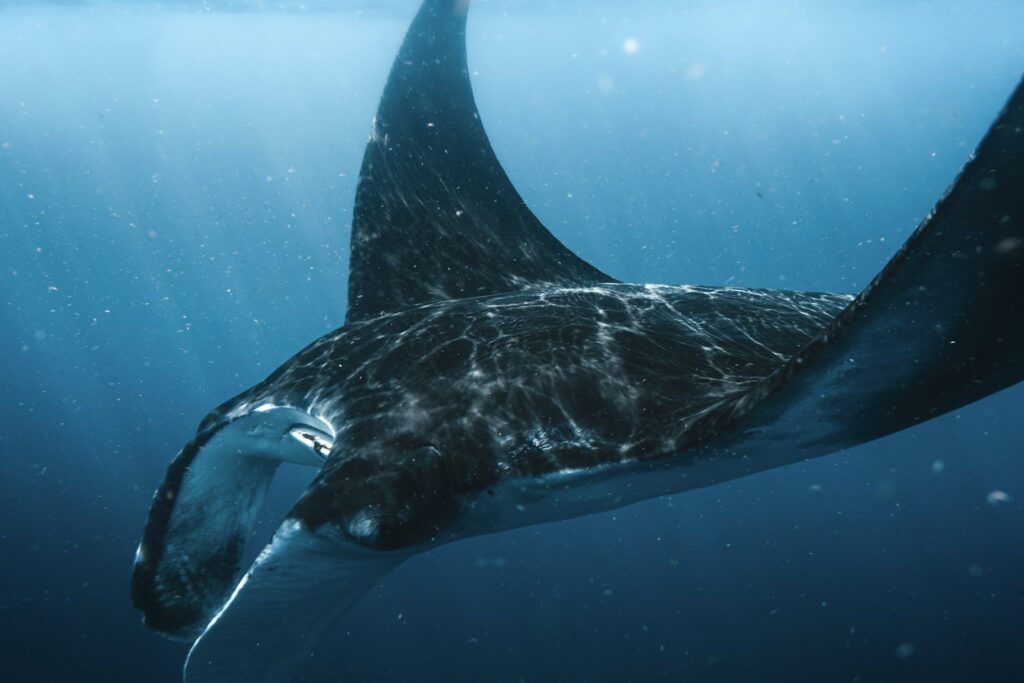
The best month for manta rays in Komodo is not a single month — it is a window. Mantas are present at Karang Makassar (Manta Point) year-round, but aggregation reliability peaks roughly November through February, when plankton blooms pull concentrations of reef mantas to the surface-feeding layer. That is the cleaner-supported reading of the available evidence, flagged last verified June 2026, and it directly contradicts a large share of what operator and aggregator pages currently publish. This piece lays out both camps, shows why they conflict, and tells you what it actually means for your trip planning.
The Contradiction in Plain Sight
Search for manta season in Komodo and you will find two clusters of claims that do not agree with each other.
Claim A — the dry-season camp. A large number of tour operator pages and booking platforms describe April through September as peak manta activity. The logic they offer: calmer seas, better visibility, and high season crowds all coincide with the dry southeast monsoon. Some pages go further and call June through August the “prime” window.
Claim B — the plankton-season camp. A different set of sources — several diving aggregators and a handful of biology-adjacent travel writers — place peak manta sightings in December through February, with November and March as the shoulder months. Their reasoning: reef mantas aggregate to feed on dense plankton, and plankton blooms in this region intensify during the northwest monsoon rainy season.
Both camps are publishing with confidence. Neither cites encounter-rate statistics. No publicly available dataset of manta sightings per visit by month exists for Komodo National Park. That absence matters — it means neither claim can be verified to the standard of “this month gives you a 70% chance, that month gives you 40%.” Anyone who gives you percentages invented them.
Why the Dry-Season Narrative Is So Dominant
The April-to-September framing dominates search results for a straightforward commercial reason. Most visitors to Labuan Bajo arrive during the dry season, when seas are calmer, visibility is higher, and peak-season marketing is active. Operators run more trips in this window and naturally accumulate more anecdote. “We saw mantas” stories from July and August are abundant simply because more people were in the water during those months.
There is also a visibility effect worth understanding. Typical reported visibility at central Komodo in the dry season runs 20–25 m in June, 15–25 m in July through September (resort climatology data, single primary source — these are ranges, not guarantees). In the northwest monsoon months of January and February, visibility typically drops to 10–15 m. Mantas that are present but moving at depth in murky water generate fewer surface reports. That suppresses the wet-season observation count in casual tourism data even if the underlying manta density is higher.
In short: visibility during dry season is better for seeing mantas once they appear. That is not the same as mantas being more abundant.
Why the Plankton-Season Case Is Better Supported
Reef mantas (Mobula alfredi) are planktivores. They aggregate where food is dense. The Indian Ocean-influenced upwelling that pushes cold, nutrient-rich water into the Komodo archipelago — most pronounced at the southern and central sites — intensifies during and after the northwest monsoon. Plankton blooms follow. Cleaning station activity at shallow bommies in the 8–15 m range, which are Manta Point’s structural feature, is also documented as more consistent in the cooler, higher-nutrient months.
This aligns with what the more biology-anchored sources report: denser aggregations, longer feeding sessions at the surface, and higher encounter reliability roughly November through February. The tradeoff is real — the northwest monsoon brings rougher seas, reduced visibility, and occasional harbor closures at KSOP Labuan Bajo when conditions deteriorate sharply. No public statistics on closure frequency exist, so the honest advice is to build buffer days into any December-to-February itinerary.
Water temperature in this period runs 28–29°C at most central Komodo sites (January through May range), which is comfortable without a wetsuit. The cold upwelling effect at southern sites like Manta Alley can push temperatures toward 22–25°C even in the warmer season — that range is approximate, not precisely measured.
What Actually Happens at Karang Makassar
Karang Makassar is a long rubble and sand plateau in central Komodo, roughly 5–15 m deep, with scattered bommies that function as cleaning stations. It is not a coral garden. Snorkelers float over open water watching mantas from the surface — when mantas are feeding in the top 0–5 m (which they do on calm mornings with a surface plankton layer), they come up to meet you. That is the encounter most snorkelers describe: a disc-shaped shadow moving toward the surface, widening, and passing within arm’s reach before banking away.
The site runs a strong tidal current — estimated 1–3 km/h typical drift, though no instrumented speed data exists for the site. Entry is up-current on the guide’s signal; you drift as a group and the boat collects from down-current. In conditions where current or swell is too strong, operators skip the entry entirely. That is good practice, not a failure. An operator who cancels a Manta Point entry because conditions are wrong is looking after you. One who rushes everyone in regardless of conditions is not.
The honest picture for snorkelers: cleaning station encounters, where mantas hold station while small fish remove parasites, happen at 8–15 m depth — closer to divers than to surface snorkelers. Surface snorkelers see mantas feeding and transiting. Both are genuine experiences; they are different experiences.
Month-by-Month Breakdown: The Honest Table
The following table synthesises seasonal conditions as reported across multiple sources. Visibility ranges trace primarily to a single resort climatology dataset — treat them as typical reported ranges, not measured guarantees. Manta reliability is qualitative, not a statistical encounter rate. All figures flagged last verified June 2026.
| Month | Season | Typical visibility (central) | Water temp (°C) | Sea state | Manta reliability (qualitative) |
|---|---|---|---|---|---|
| Jan | NW monsoon | 10–15 m | 28–29 | Rough / variable; harbor closures possible | High aggregation density reported; rough access |
| Feb | NW monsoon | 10–15 m | 28–29 | Rough / improving | High aggregation density reported; rough access |
| Mar | Transition | 15–20 m | 28–29 | Mixed, improving | Shoulder — mantas present, improving conditions |
| Apr | Dry season | 20–25 m | 28–29 | Calm | Regular sightings; calmer entry at Manta Point |
| May | Dry season | 20–30 m | 28–29 | Calm — peak visibility | Regular sightings; peak visibility window |
| Jun | Dry season | 20–25 m | 27 | Calm | Regular sightings; current still strong mid-tide |
| Jul | Dry season | 15–25 m | 25–26 | Calm; upwelling cools south sites | Regular sightings; full peak-season crowds |
| Aug | Dry season | 15–25 m | 25–26 | Calm; upwelling cools south sites | Regular sightings; peak crowds + prices |
| Sep | Dry season | 15–25 m | 25 | Calm | Regular sightings; shoulder pricing |
| Oct | Transition | 20–25 m | 26 | Mixed | Plankton building; encounter rate rising |
| Nov | Transition / early NW | variable | 27–28 | Variable | Aggregations forming; plankton season beginning |
| Dec | NW monsoon | variable | 28 | Roughening | Aggregations active; weather risk rising |
Source: compiled from resort climatology (single primary dataset), operator seasonal notes, and cross-source synthesis. Not a scientific survey. Visibility is central Komodo only — south-park sites (Manta Alley) often run several degrees cooler. Last verified June 2026.
June, July, and August: The Real Peak-Season Picture
If you are reading this in northern-hemisphere summer planning mode, here is the honest assessment: June, July, and August visitors see mantas regularly at Karang Makassar. No guarantee is possible — conditions, tidal cycles, and manta behaviour are not predictable to the encounter level. But these are not low-probability months. Operators running daily trips to Manta Point during peak season have a continuous stream of anecdote, and manta sightings are common enough that they function as a normal feature of the itinerary rather than a lucky bonus.
The practical considerations that actually affect your chances in peak season:
- Crowd density. July and August are the busiest months. More boats, more bodies in the water, more engine noise at aggregation sites. Mantas are not reliably spooked by human presence — they are generally accustomed to snorkelers at Manta Point — but a chaotic entry with 40 people thrashing around is worse than a calm entry with 10. This is one reason private charters and smaller-group operators consistently report better in-water experiences, not just because of access timing.
- Cold water. The Indian Ocean upwelling that reaches its maximum intensity in July–September cools central and south Komodo waters to 25–26°C — still comfortable for most adults in a rashguard, but noticeable on a long session. A 2–3 mm shorty wetsuit is worth packing.
- Booking lead time. Shared day-trip prices in peak season drift toward the upper bracket — Rp 1.5–1.8 million per person for a full-day Padar–Manta Point circuit, park fees excluded — and the cheaper seats sell out weeks ahead. Private charters reach Rp 10–18.5 million per day for a small-group boat. Book early, or be flexible enough to take what’s available. (All price ranges last verified June 2026; confirm with your operator.)
November Through February: The Plankton Window
This is the window the aggregation-focused sources point to, and the reasoning is sound. The northwest monsoon delivers nutrients; plankton follows; mantas concentrate. The tradeoff is access.
January and February in particular can mean cut trips, missed days, and last-minute itinerary changes. The harbor authority (KSOP Labuan Bajo) closes the port in bad weather — the frequency has no public statistics, but multi-day closures are not unusual in a stormy January. If you plan a trip specifically targeting this window, build at least two buffer days. A liveaboard that departs before conditions close in has an advantage over a day-trip base; the vessel can wait out rough conditions at anchor and reach Manta Point when the window opens.
Visibility during the wet season — 10–15 m in January and February — is lower than the dry season’s 20–30 m peak, which means mantas may be harder to spot from the surface at depth. When they come to the surface to feed, proximity is still close. The murk that limits your sightline limits theirs too, which can produce encounters where a manta appears suddenly at chest level — disorienting and extraordinary in equal measure.
November and December offer a middle-ground window: plankton season is beginning, seas are still manageable on good days, and peak-season crowds have thinned. March is similar on the back end. These shoulder months are worth considering if schedule flexibility allows.
Manta Etiquette: The Basics Are Not Optional
Indonesian law (KEPMEN-KP No. 4/2014, Ministry of Marine Affairs and Fisheries) designates all Indonesian waters — roughly six million square kilometres — as a manta sanctuary. Harassment and capture are offences under fisheries law. That is the legal floor.
The behavioural code that actually protects individual mantas goes further:
- Keep at least 3–4 m from the body, at least 4–5 m from the tail. These are Manta Trust best practice distances — they are not codified in Indonesian regulation, but reputable operators apply them as standard.
- Approach from the side, never head-on or from directly behind. Mantas can accelerate sharply when startled from the rear.
- Stay flat at the surface. Minimal fin movement. Let the manta decide whether to approach — and they frequently do, if the group is calm and quiet.
- No touching. The mucus layer on a manta’s skin is its primary protection against infection. Touching removes it. This is not dramatic — it is just damage.
- No chasing, no duck-diving into a cleaning station occupied by a manta, no blocking the exit path of a manta at a bommie.
- No flash photography. Underwater flash at close range causes a startle response and drives mantas away from cleaning stations.
- Boats should hold engine-neutral and approximately 10–30 m off visible mantas when swimmers are in the water. This is operator standard practice, not a published legal distance.
The one thing that consistently ruins manta encounters at Karang Makassar is a chaotic crowd. If your guide is managing the group well — staggered entry, horizontal hovering, no splashing — the odds of a close approach by a manta improve substantially. Follow the guide’s instructions before and during entry.
Ready to figure out the timing for your trip? Plan your trip with our concierge — or reach us on WhatsApp if you want to talk through peak-season vs shoulder options before committing to dates.
A Note on What Snorkelers Actually See vs Divers
The surface snorkeler and the scuba diver get different experiences at Manta Point, and it is worth being precise about this before you make decisions based on other people’s photos.
Cleaning stations — where mantas hover motionless at 8–15 m depth while cleaner wrasse work their gill plates — are primarily a diver’s encounter. The proximity is extraordinary from below. Snorkelers see this from 8–15 m above, which means you see the manta’s dorsal surface from a distance unless the manta subsequently rises to the feeding layer.
What snorkelers genuinely get: mantas feeding in the top 0–5 m on a calm morning with a surface plankton layer. When the conditions align — flat water, dense plankton, incoming tide at first light — mantas breach the surface-feeding zone and pass close enough for a snorkeler floating still to look directly into a cephalic fin. That encounter is real and common at Karang Makassar. It is not a consolation prize; it is a different angle on the same animal.
You do not need a diving licence to snorkel Komodo National Park. The park requires no certification for surface snorkeling. The skill requirement at Manta Point is comfort with open-water drift — not swimming strength, but composure. Non-swimmers with life jackets can enter with a guide in the water; the guide’s presence matters more than your swimming ability at a drift site.
The Summary Reading: What Is Best-Supported
Laying both claims against the available evidence produces a clearer picture than either camp alone.
- Are mantas present year-round at Karang Makassar?
- Yes — all sources, operator and aggregator alike, agree on this. Karang Makassar is not a seasonal site; it is a reliable habitat, not a migratory stopover.
- Is there a peak aggregation window?
- The plankton-season argument (roughly November–February) is better grounded in manta biology than the dry-season claim. The dry-season claim reflects observation frequency, not manta density.
- Do June–August visitors see mantas?
- Yes, regularly. The encounter is not a rare event in peak season.
- Are encounter-rate statistics available for any month?
- No. None are published. Any specific percentage is invented.
- What is the actual best month?
- If you want maximum aggregation potential and can tolerate rough-sea risk, November–February, with buffer days. If you want good conditions, solid manta odds, and calmer seas, April–May or September–October are underrated shoulder months. June–August delivers reliable sightings in the best visibility window — just plan around crowd management and book early.
None of this changes the fundamental planning advice: choose your dates based on what you can actually travel, then set accurate expectations for those dates. The difference between months is real but not dramatic enough to justify forcing a trip into weather you cannot handle.
Disclosure and Planning Help
This guide is independent — no operator pays to appear here or to change what we write. If you use our free planning help and proceed with a recommended partner or operator, they may pay us a referral fee at no extra cost to you.
Our concierge partner for Komodo snorkeling bookings is Komodo Luxury, a sister brand within Juara Holding Group. If you want help comparing shared day trips, private charters, or liveaboard options by season, our planning form gets routed to the right desk — or message us on WhatsApp for a faster conversation about dates and trip style.
Frequently Asked Questions
Can you really see manta rays snorkeling in Komodo, or is it only for divers?
Yes, snorkelers genuinely see mantas at Karang Makassar (Manta Point). Reef mantas feed in the top 0–5 m of the water column, and on calm mornings with a surface plankton layer, they pass close to snorkelers floating at the surface. The cleaning station encounters at 8–15 m depth are primarily a diver’s view, but surface feeding passes are real and not uncommon. No diving licence is required to snorkel the park.
Is there a guaranteed best month for manta rays in Komodo?
No. No published encounter-rate data exists for any month, and manta behaviour depends on plankton conditions, tidal cycles, and factors that cannot be predicted from a calendar. The November–February window is better-supported by manta biology as a period of denser aggregation. June–August visitors see mantas regularly during peak season. Neither window guarantees a sighting. Any operator or website that promises you will see mantas is overselling what is knowable. Last verified June 2026.
Why do different websites give completely different manta seasons for Komodo?
Because they are measuring different things without acknowledging it. Dry-season sources (April–September) are reflecting the months when most tourists visit, so the volume of “we saw mantas” reports is highest — not because manta density is highest. Plankton-season sources (November–February) are reflecting the biology: mantas aggregate where plankton is densest, and that coincides with the wet-season nutrient upwelling. Both sets of observations are real; the framing differs based on whether the writer is counting tourist reports or thinking about feeding ecology.
What are conditions like for snorkeling during the wet season manta window?
Rough. January and February are the peak northwest monsoon months — storms, choppy seas, and occasional harbor closures by KSOP Labuan Bajo are normal risks. Visibility drops to roughly 10–15 m (compared to 20–30 m in May and June). Build buffer days into any December–February itinerary; losing one or two trip days to weather is not unusual. Liveaboards that can anchor and wait for conditions to improve have a practical advantage over day-trip bases in this window.
Is Manta Point suitable for weak swimmers or non-swimmers?
Conditionally yes, with the right operator. Karang Makassar is a drift site with strong tidal currents — swimming ability matters less than composure in open water. Non-swimmers and weak swimmers should enter only with a life jacket and a guide in the water. Reputable operators keep guides in the water at Manta Point; budget shared boats may not. Ask explicitly before booking: “Does a crew member enter the water with guests at Manta Point?” If the answer is vague, that tells you something. Operators also skip entries entirely when current is too strong, which is the correct call — factor in that any given visit might not include a water entry.