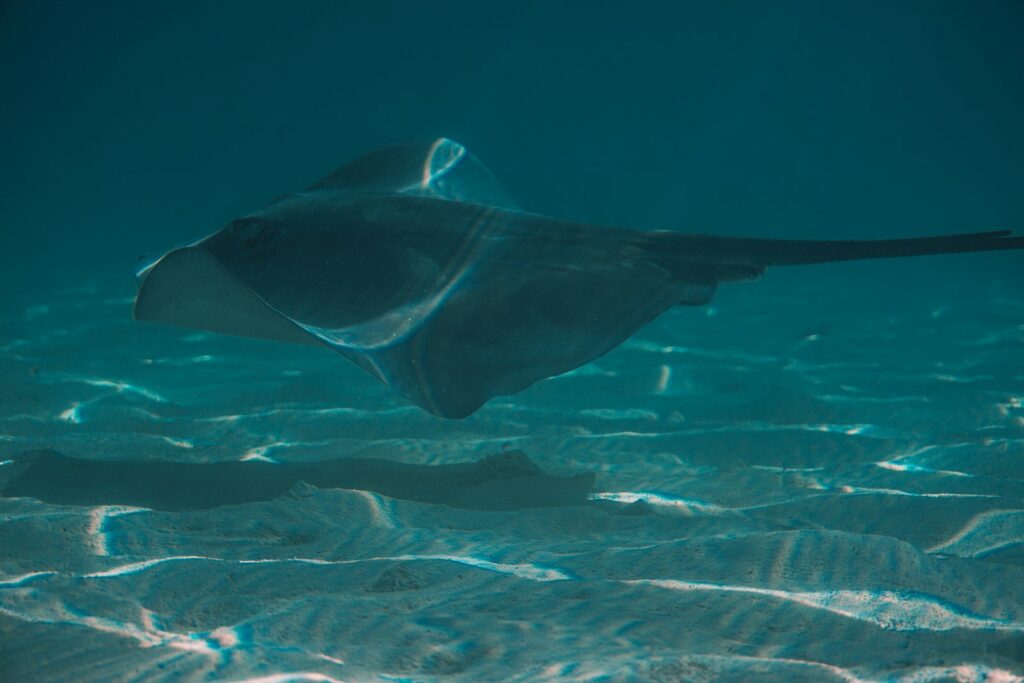
The manta ray code of conduct snorkeling guidelines are a set of approach, distance, and behavior rules — grounded in Manta Trust recommendations — that protect mantas from physical harm, mucus-layer damage, and chronic stress while keeping snorkelers safe in strong-current sites like Karang Makassar. This page lays out the complete code: not the three-word bullet lists you’ve seen on dive shop sign-in sheets, but the actual reasoning behind each rule, the legal framework in Indonesia, and where best practice ends and enforceable law begins.
Most pages you’ll find reduce this to “maintain a respectful distance.” That phrase is useless in practice. How far is respectful? Which direction does it apply? What about a manta that swims straight toward you? And what does the boat crew actually have to do — legally or by operator norm — when guests are in the water? Those are the questions this piece answers.
Why Indonesia Specifically Matters for Manta Rules
Before the behavior guidance, the legal context: under KEPMEN-KP No. 4/2014 — a ministerial regulation issued by Indonesia’s Ministry of Marine Affairs and Fisheries (MMAF) — all of Indonesia’s waters were declared a manta ray sanctuary. That is roughly six million square kilometres, making it the largest legal manta protection area in the world.
What this means practically: capture, trade, harassment, and killing of manta rays are offences under Indonesian fisheries law across the full national jurisdiction. If you touch, ride, chase, or knowingly disturb a manta at Karang Makassar or any other Indonesian site, you are not just being ethically poor — you are in territory covered by national enforcement.
What the law does not do: KEPMEN-KP 4/2014 does not codify specific snorkel-approach distances in metres, specify boat standoff distances, or define what constitutes “harassment” with the kind of precision that, say, dolphin-watching regulations in some countries do. The 3–4 m body distance and 4–5 m tail distance guidance you will see below comes from Manta Trust’s published best-practice recommendations — not from the regulation text. I flag this distinction clearly through this article because conflating voluntary best-practice with law misleads people in both directions: some become cavalier (“it’s not technically illegal”), others become litigiously frightened by something they can control through common sense.
Boat-behaviour norms — engines neutral, standoff distance from visible aggregations — are operator SOP, not a published regulatory distance. Reputable operators at Komodo National Park follow these. Budget boats do not always follow them. Ask before you board.
The Distance Rules — in Full
The Manta Trust guidelines, which have been adopted by most responsible operator networks in Komodo, specify:
- Lateral body distance
- Keep at least 3 to 4 metres from the body of the manta at all times. This applies horizontally — the manta’s wingspan can reach around 3.5 m on a large reef manta (Mobula alfredi), so 3 m on the near side means you are roughly a full wingspan away from the animal’s furthest disc tip.
- Tail distance
- Keep at least 4 to 5 metres from the tail. The tail is where you are most likely to frighten a manta into an abrupt dive — and most likely to get hit by the tail if it decides to accelerate. Mantas are not aggressive, but a startled 300 kg animal can knock a snorkeler unconscious. This is the rule most casually ignored when people are excited and scissor-kicking forward.
- Above and below
- Do not position yourself directly above or below the animal. At Karang Makassar, mantas often feed in the top 0–5 m, and they will sometimes break the surface on calm mornings. When a manta rises toward you, the instinct is to stay put and let it pass beneath. That is correct. What you must not do is sink-dive or drop your knees to intercept it from below, which blocks its upward path.
- Cleaning station distance
- Do not hover directly over a cleaning station. Cleaning stations — coral bommies where small wrasse and cleaner fish remove parasites from mantas — operate between roughly 8–15 m depth at Karang Makassar, so divers encounter them more directly than snorkelers. But if you are at the surface above a visible station, drifting directly over it or duck-diving toward it interferes with the service and displaces the mantas. Hover off to the side. Watch from the periphery.
Approach Direction: Why Head-On Is the Worst Option
Approach from the side, never head-on and never from directly behind. Head-on approaches are read by mantas the way prey reads a predator coming straight at it — it triggers avoidance. Coming from directly behind triggers the same response because the animal cannot see you until the last moment.
The side approach keeps you visible to the manta throughout. You enter its peripheral vision at a distance. The manta assesses you, usually continues its feeding run, and if you have stayed passive — flat at the surface, fins moving slowly and horizontally — it may pass within metres of its own accord. That is the sighting. Anything you do to engineer a closer pass by repositioning, kicking hard, or changing direction to intercept forfeits the encounter and likely ends it early.
In practice at Karang Makassar: the guide drops you in upstream of the expected feeding run, usually on a rough reading of the current line. You drift. The manta comes to you or it doesn’t. If you are constantly repositioning to stay ahead of it, you are chasing — even at low speed, even with good intentions.
Surface Posture and Fin Technique
Stay flat at the surface. This means:
- Horizontal body line — not upright, not with knees dropped
- Arms in, not extended downward
- Minimal fin movement — a slow, wide flutter that barely breaks the surface plane, never a deep bicycle-kick that sends bubbles and turbulence downward
- No duck-diving, even shallow ones, into the path of an approaching manta
Snorkelers have a real advantage over scuba divers here: you produce no bubbles. Mantas at Komodo that have grown used to divers often approach more readily when the noisy exhaust stops. Stay still and the noise profile of a snorkeler is low. Keep kicking frantically and you become the loudest thing in the water.
One nuance worth knowing: some mantas appear habituated to snorkelers at high-traffic sites like Karang Makassar and will approach on their own terms regardless. Do not interpret this as permission to abandon the distance rules. A habituated animal is still a wild animal that can be stressed by encirclement, flash, or sudden movement.
No Touch. The Biology of Why.
Mantas are covered by a thin mucus layer — a biological coating that provides protection against bacteria and fungal infection. Human hands remove it on contact, disrupting immune function in the affected area. The damage is not always visible. It does not bleed. But it leaves the animal susceptible to infection at the site of contact, which at worst becomes systemic.
The no-touch rule is absolute and non-negotiable: no touching, no riding, no guiding with hands, no contact initiated for any reason. This includes touching with fins, snorkel tubes, or camera equipment. The “it reached out to me” defence does not change the outcome for the manta’s skin.
Flash photography causes the same flinch-and-flee response as a sudden noise close to a human face. No flash, no video lights aimed directly at the animal. Natural-light photography at Karang Makassar on a calm morning, with the manta near the surface, produces good frames. You do not need artificial light, and using it is disruptive.
Chasing: What It Looks Like and Why It Ends the Encounter
Chasing does not require speed. A snorkeler who slowly repositions three or four times to keep a manta in frame is chasing. A group that collectively spreads into a loose arc to surround a feeding manta from multiple directions — even if each individual is holding distance — is collectively blocking exit routes. Mantas will dive.
The practical rules against chasing:
- Once you have entered the water and set your drift line, do not change course to follow the animal
- If the manta departs, let it go. Do not swim after it.
- If the manta approaches you, stay still. Resist the urge to reposition for a better angle.
- Groups of more than six snorkelers in the water at once should be split into sub-groups — ask your operator whether they do this. Crowded entry deploys too many bodies across the manta’s path simultaneously.
If you are planning a Manta Point visit and want to think through what a well-run entry looks like, our planning form lets you ask your operator specific questions in advance — or reach out via WhatsApp and we will help you phrase them.
Boat Behaviour at Aggregation Sites: Operator SOP, Not Regulation
The following is what responsible operators at Komodo National Park follow as standard practice. These are operator SOP — not a published legal standoff distance under Indonesian maritime or fisheries regulation:
| Behaviour | Standard Operator Practice | Status |
|---|---|---|
| Engine at aggregation site | Neutral or off when swimmers are in the water | Operator SOP |
| Boat standoff from visible mantas | Approximately 10–30 m | Operator SOP (no regulatory distance published, last verified June 2026) |
| Entry sequence | Enter up-current of feeding run; no motor running at entry | Operator SOP |
| Collection at end of drift | Boat shadows down-current and collects group at end of drift | Operator SOP |
| Abort decision | Guide may call abort if current or swell is unsafe — this is a good sign, not a failure | Operator SOP |
When choosing a boat for Manta Point, ask explicitly: “Does your guide get in the water with us?” and “What happens if the current is too strong?” A quality operator gives you clear, honest answers to both. An operator who says current is never a problem at Karang Makassar is telling you something worth knowing about their candour.
The Difference Between Law and Best Practice — Why It Matters
I keep returning to this distinction because conflating the two creates predictable problems. If snorkelers believe the 3–4 m distance rule is Indonesian law, they may expect park rangers to enforce it during their dive — and be confused when they do not, or when budget operators breach it without consequence. That confusion can slide into cynicism: “nobody enforces it anyway, so why bother.”
The answer to why bother is simpler than law: mantas at sites like Karang Makassar are the reason snorkelers come here. The global reef manta population — Mobula alfredi — is assessed as Vulnerable on the IUCN Red List, with a reproductive rate of roughly one pup per female every two to three years. The aggregation you drift through on a Tuesday morning in July exists because, for now, the disturbance level is low enough that mantas still find it worth using. Sites that become too chaotic lose their mantas. Indonesia’s sanctuary law protects against the worst abuses. The distance guidelines protect against chronic low-level harassment that the law cannot easily quantify.
Follow both. Understand what each is.
What to Do When Things Go Wrong at the Surface
Two scenarios worth being prepared for at Karang Makassar:
A manta approaches head-on: Stop kicking. Go still. Let it pass. Do not back-pedal — sudden backward movement reads as alarm behaviour. A manta that has chosen to come toward you has decided you are not a threat. You confirm this by doing nothing. It will curve away at the last moment or pass below you.
You are caught in the current and separated from the group: Float. Stay calm. Raise your arm. Do not fight the current by swimming against it — you will exhaust yourself. The boat crew should be down-current of the group. A good operator has already briefed this protocol before you enter the water; if yours has not, ask before you enter.
Reef Manta Versus Oceanic Manta — Does the Code Differ?
Komodo National Park is primarily Mobula alfredi territory — the reef manta. The oceanic manta (Mobula birostris), which can reach wingspans of 5 m or more, passes through on occasion. The same code applies to both species. Oceanic mantas tend to be shyer at the surface and move faster; if you encounter one, the passive, still-on-the-surface approach is even more important. The wider body means the tail-distance rule of 4–5 m is if anything more relevant — a 5 m oceanic manta’s tail is considerably further from its head than a 2.5 m reef manta’s.
Manta Etiquette Quick Reference
- Approach angle
- From the side — never head-on, never from directly behind
- Body distance
- 3–4 m minimum (Manta Trust best practice, not codified Indonesian law)
- Tail distance
- 4–5 m minimum
- Surface posture
- Flat, horizontal, slow-flutter fins, arms in
- Chasing
- Never — including slow repositioning
- Duck-diving into its path
- Never
- Blocking cleaning stations
- Never hover directly above; watch from the periphery
- Touch
- Never — mucus-layer damage is real and not reversible on contact
- Flash or video lights
- Never — flinch response; natural light only
- Group size in water
- Prefer sub-groups of six or fewer; ask your operator
- Legal framework
- KEPMEN-KP 4/2014 — all Indonesian waters a manta sanctuary; harassment and capture prohibited; approach distances are best practice, not regulation
Planning a Manta Point Visit
Karang Makassar draws snorkelers from all skill levels. But the site is a drift-current environment, and sightings are never guaranteed — encounter rates are not published anywhere, and any operator who implies a guarantee is telling you something worth knowing about their accuracy. Mantas are most reliably present from roughly November to February during peak plankton season, but sightings happen throughout the year, including during the June–August dry season when water conditions are generally calmer.
If you want help identifying which boats run genuine manta-first itineraries — with a guide in the water and an honest abort policy when the current runs hard — start with our planning page. We partner with Komodo Luxury, our concierge operator within Juara Holding Group (disclosed: if you book via them, they may pay us a referral fee at no extra cost to you — no one pays us to change what we publish). You can also reach our team directly on WhatsApp for a no-obligation chat about which tours suit your skill level and dates.
Frequently Asked Questions
Is it legal to touch a manta ray while snorkeling in Indonesia?
Touching a manta ray is illegal under Indonesia’s national manta sanctuary declaration (KEPMEN-KP No. 4/2014), which prohibits harassment and interference with mantas across all Indonesian waters. Touching damages the manta’s protective mucus layer and constitutes exactly the kind of interference the regulation covers. No-touch is both a legal requirement and the baseline ethical standard.
How far do I legally need to stay from a manta ray while snorkeling?
Indonesian law (KEPMEN-KP 4/2014) does not codify a specific metre distance for snorkelers. The 3–4 m from the body and 4–5 m from the tail guidance comes from Manta Trust best-practice recommendations, not the regulation text. The distinction matters: there is no ranger who will measure your distance with a tape — but the biological reason for that distance is real regardless of enforcement, and the sanctuary law covers harassment broadly.
Can snorkelers actually see manta rays at Komodo without scuba diving?
Yes. At Karang Makassar (Manta Point), reef mantas feed in the top 0–5 m of the water column, and on calm mornings they sometimes break the surface entirely. Snorkelers see them genuinely well from the surface on a good day. Cleaning stations at 8–15 m depth are primarily a diver experience, but the feeding runs are fully accessible from above. No certification is needed to snorkel; the current is the challenge, not the depth.
What should the boat be doing while I am in the water at Manta Point?
Standard operator practice — which is SOP, not published regulation — is for the engine to be in neutral or off while swimmers are in the water, with the boat maintaining approximately 10–30 m from any visible manta aggregation. The boat should be positioned down-current of the group to shadow the drift and collect snorkelers at the end. Ask your operator explicitly before entering the water. If the engine is running while you are near the animals, that is a problem worth raising with the crew.
What happens if a manta ray swims straight toward me?
Stop kicking, go completely still, and let it pass. Do not back-pedal, as sudden backward movement signals alarm. A manta approaching head-on has already registered you as a non-threat; your job is to confirm that by doing nothing. It will curve away or pass below you. Attempting to reposition for a better view at that moment — even slowly — will trigger evasion. Stay still. That is the sighting.