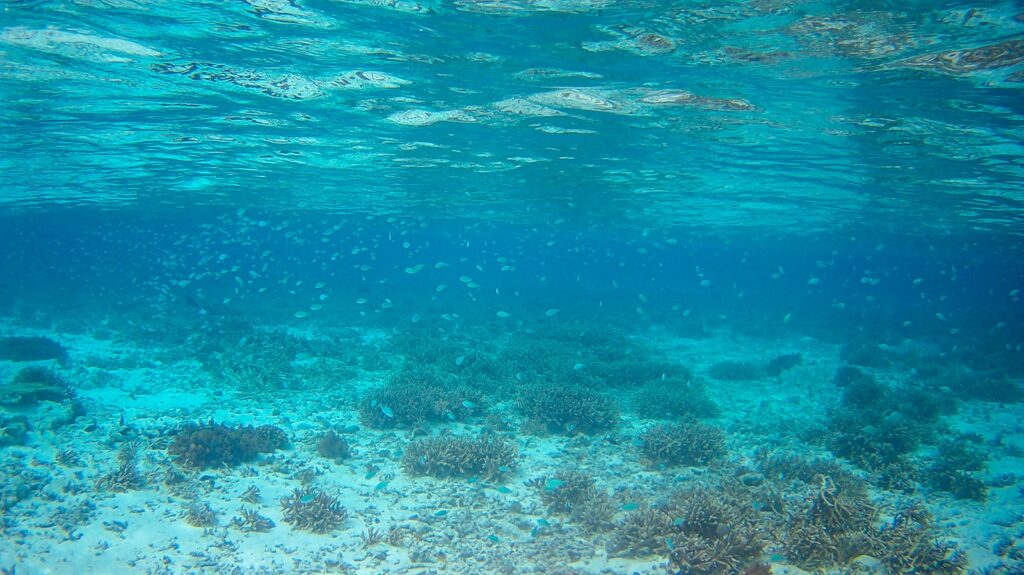
On reputable Komodo snorkeling tours, yes — guides routinely enter the water alongside guests, and on stronger-current sites like Karang Makassar (Manta Point), crews are documented physically steadying non-swimmers and directing drift groups. That said, guide-in-water is a practice, not a park-wide enforced standard. Komodo National Park does not mandate a specific guide-to-swimmer ratio or require that crew enter the water with you. Whether a guide gets in, and how many do, comes down entirely to the operator you choose. This is the single most important question weak swimmers and families can ask before stepping onto a boat.
Why This Question Matters More Than It Looks
Most booking pages for Komodo snorkeling tours spend their word count on manta rays and coral gardens. Fair enough — those things are why you came. But a shared speedboat on the standard Labuan Bajo circuit carries up to 22 passengers, and the standard run includes Manta Point, where currents run strong and the open-water depth below you stretches well past anything recreational snorkelers are used to. On a boat that full, if the crew stays aboard while you drift, you are effectively alone in the water.
For confident swimmers in calm conditions, that is fine. For anyone who is not a strong swimmer, or who is travelling with children or older family members, the answer to this question determines whether a particular boat is even the right choice.
What Good Practice Looks Like on a Reputable Boat
On well-run Komodo snorkeling operations, guide-in-water practice follows a clear pattern:
- At least one crew member enters the water at current-prone sites — Manta Point, Mawan, the edges of Taka Makassar on a running tide — and stays within arm’s reach of guests who have flagged themselves as weak swimmers or non-swimmers.
- A second crew member watches from the boat, engine idling, shadowing the drifting group down-current so the pick-up at the end of the drift is smooth and fast.
- Life jackets are required in the water for guests who cannot swim. Indonesian law requires all passengers to have access to flotation on board; guides on conscientious boats extend that requirement into the snorkel itself.
- Entry into the water at Manta Point is done on the guide’s signal: you enter up-current, drift together as a tight group, and never swim against the flow. If someone falls behind or separates, the protocol is to float, stay calm, raise one arm, and wait for the boat — not to panic and fight the current.
This is the standard many Labuan Bajo operators follow. It is not legally enforceable, but it is the baseline you should accept nothing less than.
Shared Boat vs. Private Charter: The Ratio Reality
The number of crew members who enter the water is shaped partly by boat capacity. Here is how it tends to break down in practice.
| Boat Type | Typical Capacity | Typical Crew | Guide-in-Water Reality |
|---|---|---|---|
| Shared speedboat (open trip) | Up to 22 pax | 2–3 crew + 1 guide | Usually 1 guide in water; 1 crew watches boat. Ratio can be 1:22 at worst. |
| Small shared boat (6–10 pax) | 6–10 pax | 2 crew + 1 guide | Guide more likely to stay close; smaller group means real supervision. |
| Private speedboat charter | 2–6 pax | Dedicated crew + guide | Guide almost always in water; crew can split roles more freely. |
| Private phinisi charter | Custom | Full crew ratio | Highest supervision; some operators assign one crew per guest on request. |
The math here is worth sitting with. A maximum-capacity 22-passenger shared speedboat with one guide in the water means a 1-to-22 guide-to-swimmer ratio at Manta Point drift. That is not dangerous for confident swimmers who follow instructions. For a non-swimmer or a child, it means that guide cannot physically be with you the entire time. Private charters — small speedboats at roughly Rp 6–10 million per day for 2–6 passengers, or larger options at Rp 10–18.5 million (last verified June 2026) — change that ratio entirely. If anyone in your group is a weak swimmer, the upgrade is worth the arithmetic.
Manta Point Specifically: Why Guide Presence Is Non-Negotiable
Karang Makassar, the site locals call Manta Point, is a long rubble-and-sand plateau in central Komodo. Currents here are widely documented as strong — the kind that drift you faster than you expect. The site is graded intermediate-plus: weak swimmers should only be in the water here with a life jacket AND a guide physically nearby. Operators who take the job seriously will sometimes skip the water entry entirely if conditions are wrong — current running too fast, swell building, visibility dropping. That decision is a positive sign, not a failure. Any guide who pushes guests into a running Manta Point current without a plan is the one to worry about.
Mantas feed in the top 0–5 metres of the water column and are genuinely seen from the surface on calm mornings, so snorkelers do not need to dive down to have a real encounter. But the current, not the depth, is the hazard at this site. Guides who enter the water at Manta Point perform two functions: they read the current in real time and decide whether the group enters, and they hold the group together so the boat can collect everyone cleanly at the end of the drift.
Ready to work out which tour format suits your group? Plan your trip with our concierge — we can point you to operators whose guide-in-water practice we have verified directly.
The Exact Questions to Ask Before You Book
Because this is not a regulated standard, you have to confirm it per operator. Ask these questions in writing — by WhatsApp message or email — before you pay:
- Does a guide enter the water at every snorkel stop?
- You want “yes” as the default, not “on request” or “if needed.”
- How many crew members go into the water at Manta Point / Karang Makassar?
- One minimum. Two is better on a large shared boat. If the answer is “none — our guide watches from the boat,” find a different operator.
- What is the maximum number of passengers on the boat?
- A 22-passenger boat is not wrong, but you are entitled to know the ratio. Use the table above.
- If someone in my group cannot swim, what is the procedure?
- A clear answer — life jacket required in water, guide stays alongside, certain sites skipped — is what you want. Vague reassurance is not.
- Do you skip Manta Point entry if currents are dangerous?
- “Yes, we assess conditions on the day and will skip if unsafe” is the correct answer. Any operator who guarantees you will snorkel at Manta Point regardless of conditions is prioritising itinerary completion over your safety.
Sites Where Guide-in-Water Matters Most
Not every stop on the standard circuit carries the same risk. Here is an honest snapshot, graded by how much the guide’s presence in the water changes the safety picture for a weak swimmer.
- Karang Makassar / Manta Point: High impact. Drift current, open water, no fixed exit point. Guide in water is essential for non-confident swimmers.
- Mawan: High impact. Current rated strong; manta and reef-shark encounters here make it compelling, but it is not for unconfident swimmers under any conditions.
- Taka Makassar sandbar edges: Medium impact. The bar itself is very shallow at low tide — children can stand. The edges that push toward the manta channel on a running tide are a different matter. A good guide will position the group on the bar side only.
- Pink Beach: Low to medium impact. Semi-sheltered bay, calmer than Manta Point. Micro-location matters — the south end of the bay has stronger flow off the headland.
- Siaba Besar: Lower impact. Shallow, protected hard-coral reef, mild current, consistent turtle sightings. The calmest deep-park site on the circuit. Still not a reason to skip the life jacket for non-swimmers.
- Kanawa: Low impact. Protected house reef, mild current, beach entry from 1–2 metres. The beginner site of choice if your boat visits it.
Weak swimmers and families should read our full guide on snorkeling in Komodo if you can’t swim, and the safety and currents breakdown on our currents and safety page. Both cover site-by-site current grades and life jacket policy in detail.
What Happens When You Are Separated From the Group
Drift separations do happen, even on well-managed tours, and knowing the protocol in advance is part of safe snorkeling. The standard procedure on responsible Komodo boats: if you find yourself separated, do not fight the current — you will exhaust yourself and drift further. Float on your back or front, stay calm, raise one arm straight up, and wait. The boat’s second crew member is watching from above and will motor to you. Panicked swimming burns energy fast. Calm floating is survivable for a long time.
Guides who enter the water reduce the chance of separation because they physically hold the group together and signal everyone before the drift gains speed. This is why asking about guide-in-water practice matters more than almost any other logistical question on the pre-booking checklist.
The Funding Note
This site is an independent planning guide: no one can pay to change what we publish. If you use our free help and proceed with a partner or operator, they may pay us a referral fee at no extra cost to you. Our operator recommendations are based on what we have verified about their safety practices and guest experience.
If you have questions about which tour format suits your group — or want to confirm guide-in-water practice for a specific departure — message our planning team on WhatsApp or visit our planning form. We will match you with an operator whose protocols align with what your group needs.
Frequently Asked Questions
Is guide-in-water a legal requirement on Komodo snorkeling tours?
No. Komodo National Park does not regulate a minimum in-water guide ratio for snorkeling. Indonesian maritime law requires life jackets for all passengers on board, but the practice of crew entering the water alongside snorkelers is an operator standard, not a park or national regulation. This is why you must confirm it per operator before booking.
What guide-to-swimmer ratio should I expect on a shared boat?
On a full 22-passenger shared speedboat — the standard open-trip format out of Labuan Bajo — you may have as few as one guide in the water. That gives a worst-case ratio of 1:22 at strong-current sites like Manta Point. Smaller shared boats (6–10 passengers) give a more manageable ratio. Private charters (2–6 pax) allow dedicated supervision and are the right choice if anyone in your group is a weak swimmer or a young child.
Can non-swimmers snorkel safely at Manta Point with a guide in the water?
With a life jacket, a guide who enters the water, and the right conditions, non-swimmers do snorkel at Karang Makassar. The current is the hazard, not the depth — mantas feed near the surface and are visible without diving. If the current is running fast on the day, a responsible operator will skip the water entry entirely. That decision protects you, and you should treat it as a mark of a good operator rather than a disappointment.
What if the tour operator says the guide watches from the boat?
At calm sites like Siaba Besar or Kanawa, a guide monitoring from the boat is acceptable for competent swimmers. At Manta Point or Mawan, it is not acceptable for weak swimmers or children. If that is the only option a shared-boat operator offers and your group includes non-confident swimmers, book a private charter or choose a different operator. The price difference between a shared and private speedboat — roughly Rp 1.4–1.6 million per person shared versus Rp 6–10 million total for a private 2–6 person boat (last verified June 2026) — is meaningful, but a private boat resets the supervision ratio entirely.
Does having a guide in the water guarantee manta sightings?
No. Manta sightings at Karang Makassar are possible year-round — aggregations tend to peak roughly November through February when plankton concentrations are highest — but no operator can guarantee an encounter. The guide’s role in the water is safety and group management, not wildlife wrangling. Any booking page or salesperson who promises a manta sighting is making a claim that is not supportable. Come for the real possibility of seeing one, not for a guarantee.