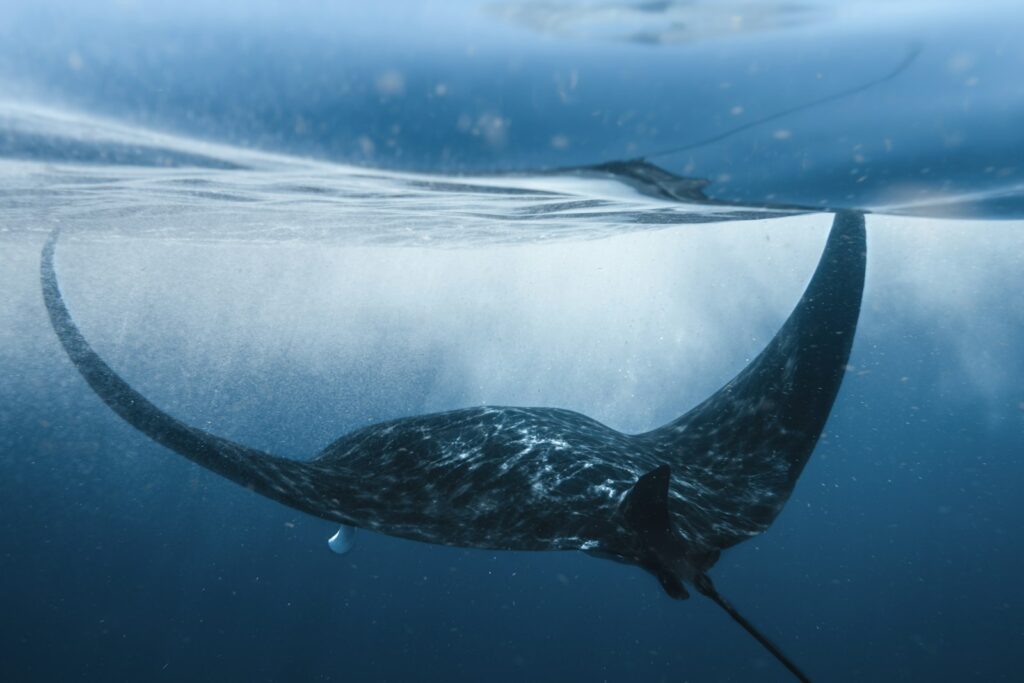
Yes, you can snorkel with manta rays in Komodo National Park — and no diving licence is required. Oceanic manta rays (Mobula birostris) feed in the top 0–5 metres of the water column at Karang Makassar, the site most guides call Manta Point, and on calm mornings they rise close enough to the surface that snorkelers floating above them see the full span of their wingspan passing below. You do not need to descend to see them. The view from the surface is genuinely impressive. That said, sightings are never guaranteed: encounter-rate percentages are not published anywhere in the scientific or tourism literature, and any operator claiming otherwise is not being straight with you.
What Actually Happens at Karang Makassar (Manta Point)
Karang Makassar is a long rubble-and-sand plateau sitting in the central section of Komodo National Park, roughly between Komodo and Rinca islands. The bottom ranges from about 5 to 15 metres down — it is not a shallow coral garden, and there is no dramatic wall to press against. What draws mantas here is plankton. When tidal conditions concentrate zooplankton near the surface, mantas rise into the top few metres and feed in long, looping passes, sometimes barrel-rolling through the water with their cephalic fins unfurled. That feeding arc is exactly what snorkelers watch from above.
Cleaning stations — fixed coral heads where wrasse and other small fish remove parasites from mantas hovering in place — sit deeper, typically 8 to 15 metres down. That close, slow, hovering image you see in underwater photography? That is the diver's angle, not the snorkeler's. Snorkelers at Manta Point see mantas in motion: gliding, banking, surfacing. It is a different experience, not a lesser one.
The current reality
Karang Makassar is a drift site. Current is described as strong across every source we trust, and that description is accurate — when the tide runs, this water moves. Estimated drift speed is roughly 1 to 3 km/h (inferred from operator accounts; no instrumented data is published for this site). Your guide signals the entry point up-current; the group drifts together as a unit; the boat tracks you from down-current and collects everyone at the end of the drift. You do not swim against it. You float.
If conditions are wrong — current too fast, swell too high, visibility poor — reputable operators skip the entry entirely. This is the correct call. Treat a skipped stop as a sign of a good operator, not a failure of the trip.
Who Can Join a Manta Snorkel
No certification is required to snorkel anywhere in Komodo. You do not need an Open Water or any PADI qualification. What matters is your comfort in moving water, because Karang Makassar is not a calm lagoon.
Honest grading by skill level:
- Confident swimmers
- Float on the surface in a life jacket or without one, follow the guide's pace, enjoy the drift. This is the ideal scenario.
- Weak or nervous swimmers
- Indonesian law requires life jackets for all passengers, and guides commonly require non-swimmers and weak swimmers to keep one on in the water. A life jacket makes the drift manageable — you stay buoyant without effort. The catch: you are still in open water with current. Some operators enforce a guide-in-water requirement for this group; confirm before departure.
- Non-swimmers
- Manta Point with a running current is a poor choice without water confidence. Siaba Besar (turtles in 2–6 m of calm water) or Kanawa (gentle house reef, beach entry) are the right first stops. If the tide is slack and conditions are genuinely glassy, a non-swimmer in a well-fitted life jacket with a guide in the water has joined this drift before — but it requires an honest conversation with your operator, not an assumption.
- Children
- Operator norms (not park regulations) typically place current-prone sites including Manta Point off-limits for young children. Most operators set informal minimum ages of 8+ for Karang Makassar. Ask your specific boat about their policy before booking. Budget boats are the least consistent here — private charters give you the control to decide site-by-site.
When to Go: Manta Season vs. Year-Round Reality
Mantas are present at Karang Makassar throughout the year. The question is aggregation density, not presence or absence.
The aggregation peak correlates with the northwest monsoon and elevated plankton — roughly November through February. Multiple mantas feeding in a single drift is more commonly reported in those months. During the dry season (April through November), which is when most tourists visit, mantas are still sighted regularly; the difference is that you may see one animal instead of five, or none on a given day instead of a near-certain encounter. No one has published reliable encounter-rate statistics for either period.
The complication with November–February is sea state. The northwest monsoon brings rougher water, occasional harbor closures by KSOP Labuan Bajo at short notice, and a real possibility of cancelled trips or multi-hour delays. If you travel in December through early February specifically for mantas, build buffer days into your itinerary.
Monthly water conditions for context (typical reported ranges — last verified June 2026; based on resort climatology, flag as indicative):
| Month | Visibility (approx.) | Water temp (surface) | Manta aggregation likelihood | Sea state |
|---|---|---|---|---|
| Jan–Feb | 10–15 m | 28–29°C | Higher (monsoon plankton) | Rough; cancellations possible |
| Mar | 15–20 m | 28–29°C | Moderate–high | Transitional |
| Apr–May | 20–30 m | 28–29°C | Moderate | Calming, good |
| Jun | 20–25 m | 27°C | Moderate | Dry, reliable |
| Jul–Sep | 15–25 m | 25–26°C | Lower but present | Dry, calm; bring a shorty wetsuit |
| Oct | 20–25 m | 26°C | Moderate–rising | Good |
| Nov | Not published | ~27–28°C (est.) | Rising toward peak | Watch forecasts |
| Dec | Not published | ~28°C (est.) | Higher (peak range begins) | Variable; buffer days advised |
Note: southern park sites run several degrees cooler than the central area — Indian Ocean upwelling can push water temperatures down to roughly 22–25°C in those locations. Southern spots are primarily dive territory anyway, but worth knowing if your trip passes near them.
The Manta Code of Conduct: What You Must Know Before Getting in the Water
Indonesia declared all of its waters — roughly 6 million square kilometres — a manta sanctuary under KEPMEN-KP No. 4/2014 issued by the Ministry of Maritime Affairs and Fisheries. Harassment, capture, and trade of mantas are enforceable under fisheries law. This is real legislation, not a voluntary guideline.
The specific in-water distances and approach protocols below are Manta Trust best-practice guidance rather than codified Indonesian law, but they are the standard your guide will enforce and the standard you should hold yourself to:
- Distance: keep at least 3–4 metres from the body, 4–5 metres from the tail. Mantas can injure you with their tail if startled — this is also about your safety.
- Approach direction: from the side only. Never approach head-on, never drop in from above, never come from behind.
- Movement: stay flat at the surface. Minimal fin kicks. Let the manta come toward you; do not chase it.
- Cleaning stations: never hover over or block a cleaning station. A manta that feels cornered will abandon the station. Divers occasionally ruin encounters for the entire group — snorkelers at the surface rarely cause this, but the rule applies regardless.
- No touching: the mucus layer on a manta's skin protects it from infection. One hand causes damage that takes weeks to heal.
- No chasing, no riding, no duck-diving into the manta's path.
- Photography: no flash. A flash at close range startles the animal and degrades the encounter for everyone else in the water. Natural light in 0–5 m of clear Komodo water is sufficient.
- Boats: operators running reputable trips hold 10–30 metres off visible manta aggregations and cut engines when snorkelers are in the water. If a boat you are on idles its engine directly over feeding mantas, that is a red flag about the operator.
These are not optional courtesies. Budget day trips mix snorkelers and divers from multiple boats at the same site; crowded approaches drive mantas away faster than anything. A group that holds discipline — quiet entries, controlled drift, no chasing — consistently gets longer and closer encounters than a group that charges in.
What Snorkelers See vs. What Divers See
This is the question most people are really asking when they search for information on manta snorkeling: do I need a diving qualification to get a meaningful encounter?
At Karang Makassar specifically, the honest answer is no. The feeding behaviour happens at the surface. You will see a manta from above — wingspan spread, the pattern of its underside, its cephalic fins open — and that view is complete. You do not need to descend to 12 metres to experience it.
What divers get at this site that snorkelers do not: the cleaning station angle. Watching a manta hover motionless while small wrasse work along its gills at 10 metres depth is a different, slower, more intimate experience. If that specific image is what you are after, you need an Open Water certification and a dive operator.
Southern Manta Alley — a separate site inside the park — sits in deeper water and is primarily a dive location. Snorkelers do not access the significant encounters there.
Elsewhere in the park, snorkelers genuinely see:
- Green turtles at 2–6 metres, multiple per session, at Siaba Besar — the easiest and most reliable large-animal encounter in the park for non-divers
- Hawksbill turtles and occasional reef sharks at Mawan (an experienced-snorkeler site; current is strong)
- Healthy coral gardens at 1–5 metres at Kanawa and along Pink Beach's calmer sections
- Reef fish at every site — the biodiversity here is genuine
What stays out of snorkeler reach: the wall action at Batu Bolong from 15 metres down, the pelagic schools at Castle Rock and Crystal Rock at 20–30 metres, and the full cleaning-station experience anywhere. None of that is accessible from the surface, and no amount of freediving skill changes the current and depth physics involved.
If you are deciding whether to take a snorkeling trip or invest a week in a beginner dive course before coming, the honest take is: a snorkeling-focused Komodo trip is worth doing on its own terms. It is not a consolation prize for people who cannot dive.
Getting to Manta Point: Tour Options from Labuan Bajo
Karang Makassar is reachable on both day trips and liveaboards from Labuan Bajo. The practical difference matters for snorkelers specifically.
Shared day boat (speedboat)
The standard shared speedboat runs a 6-stop circuit: Padar hill hike, Komodo dragon trek, Pink Beach, Taka Makassar sandbar, Manta Point, and one more snorkel stop. Typical price range is roughly Rp 1.4–1.6 million per person (approximately USD 85–100) as of June 2026 — last verified June 2026, confirm with current operators. Park fees are almost always excluded from this price; budget an additional Rp 400,000–550,000 in cash for a full-day Padar-dragons-snorkel itinerary including ranger fee shares.
The snorkeling time at any single stop on a 6-stop shared day boat is limited — typically 30–45 minutes in the water before the group moves on. The 1.5-hour in-water session at Manta Point that occasionally appears in older trip reports is the exception, not the standard on rushed shared boats.
Private charter
Small private speedboats (2–6 passengers) run approximately Rp 6–10 million per boat per day; larger or premium vessels go up to Rp 18.5 million or more. The advantage for manta-focused snorkelers is control: you can linger at Karang Makassar until the conditions shift or the group is satisfied, rather than competing with the clock of a shared itinerary.
Snorkeling-first tours
A small number of Labuan Bajo operators run dedicated snorkeling tours — boats configured around snorkel time rather than dive briefings, with guides trained specifically for surface-water assistance. These are worth seeking explicitly if manta snorkeling is your primary goal. Ask operators directly: how many stops are snorkel stops, how long is the in-water time per stop, and does a guide enter the water with snorkelers at Manta Point? The answers distinguish snorkeling-first operations from dive boats that tolerate snorkelers on the side deck.
Want help choosing the right setup for your group? Plan your trip with our concierge team — we can match you to operators who suit your pace, your group size, and your comfort in the water. WhatsApp planning works well for quick questions before you commit to a booking.
Gear Notes for Manta Snorkeling
Most day boats include a mask and snorkel in the tour price; fins are included on some boats and not others. The quality is variable. Budget shared boats commonly carry scratched masks with tired straps and fins that do not fit many adults well. A leaking mask at Manta Point — in open water, current running — is genuinely unpleasant. If you have your own mask, bring it. The seal and the visibility difference are worth the luggage space.
Water temperature at Karang Makassar runs 25–29°C depending on season (cooler in July–September). A rashguard and leggings are sufficient for most people in the warmer months. If you are visiting in July through September or plan long sessions, a 2–3 mm shorty wetsuit is worth considering — an hour in 25°C water with current draws heat faster than you expect.
On sunscreen: as of June 2026, Indonesia has no national law banning oxybenzone or octinoxate reef-damaging sunscreen compounds (unlike Hawaii or Palau). Reef-safe mineral sunscreen is strongly recommended practice in any case — the coral at these sites does not need additional chemical stress — but do not let anyone tell you there is a legal requirement. There is not, currently.
Park Fees for Snorkelers
Park fees in Komodo have changed significantly in recent years. The current structure under PP 36/2024 (last verified June 2026 — confirm with your operator, as the regulatory annex was not independently reviewed):
- Foreigner entrance fee
- Rp 250,000 per person per day — applies to snorkelers, trekkers, and divers equally
- Indonesian citizen entrance fee
- Rp 50,000 weekday / Rp 75,000 Sunday and public holidays
- Diving surcharge
- Rp 25,000 per diver per day — snorkelers are exempt from this
- Separate snorkeling activity fee
- No separate snorkel fee is itemized as of June 2026. The historical Rp 15,000 snorkel fee from the old PP 12/2014 tariff appears to have been absorbed. Confirm with your operator.
- Harbor fee
- Rp 25,000 per person
- Conservation fee
- Rp 100,000 per foreigner / Rp 10,000 domestic — reported by some 2026 sources, absent from others; flag as contested
- Ranger or naturalist fee (island landings only)
- Rp 200,000 per group of up to 5 (Komodo or Rinca); Rp 150,000 per group of up to 5 (Padar). Snorkel-only trips with no island landing may skip this entirely.
Realistic total for a foreign snorkeler on a full-day Padar-dragons-snorkel trip: Rp 400,000–550,000 in cash, covering entry, harbor, possible conservation fee, and ranger shares. Bring cash; card payment is not reliably available at park entry points. Fees are almost always excluded from tour prices — do not assume they are included unless explicitly confirmed in writing.
A Word on Guarantees
Manta rays are wild animals. They are not on a schedule. In the years we have spent watching this water, we have had sessions at Karang Makassar with four mantas circling below us for forty minutes, and we have had sessions where the plateau was empty and the current was the only thing moving. Both are true of this place.
No operator can guarantee a manta sighting. No season makes one certain. Encounter-rate percentages — the kind you sometimes see cited in promotional copy — do not appear in any peer-reviewed literature or published park data for this site. If an operator tells you mantas are guaranteed, that claim is not supported by evidence and you should factor it into how you assess everything else they tell you.
What is true: Karang Makassar is the most reliable manta site in the central park. Mantas are present year-round. The feeding behaviour brings them to snorkeling depth. The peak aggregation window is roughly November through February. A well-timed, well-run trip with good conditions gives you a high probability of a genuine encounter. That is the honest version.
Ready to start planning? Use our planning form or reach us on WhatsApp — we help with itinerary timing, operator selection, and the questions worth asking before you book. No one can pay to change what we publish; if you proceed with one of our partner operators after using our free guidance, they may pay us a referral fee at no extra cost to you.
Frequently Asked Questions
Do I need a diving licence to see manta rays in Komodo?
No. Manta rays feed in the top 0–5 metres of the water at Karang Makassar (Manta Point), and snorkelers see them from the surface without any certification or descent. A diving licence gives you access to the cleaning stations at 8–15 metres depth — a different and closer angle — but it is not required for a meaningful manta encounter.
What is the best month to snorkel with mantas in Komodo?
Mantas are present year-round. The aggregation peak — when multiple animals are more commonly reported at the surface — falls roughly in November through February, coinciding with elevated plankton during the northwest monsoon. The tradeoff is that this period also brings rougher seas and occasional harbor closures. The dry season (April–November) offers more reliable sea conditions with mantas still present, though potentially in smaller numbers on any given day. These figures are last verified June 2026; sources conflict and no published encounter-rate data exists.
Is Manta Point safe for beginner snorkelers?
Karang Makassar is a drift site with strong tidal current — it is graded intermediate-plus by most experienced operators. Beginners and weak swimmers can join with a properly fitted life jacket and a guide in the water, but it is not a casual lagoon snorkel. If you are not comfortable floating in open water with current, Siaba Besar (protected reef, turtles in 2–6 m) and Kanawa (mild current, beach entry) are the right starting points. Always confirm the operator's guide-in-water policy before boarding.
Are manta rays dangerous to snorkel with?
Manta rays are filter feeders — they eat plankton and pose no predatory threat to snorkelers. The main physical risk is accidental contact: a startled manta can whip its tail, and a tail strike at close range can injure you. Keeping 4–5 metres from the tail and approaching from the side, as the code of conduct requires, eliminates this risk in practice. The documented hazard at Manta Point is current, not the animals.
What if the manta rays do not show up on my trip?
It happens, and no operator can prevent it. If mantas do not appear at Karang Makassar, reputable boats move to an alternative snorkel site — usually Siaba Besar for turtles or Kanawa for coral. The overall snorkeling in the park is excellent regardless of manta sightings; a missed manta encounter on day one is a reason to build extra days into your trip, not a sign that the park has failed you.