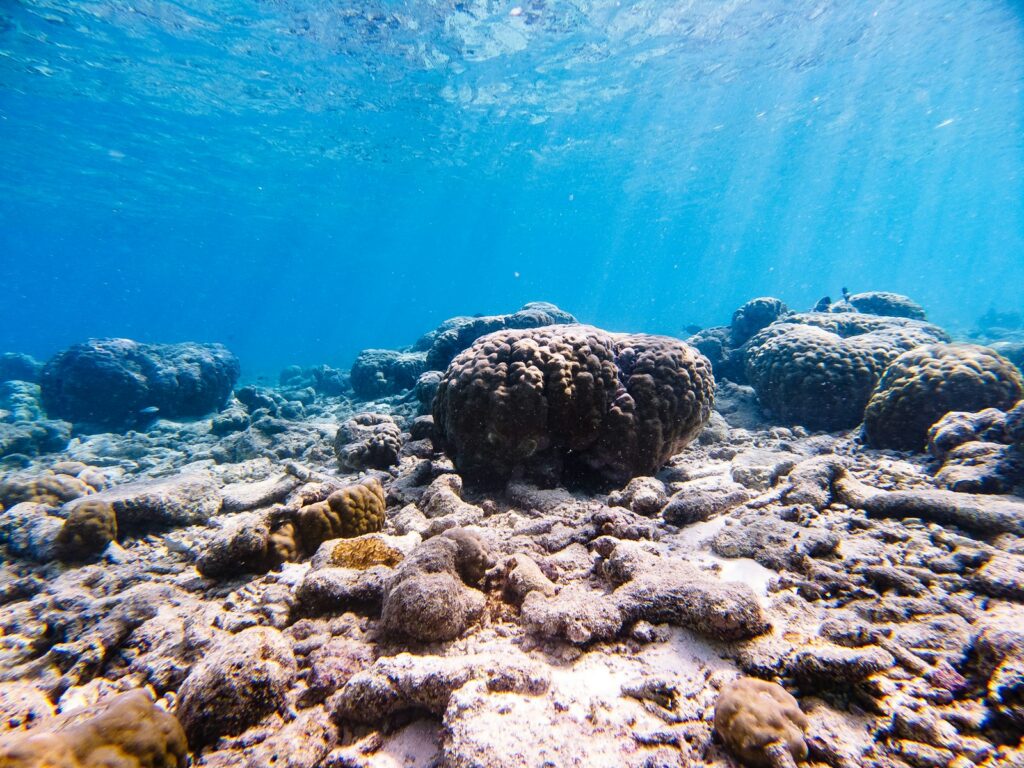
Siaba Besar snorkeling means a shallow, protected hard-coral reef where the main band sits at 2–6 metres and green turtles are present in numbers that make multiple sightings per session the norm, not a lucky exception. Within Komodo National Park, it is widely considered the single best first stop for nervous swimmers, young children, and anyone entering the water for the first time — not because it is the most spectacular reef in the park, but because the conditions are consistently forgiving and the wildlife reward is immediate.
That said, no honest guide will promise you a specific count. Turtle density at Siaba Besar is unquantified — there is no published census, no survey methodology, no official record of how many individuals use the reef. What multiple operators and independent trip reports consistently describe is that encounters are frequent. Go expecting to see turtles; do not go expecting a guaranteed number.
Where Siaba Besar Sits in the Park
Siaba Besar is an island in the northern section of Komodo National Park, a short boat ride from Labuan Bajo. It is one of a cluster of smaller islands and reefs that sit in relatively sheltered waters compared to the exposed southern sites like Mawan or the open-water drift at Karang Makassar (Manta Point). That sheltered position is the key to everything that makes it a beginner site: calmer surface conditions, predictably mild current, and a reef structure that keeps most of the interesting marine life in the top five metres of water.
Most standard day-trip itineraries departing Labuan Bajo include Siaba Besar as one of several stops. On a typical 6-stop full-day tour visiting Padar, Komodo Island, Pink Beach, Taka Makassar, and Manta Point, Siaba Besar either replaces one of the snorkel stops or is added for families and groups with non-swimmers. On snorkeling-focused itineraries — which allocate more in-water time and fewer hiking stops — it is almost always included.
The Reef: What You Are Actually Entering
The reef at Siaba Besar is dominated by hard coral rather than the soft-coral gardens you find at some other Komodo sites. The main coral band runs from roughly 2 to 6 metres depth, which means even a swimmer who is not comfortable with depth can float over the reef crest at 2 metres and look down into a dense, textured coral landscape. There is no need to duck-dive or free-dive to reach the interesting structure.
Current is rated mild to protected at this site. That does not mean flat-calm — Komodo is never truly slack, and conditions shift with the tide — but it means a confident beginner wearing fins can hold position and look around without being swept off. Guides typically brief snorkelers before entry and will call people back to the boat if the current picks up unexpectedly. If you are a first-time snorkeler, listen to that brief carefully. It will tell you which direction to drift and where the boat will collect you.
Visibility at Siaba Besar tracks the park-wide seasonal pattern. Typical reported ranges for central Komodo (last verified June 2026, traced to resort climatology — treat as indicative):
| Month | Typical visibility (m) | Water temp (°C) | Conditions |
|---|---|---|---|
| January–February | 10–15 | 28–29 | Wet season; rougher seas, possible closures |
| March | 15–20 | 28–29 | Transition; improving |
| April–May | 20–30 | 28–29 | Prime — best visibility of the year |
| June | 20–25 | 27 | Peak season begins; clear, calm |
| July–September | 15–25 | 25–26 | Peak season; cooler water, good vis |
| October | 20–25 | 26 | Shoulder; still excellent |
| November–December | Variable | 27–28 | Wet season approaches |
Note the July–September dip in water temperature to 25–26°C. For most adults in good health this is comfortable for a 45–60 minute snorkel in a rashguard, but children and lean adults may want a shorty wetsuit (2–3mm) for longer sessions. A rashguard and leggings are sufficient for most of the year.
The Turtles: What to Expect (and What Not to Expect)
Green turtles (Chelonia mydas) are the defining feature of Siaba Besar, to the point where the site has long been nicknamed Turtle City in operator briefings and travel circles. Green turtles graze on seagrass and rest on the reef structure, which means they do not require visibility into deeper water — the same shallow band that suits beginner snorkelers is exactly where the turtles spend their time.
Why so consistent here compared to other Komodo sites? The likely answer is food and shelter: the protected hard-coral reef supports the seagrass patches and resting spots turtles need, and the relatively calm current means they are not expending energy fighting flow the way animals at more exposed sites would. Turtles come to the surface to breathe regularly, which means patient surface-floating snorkelers routinely intercept that ascent. You do not need to chase them.
What the site is honest about: no published density figure exists. Operator anecdotes consistently describe multiple turtles per session, and this is corroborated by independent trip reports, but there is no science-backed survey or census behind that claim. Sightings depend on time of day, tide, and how many other snorkel groups are already in the water. Early starts — arriving before the main wave of day boats — consistently produce better encounters.
Occasional hawksbill turtles (Eretmochelys imbricata) are also reported at some Komodo sites, though Siaba Besar is primarily a green turtle spot. Reef fish are abundant across the coral band, and reef sharks have been recorded in the park generally, though Siaba Besar’s sheltered, shallow reef is not a shark concentration site the way the channel edges at Mawan or Karang Makassar are.
Turtle Etiquette: The Rules That Actually Matter
This section is not optional reading. Green and hawksbill turtles are protected under Indonesian law. Harassment, capture, and interference with their movement are enforceable offences. Beyond the legal baseline, your behaviour in the water determines whether future snorkelers at Siaba Besar have the same experience you did.
No touching, ever
Turtles carry a protective mucus layer on their shell and skin. Human hands remove that layer, leaving them vulnerable to infection. The instruction is absolute: keep your hands to yourself. This includes resting a hand on a turtle’s shell, touching a flipper, or grabbing to slow its movement. Operators who catch guests touching turtles routinely end the snorkel session early.
Never block a turtle’s path to the surface
Turtles are air-breathers. They must reach the surface to breathe. If a turtle is ascending and you position yourself directly above it — even unintentionally — you are forcing it to redirect around you, burning oxygen it needs. When you see a turtle below you rising, move sideways and give it a clear vertical lane. Watch the ascent from a horizontal distance of at least 3–4 metres.
Stay flat and slow at the surface
Aggressive fin kicks create pressure waves that spook turtles and push them away. The effective technique is the one that feels almost passive: slow, steady kicks from the knees, body horizontal, face in the water. Let the turtle’s curiosity work for you. A calm, still snorkeler is far more likely to have a turtle swim toward them than one thrashing around with the camera.
No flash photography
Flash photography near marine animals causes documented startle responses. If you are shooting underwater, use natural light and a red filter if you have one. Action cameras without flash — GoPros and similar — are fine on their own; the issue is with dedicated strobe or flash setups.
Groups and spacing
Siaba Besar sees multiple boats at once during peak season (June–August). If there are already snorkelers near a turtle when you enter, do not pile in. Give the animal space and wait. A turtle that has ten masks pointed at it from two metres away is a turtle that has learned to leave quickly. Spread out, stay calm, and the encounter lasts longer for everyone.
Why Siaba Besar Is the Right First Stop for Beginners
The case for Siaba Besar as a beginner site comes down to three factors: depth, current, and reward. The main reef at 2–6 metres means nothing in your sightline requires going below your comfort zone. The mild current means you are not fighting to stay in place. And the turtles mean you are almost certainly going to see something extraordinary within the first ten minutes, which matters enormously for people who are not sure they are going to enjoy snorkeling.
Compare that to Karang Makassar (Manta Point), which has a strong drift current, requires floating over open water at 5–15 metres, and offers manta sightings that are spectacular when they happen but far from certain on any given day. Or Mawan, where the current is described as strong and guides commonly restrict the entry to experienced swimmers. Siaba Besar removes those variables.
For nervous swimmers specifically: life jackets are provided on all legally operating boats in Indonesia, and reputable operators require them for non-swimmers and weak swimmers in the water. At Siaba Besar the shallow reef means a snorkeler in a life jacket can float above the coral and see turtles without ever feeling out of their depth. This is not always true at current-prone or deep sites.
- Skill grade
- Beginner — suitable for first-time snorkelers, children (typically 6+ with a parent in water), and non-swimmers with a life jacket and guide nearby
- Depth of main interest
- 2–6 metres (hard coral band)
- Current rating
- Mild to protected (tide-dependent; always ask your guide at briefing)
- Primary wildlife
- Green turtles (density unquantified but consistently reported); reef fish; coral structure
- Best time of day
- Early morning before peak boat traffic — specific slack-tide windows vary; ask your operator
- Season
- Year-round; prime visibility and calmer seas April–October (dry season)
Siaba Besar for Kids and Families
There is no park-wide minimum age for snorkeling in Komodo National Park. Operator norms vary: most boats accept children as passengers from around age 4–6, and most put a practical minimum of 6–8 years old for active snorkeling, requiring a parent in the water and a mandatory life jacket. These are operator guidelines, not park regulations — confirm the specific policy with your boat before you book.
For families, Siaba Besar is the site that actually works. A six-year-old in a well-fitting mask and life jacket, floating over 2 metres of reef, seeing a turtle surface to breathe two metres away — that is a reliable family memory. The same child would not be appropriate at Manta Point, where the drift current and depth make it unsuitable for young or anxious swimmers regardless of equipment.
One practical note on gear for children: kids’ mask sizes and child-appropriate PFDs (personal flotation devices) are available on dive-centre-run boats and higher-end private charters, but they are not guaranteed on budget shared boats. If you are travelling with a child under roughly ten years old, bringing your own well-fitting child snorkel mask and a correctly sized PFD is the reliable option. An ill-fitting mask that leaks kills the experience faster than almost anything else.
Getting to Siaba Besar: Tour Options and What to Expect
Siaba Besar is typically included on snorkeling-focused day trips from Labuan Bajo. It does not usually appear on the standard 6-stop “dragons and snorkeling” itinerary (which prioritises Padar, Komodo, Pink Beach, Taka Makassar, and Manta Point for a mixed trekking-and-snorkeling crowd). If seeing turtles at Siaba Besar is a priority for you, ask specifically when booking whether the itinerary includes it — or book a snorkeling-first private charter where you choose the stops.
Tour price ranges for Labuan Bajo day trips (last verified June 2026 — treat as indicative ranges, confirm directly with operators):
| Tour type | Typical price range | Park fees | Notes |
|---|---|---|---|
| Shared speedboat full-day | Rp 1.4–1.6M/pp (~USD 85–100) | Not included — bring cash | Market span USD 60–150; seats fill early in Jul–Aug |
| Shared slow/wooden boat | ~Rp 900k–1.3M/pp (~USD 55–80) | Not included | Fewer stops, longer transit; more seasickness risk |
| Private speedboat charter | Rp 6–10M/day (small, 2–6 pax) | Not included | You set the itinerary; best for families or small groups |
| Private premium charter | Rp 10–18.5M/day | Not included | Larger boats, comfort, flexible stops including Siaba Besar |
Park fees are almost always excluded from tour prices and must be paid in cash at the point of entry. For a foreign visitor on a full-day snorkeling trip, the realistic cash figure to carry is Rp 275,000–375,000 minimum (entrance fee Rp 250,000 + harbor fee Rp 25,000, plus a contested conservation fee of Rp 100,000 reported by some sources but not others). Operators commonly advise bringing Rp 400,000–550,000 for a full itinerary that includes ranger fees for island landings. All fee figures carry the caveat: last verified June 2026, confirm with your operator — the park fee structure changed with PP 36/2024 and secondary sources do not always reflect current annex text.
If Siaba Besar is your focus, the private charter option gives you the flexibility to time your arrival for early morning and spend longer in the water than a shared boat’s schedule allows. That early-morning window — before the cluster of day boats arrives around mid-morning — is consistently reported as the best time for undisturbed turtle encounters.
Ready to work out which itinerary suits your group? Plan your trip with our concierge — or reach us on WhatsApp for a quick answer on which current operators include Siaba Besar on a snorkeling-first route. No one can pay to change what we publish; if you proceed with a partner operator through our free planning help, they may pay us a referral fee at no extra cost to you.
Gear for Siaba Besar
The basics — mask, snorkel, fins — are included on nearly all Labuan Bajo day tours. Quality is variable. Budget shared boats typically carry scratched masks with tired silicone skirts that break the seal on wider or narrower faces; mismatched fins that do not fit properly; and snorkels with no dry-top valve. None of this ruins the experience if conditions are calm, which they usually are at Siaba Besar. But a poorly sealing mask in any chop will flood repeatedly, and flooding masks are exhausting when you are trying to watch a turtle.
The practical advice: if you own a mask, bring it. The seal fit of your own mask is known and reliable. If you are renting, ask the crew to let you test the mask seal on your face before entering the water — press the mask to your face without the strap, inhale gently through your nose, and check whether it holds for a few seconds. It takes thirty seconds and eliminates the main equipment failure point.
Fins matter more at current-prone sites than at Siaba Besar, but they still help for positioning and turning. Rental fins on shared boats are often mismatched by size; bring your own open-heel fins if you have them, or accept that you will make do.
For thermal protection: a rashguard and leggings cover you for most of the year and provide UV protection for surface time, which adds up faster than most people expect at tropical latitudes. For July–September sessions when water drops to 25–26°C, a lightweight shorty wetsuit (2–3mm) is a reasonable addition, especially for children and lean adults who cool faster.
Sunscreen: there is no legal ban on oxybenzone or octinoxate sunscreen in Indonesian waters as of June 2026 (unlike Hawaii or Palau). Reef-safe mineral sunscreen — zinc-oxide or titanium-dioxide based — is strongly recommended practice given that coral bleaching is documented across Komodo, but it is not a legal requirement. Apply before you arrive at the marina rather than on the boat; residue in the water starts when you first enter.
How Siaba Besar Compares to Other Beginner Sites in the Park
Two other sites are regularly recommended for beginners: Kanawa and the sandbar section of Taka Makassar. Here is how they differ from Siaba Besar in practice.
Kanawa is a beach-entry reef from roughly 1–2 metres to 5–8 metres (depth range inferred). Current is mild to protected, visibility is consistently good, and the coral is healthy. It is an excellent beginner site and arguably has more variety in reef fish than Siaba Besar. The key difference is wildlife: Kanawa does not have the same turtle concentration. If seeing turtles is the priority, Siaba Besar wins.
Taka Makassar is a sandbar that exposes at low tide. On the bar itself, in 0.5–2 metres of calm water at slack tide, it is very beginner-friendly and makes for great photos. The edges of the sandbar approach the manta channel and carry stronger current on a running tide — not a place to drift toward without a guide. The snorkeling value at Taka Makassar is lower than Siaba Besar; it functions more as a tide-dependent photo stop.
For a first-time snorkeler who wants to see something memorable with minimal stress, Siaba Besar is the clear recommendation. The shallow hard-coral reef and the turtle frequency make it reliably rewarding in a way that does not depend on timing a manta aggregation or finding a specific slack-tide window.
A Practical Note on Crowding
Komodo National Park operates a pre-booking system via the SiORA platform (Sistem Informasi Online Reservasi Wisata Alam) — a mandatory pre-booking app that was reported in trial from January 2026 and implemented permanently around April 2026, with walk-in ticket sales reportedly ending. This has reduced the chaotic peak-hour queuing that plagued the park in earlier years, but it has not reduced the overall visitor volume during July–August. Siaba Besar’s reputation means it attracts a concentration of boats during peak hours.
The cleaner experience is an early start. Boats that depart Labuan Bajo marina at 7:00–7:30 AM typically reach Siaba Besar before the mid-morning rush. If you are booking a private charter specifically for Siaba Besar, discuss departure time with the operator. This is one of those details that is worth asking about directly rather than assuming.
All SiORA booking information is last verified June 2026 from secondary sources — no official park notice was independently verified. Confirm current booking requirements with your operator before travel.
Thinking about adding Siaba Besar to your itinerary? Use our planning form or drop us a message on WhatsApp — we can point you toward operators currently running snorkeling-first routes that include it.
Frequently Asked Questions
Is Siaba Besar snorkeling suitable for complete beginners who have never snorkeled before?
Yes. Siaba Besar is consistently rated the most beginner-friendly snorkel site in Komodo National Park. The main reef sits at 2–6 metres, the current is mild to protected, and the hard-coral structure keeps interesting marine life at shallow depth. First-time snorkelers wearing a life jacket and guided by crew can see green turtles without needing to dive below the surface. The one practical step that helps most: test your mask seal before you enter — a leaking mask on a first session makes everything harder than it needs to be.
How many turtles will I see at Siaba Besar?
Multiple sightings per snorkel session is what independent reports consistently describe, and it is why the site has earned its “Turtle City” nickname among Labuan Bajo operators. However, there is no published census or density figure for this site. Sightings depend on time of day, tide, and boat traffic — an early-morning arrival before peak boat hours typically produces better encounters. Never book a trip expecting a guaranteed count; go expecting to see turtles and you are very likely to leave satisfied.
Can I touch the turtles at Siaba Besar?
No. Touching turtles — including resting a hand on their shell or making contact with a flipper — removes their protective mucus layer and leaves them vulnerable to infection. It is also prohibited under Indonesian law, which protects all sea turtles under fisheries regulations. Reputable operators will remove guests from the water for touching turtles. The practical guide is: stay at least 3–4 metres from any turtle’s body, never position yourself above an ascending turtle, keep fin movement slow, and let the animal approach you on its own terms if it chooses to.
Is Siaba Besar included in standard day tours from Labuan Bajo?
Not always. The most common full-day tour itinerary (Padar, Komodo, Pink Beach, Taka Makassar, Manta Point) does not automatically include Siaba Besar. It appears more frequently on snorkeling-focused itineraries and private charters where you have input into the stop list. When booking, ask directly whether Siaba Besar is on the route — or whether the operator can substitute or add it. A private charter is the most reliable way to guarantee the stop and control your timing on the reef.
What park fees do I need to pay to snorkel at Siaba Besar?
Komodo National Park entry fees apply regardless of which site you visit within the park. For foreign visitors, the current entrance fee is Rp 250,000 per person per day, plus a harbor fee of Rp 25,000 per person (last verified June 2026 — these are multi-source secondary figures; no official PP 36/2024 annex text was independently verified, so confirm with your operator). A contested conservation fee of Rp 100,000 is reported by some sources but not others. Snorkelers do not pay a separate snorkeling surcharge as of June 2026 — there is no itemised snorkel activity fee in current fee tables, unlike the Rp 25,000 diving surcharge that scuba divers pay. Bring Rp 400,000–550,000 in cash for a full-day itinerary that includes island landings with rangers.