There is no park-wide minimum age regulation for Komodo snorkeling. Komodo National Park does not publish or enforce a minimum age for boat passengers or for entering the water — that decision sits entirely with the operator running your boat. In practice, most operators allow children from roughly four to six years old on board as passengers, and they permit children to snorkel from around six to eight years old, provided a parent is physically in the water beside them and the child is wearing a life jacket at all times. Those numbers are operator norms, not Indonesian law, and they vary boat by boat. Confirm them directly before you book.
Why There Is No Single Rule — and Why That Actually Matters
The absence of a regulated minimum age is not an oversight. Komodo National Park covers a complex mix of sites: some are sheltered bays where a calm, shallow reef starts just off the beach; others are open-ocean drift sites where current strength can change within minutes. A blanket age floor that works at Siaba Besar’s turtle garden would be absurdly restrictive, and one calibrated to Karang Makassar drift conditions would unnecessarily block families from the park’s easiest sites.
What operators fill in instead is a system of site-by-site restrictions layered on top of a general age floor. The two are different things. A six-year-old in a correctly fitted vest with a parent in the water may be perfectly safe at Kanawa Island or Taka Makassar at slack tide. That same child has no business entering the water at Karang Makassar on a running tide, regardless of who is holding them.
The practical consequence for families: your child’s eligibility depends on which specific stops your tour visits, not only on their age. That is why asking a single question — “do you take children?” — gives you incomplete information. The full question is: “Which stops will my child be permitted in the water, and which are off-limits for kids?” Ask both.
What Operators Actually Enforce: A Site-by-Site Breakdown
The table below summarises how reputable Labuan Bajo operators typically handle children at each main snorkeling stop. These are norms drawn from current operator practice as of June 2026 — not a park regulation, not a legal standard. They can and do vary. Verify with your specific boat before departure.
| Site | Typical minimum to enter water | Conditions that override the age floor | Notes |
|---|---|---|---|
| Siaba Besar | 6+ with parent in water and vest | None significant — protected, mild current | Best family site in the park; shallow hard coral 2-6 m, green turtles nearly every visit |
| Kanawa Island | 6+ with parent in water and vest | None at most states of tide | Beach-entry house reef, 1-2 m near shore; one of the park’s calmest snorkel sites |
| Taka Makassar sandbar | 6+ on the bar itself (with vest) | Running tide makes the edges hazardous — on-bar only, no edge snorkeling | Exposed at low tide; shallows on the bar are 0.5-2 m; edges drift toward the manta channel |
| Pink Beach | 8+ with parent in water and vest | Skip on incoming swell; one beach section has an unpredictable rip | Semi-sheltered bay, but micro-location matters — guides choose entry point; reef condition variable |
| Kelor Island | 8+ with parent in water and vest | Current off the headland; calm on the lee side at mild tide only | Better known as a hilltop photo stop; snorkeling quality is site-dependent and tide-sensitive |
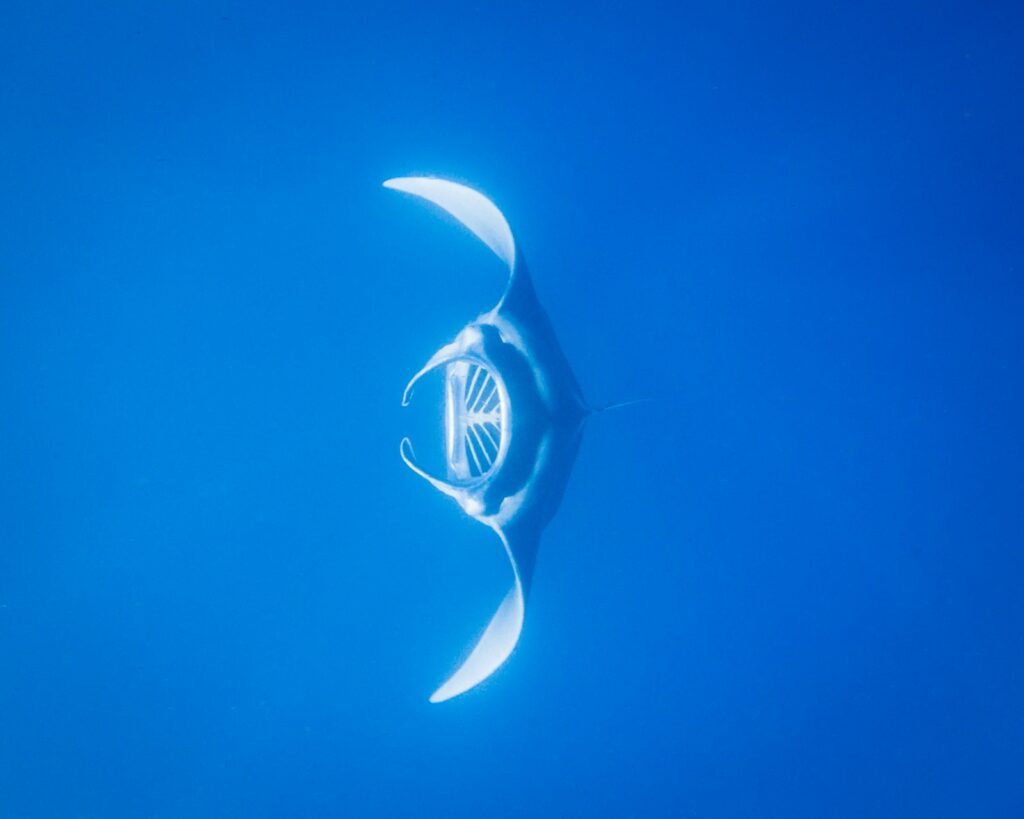
| Karang Makassar (Manta Point) | Most operators: 10-12+ or adults only | Site may be skipped entirely when current is too strong — even for adults | Open-water drift site, strong current; mantas feed near the surface but the entry demand is real; not a shallow reef |
| Mawan | Adults only / experienced swimmers only | Current rated strong; manta encounters often on rising tide | Manta and hawksbill encounters possible, but current discipline is required; not a family stop |
The age figures in that table represent the more careful end of the operator spectrum. Budget open-trip boats do not always enforce them. Private charters tend to be more responsive because you are the whole group and the guide can make decisions around your family specifically rather than averaging across 20 strangers.
The Vest and Parent-in-Water Rules Are Not Optional
Indonesian maritime law requires that all passengers have access to life jackets on board. On the water side, guides on reputable boats require that non-swimmers and young children wear a life jacket the entire time they are in the water — not just while boarding. This is not a formality. The combination of tidal current change and a child who panics in open water is a documented hazard in this park.
Two things worth understanding here. First, boat-provided life jackets are often basic foam vests, not SOLAS-rated. Child-specific sizing is unreliable on budget boats. If you are bringing children under ten, bring your own properly fitted child PFD. It will also remove the negotiation at the ladder when the guide asks whether the child can wear a vest.
Second, the norm of a guide entering the water alongside non-swimmers and children is common on reputable boats — crew members regularly assist weaker swimmers — but it is not a park-wide enforced standard. It is operator-dependent. Ask before you board: “Does a crew member or guide get in the water with children at the snorkel stops?” If the answer is vague, that is a relevant data point about the boat.
What Changes at Current-Prone Sites
Karang Makassar and Mawan are in a different category from the family sites above. Both are current-driven sites where the snorkeling value — manta encounters, reef sharks, large pelagics — is inseparable from the hydrodynamics that also make them challenging. At Karang Makassar in particular, the protocol for adults is a drift: enter up-current on the guide’s signal, move as a tight group, let the boat shadow you down-current and collect the group at the end. That is manageable for a confident adult swimmer. It is not manageable for a child who cannot yet maintain their own position in moving water.
I have watched guides at Karang Makassar read the surface chop for ten minutes and then wave off the entry entirely. That is the correct call, not a disappointment. The manta sighting chance is real year-round — aggregations are typically strongest around November to February when plankton density peaks, though mantas are present during the June to August dry season too. No operator can guarantee a sighting on any given day. That is not how the ocean works.
For families specifically: if manta rays are the primary goal and you have young children, the more realistic approach is to book a private charter and tell the operator your child’s age before you confirm. Private boats — typically two to six passengers — allow the guide to make site decisions around the weakest member of your group rather than around the median passenger on a shared boat of twenty.
Gear Realities for Children on Komodo Boats
Mask and snorkel are included on nearly all day tours, but this is where the experience gap between boat types opens widest for families. Budget shared boats carry adult-sized masks and often mismatched fins. A child who spends the first fifteen minutes of a snorkel stop fighting a leaking mask that does not fit their face is having a miserable time — and a frightened child in a leaking mask near a current is a safety problem.
Bring a child-sized mask from home if your child is under twelve. If the rental mask fits cleanly at the dock, fine — test it before you are at the snorkel site. Some dive-centre-run boats carry children’s kit, but this is not guaranteed on standard open-trip operators.
On thermal protection: water temperature in the park runs 25-29 degrees Celsius across most of the year, dropping toward 25-26 degrees in July and August and dipping further at southern sites from Indian Ocean upwelling. A rashguard is sufficient for most short sessions. For children who move less in the water and cool faster, a thin shorty wetsuit is worth having for July to September visits or for tours with multiple long stops.
If you want to plan your family’s itinerary around your children’s ages and comfort levels, plan your trip with us and we can match you to the right boat type — our concierge knows which operators carry child-sized gear and which guides are comfortable working with families in the water. WhatsApp planning is available for quicker questions.
Questions to Ask Your Operator Before You Book
Rather than relying on any single source to confirm what your specific boat allows, here is the list of questions that produces the information you actually need.
- What is your minimum age for passengers on board?
- Most reputable operators: four to six years. Some say six. Confirm this for your child’s specific age.
- What is your minimum age to enter the water?
- Most operators: six to eight years with a parent in the water and a mandatory vest. Some set it higher. Get the answer per boat, not per booking website description.
- Which specific stops will my child be allowed in the water at?
- The critical question. Karang Makassar (Manta Point) is typically off-limits for young children regardless of the general age floor. Ask this stop by stop.
- Does a crew member or guide enter the water with children?
- Standard on better boats; not universal. Clarify before boarding.
- Do you carry child-sized life jackets and masks on board?
- Ask and confirm, especially if your child is under ten.
- Is this tour on a shared boat or can we book privately?
- Private charters allow site decisions to be built around your family. Worth the cost for families with children under eight.
How Age Interacts With the Standard Day Tour Itinerary
The standard shared-boat day tour from Labuan Bajo typically visits five to six stops: Padar Island viewpoint, Komodo Island for dragon viewing, Pink Beach, Taka Makassar, Karang Makassar (Manta Point), and one more snorkel stop — often Siaba Besar or Kanawa depending on the boat’s route. Not all of those are snorkel stops. The land-based stops at Padar and Komodo Island are walking, not swimming. The in-water stops usually number two to three.
For a family with children aged six to nine, a standard shared tour can work. Understand that Karang Makassar will likely be a boat-side watch for the children while adults snorkel, and that the guide’s in-water attention will be partly occupied by the family. An honest assessment: this is fine. The calm-site snorkel stops — Siaba Besar and Taka Makassar bar — are genuinely excellent for young children, and green turtle encounters at Siaba are close to routine. The children are not missing the best of what the park offers for their age.
For children under six: the question of whether they can come on board is operator- and vessel-dependent. Speedboats produce significant spray and impact in choppy conditions. A family speedboat experience in April or May when seas are calm is very different from the same boat in August swell. Wooden slow boats run more smoothly in chop at the cost of more time in transit. For under-sixes, a private wooden boat on a calm-sea day is the more sensible choice.
The full age-by-site matrix — including specifics on teenagers, seniors, and swimmers with varying ability levels — is covered in the family snorkeling guide with site-by-site suitability ratings. That page also addresses multigenerational trips where ability levels span several decades.
When the Boat Gets It Wrong
Not every boat enforces its own stated age policy consistently, particularly in peak season when pressure to fill seats is high. A sales agent who says “children are fine” without specifying the in-water policy is not lying — they just have not answered the relevant question. The gap between “passengers are welcome” and “children may enter the water at all stops” is where mismatches happen.
If you arrive at a stop and the guide is reluctant to let your child in, that reluctance is usually well-founded. The guide sees the current and the surface chop. You do not yet have that read. The correct move is to ask which stops will be suitable and plan the in-water time around those.
The most useful thing families can do is confirm the site-by-site permission in writing before departure — even a WhatsApp message — so there is no ambiguity at the water entry when everyone is excited and the boat is rolling.
If you want a second pair of eyes on your operator choice or itinerary before committing, our planning form is the quickest route. We are independent — no one can pay to change what we publish, and if you proceed with one of our operator partners after using our free guidance, they may pay us a referral fee at no extra cost to you.
Frequently Asked Questions
Is there a minimum age to snorkel in Komodo National Park?
No. Komodo National Park does not publish or enforce a minimum age for snorkeling or for joining a boat tour. Minimum age rules are set by individual operators and typically fall in the range of six to eight years for entering the water, always with a parent alongside and a mandatory life jacket. These norms vary by boat; confirm with yours before booking.
Can a four-year-old join a Komodo boat tour?
Some operators permit children as young as four years as boat passengers, but most do not allow children that age to enter the water for snorkeling. On a calm-day private charter, a four-year-old can watch the snorkeling from the boat or sit in the shallows at the Taka Makassar sandbar at low tide with a parent. Verify the specific operator’s policy; it is not uniform across boats in Labuan Bajo.
Are Karang Makassar (Manta Point) and Mawan suitable for children?
No, not for young children. Both are current-prone open-water sites. Most reputable operators restrict water entry at Karang Makassar to confident adult swimmers or older teenagers; Mawan is typically adults only. A child can watch from the boat and may well see a manta surface near the hull — but entering the drift at these sites with a young child is not something responsible operators permit, and for good reason.
What are the best snorkel stops for families with children under ten?
Siaba Besar is the top choice: a shallow, protected hard-coral reef at 2-6 m depth with mild current and consistent green turtle sightings. Kanawa Island’s house reef is similarly calm and beach-entry. The Taka Makassar sandbar is good at low tide when the bar is exposed — keep children on the bar itself, not near the edges where current picks up. Pink Beach can work with an experienced guide selecting the right entry micro-location, but requires more judgment than Siaba or Kanawa.
Should I bring a child life jacket or will the boat provide one?
Indonesian law requires life jackets on board all passenger vessels, but boat-supplied vests are typically basic foam designs and child-specific sizing is unreliable on budget shared boats. For children under ten, bring your own properly fitted child PFD from home. It guarantees fit, removes uncertainty at the ladder, and ensures your child is wearing something that actually keeps their face clear of the water in moving conditions.